International scholars discuss the interplay of universities, industry and innovation at UI
In recent years, leading scholars worldwide have focused on one key question: How can knowledge offer real value to society and industry?
An increasing number of studies suggest that the relationship between universities and industry is not simply a one-way transfer of ideas from academia into society, but rather a dynamic interaction in which research, collaboration, and shared knowledge actively shape innovation. Collaboration is a crucial factor, both through informal connections and through organised partnerships in complex research projects where different academic disciplines and sectors meet.
The University of Iceland will bring this development into sharp focus at an international event in the Main Building’s Ceremonial Hall on Tuesday, May 26, from 9:00 to 11:30 a.m. Three of Europe’s leading scholars in this field will give presentations and discuss how connections between universities and industry influence research, social development, and future innovation. The event is organised in cooperation with the Ministry of Culture, Innovation and Higher Education and the Icelandic Centre for Research.
Interdisciplinary collaboration has become a key prerequisite for innovation
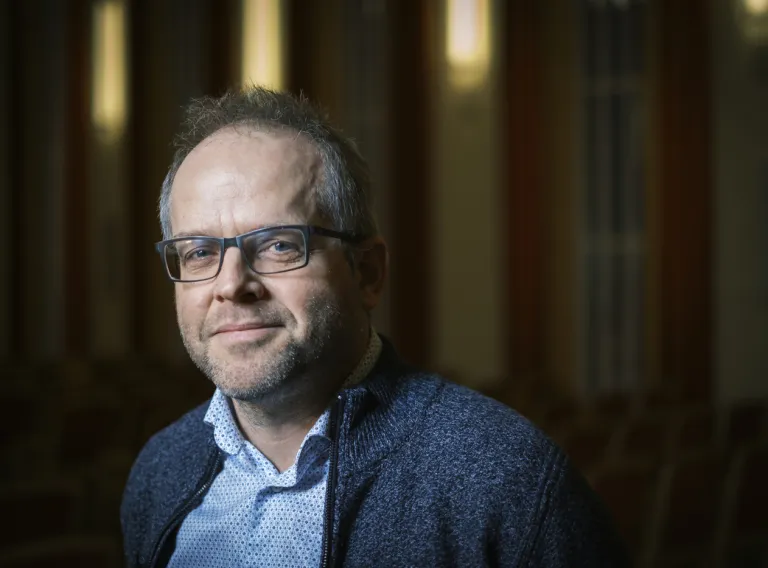
The moderator will be Rögnvaldur Sæmundsson, Pro-Rector for Science and Interdisciplinarity at the University of Iceland and professor of industrial engineering. We spoke with Rögnvaldur about why this discussion is becoming increasingly important for universities and society as a whole.
“For a long time, the relationship between universities and industry was discussed as though it were a one-way process, where knowledge was created within universities and then transferred into society or businesses,” says Rögnvaldur. “Research in recent years, however, reveals a much more complex reality. Knowledge and innovation are created through interaction, where research, collaboration, and experiences from different directions influence one another.”
Rögnvaldur says this perspective has changed how many people view universities' role in society.
“Collaboration with industry is no longer just something that happens afterwards or outside the research itself. In many cases, it is part of the process of creating new knowledge. Researchers work with companies, institutions, and communities on projects where research questions, methods, and solutions evolve jointly.”
According to Rögnvaldur, this is especially relevant when societies face complex challenges.
“Many of the greatest challenges of our time, whether it’s climate issues, healthcare, energy, or the development of artificial intelligence, won’t be solved within a single academic discipline or institution. Interdisciplinary collaboration becomes essential. That is also why we have placed such a strong emphasis on interdisciplinarity at the University of Iceland.”
The biggest ideas rarely emerge within a single discipline
At the recent Annual General Meeting of the University of Iceland, a central theme was how innovation emerges across academic disciplines, where discoveries often happen at the boundaries between different fields. Rögnvaldur points out, however, that such collaboration is not always simple.
“Interdisciplinary collaboration is often creative but also demanding. People bring different languages, methods, and even different understandings of what constitutes important knowledge. But it is precisely this friction that often creates new ideas.”
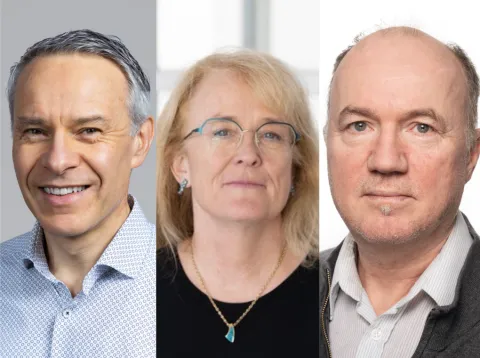
At the event, Markus Perkmann, professor at Imperial College Business School, will present his research on university-industry relations. Perkmann is one of Europe’s most influential scholars in this field and has demonstrated that collaboration with industry not only leads to new solutions and societal value, but can also strengthen research itself by generating new research questions and opportunities within universities.
“Perkmann has pointed out that collaboration with industry should not be viewed as a deviation from academic work,” says Rögnvaldur. “On the contrary, it can be part of the very core of research activity, creating new research questions, new perspectives, and new opportunities.”
Maureen McKelvey, professor at the University of Gothenburg, will discuss how innovation develops through long-term collaboration between universities, companies, and governments.
“She has studied how value creation emerges in societies where relationships are reciprocal and built on trust over time. This is not just about individual projects, but about ecosystems in which knowledge evolves collectively.”
Magnus Guldbrandsen, professor at the University of Oslo, will address the tension that can arise between practical application and research independence.
“It is important to discuss this tension openly,” says Rögnvaldur. “Universities must safeguard research independence and academic freedom. At the same time, societies want research to make an impact. Guldbrandsen’s research shows that this tension is not necessarily a weakness, but often part of what drives development forward.”