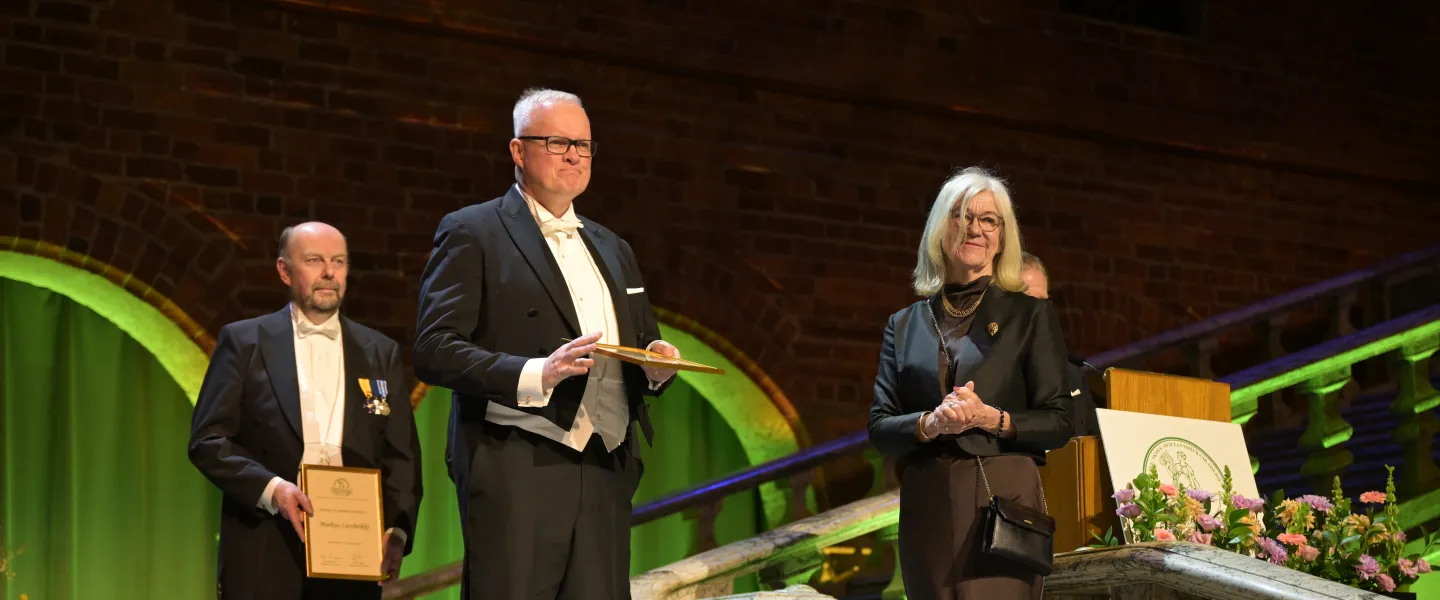
Jón Geir Pétursson, professor of environment and sustainability studies at the University of Iceland at the KSLA induction ceremony.

“Being selected for the Academy is first and foremost an honour, but it’s also an opportunity to take part in its diverse work and benefit from its extensive network. The Academy plays an important role as an independent forum for research, policy, practice and industry. It influences the development of sustainable natural resource management in Sweden and internationally,” says Jón Geir Pétursson, professor of environment and natural resources at UI. Early this year, he was invited as a fellow to the Royal Swedish Academy of Agriculture and Forestry (KSLA). It is certainly not everyday that an Icelandic scientist is selected for the Academy, and indeed Jón Geir’s academic career has been unusual in many ways. He had already worked for many years in policy and administration in various environmental and natural resources issues before becoming a research scientist at UI, where his work has created opportunities for collaboration all over the world, for example in Africa and the Himalayas.

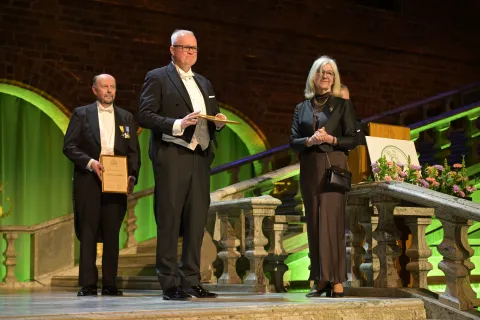
Jón Geir was one of six international experts admitted to KSLA in January at a ceremony in Stockholm City Hall attended by King Carl XVI Gustaf of Sweden, who is the Academy’s patron. It was in Sweden that Jón Geir originally studied forest management, pursuing a passion for nature and the environment that began in childhood.
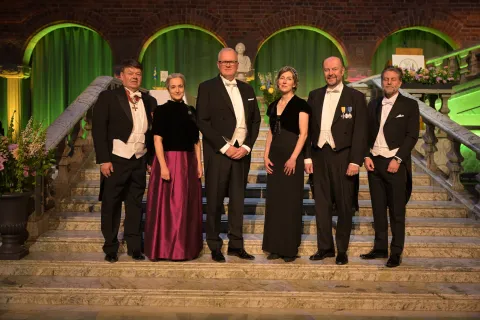
Jón Geir Pétursson at the KSLA induction ceremony along with other international experts.
Jón Geir in the middle at the with other international experts at the Royal Swedish Academy of Agriculture and Forestry induction ceremony.

Childhood passion for the environment

“I spent a lot of time in the countryside as a farm hand as a child and teenager, which probably explains my deeply rooted interests. I had a summer job in forestry, which eventually led to a career in environment and natural resources management. I studied biology at the University of Iceland, did a Master's degree in forest management at the Swedish University of Agricultural Sciences in Umeå, the first part of a Master's degree in natural resources management at the Norwegian Agricultural College and finally a PhD from the Norwegian University of Life Sciences (NMBU), focusing on environment and natural resources governance. So I’ve received an interdisciplinary education in the natural and social sciences and I’ve had opportunities to learn both in Iceland and abroad,” explains Jón Geir, who completed his PhD in 2011.

Jón Geir spent many years working for the Icelandic Forestry Association, which gave him valuable experience at a non-governmental organisation that operates across the whole country. “I then worked for the government for around 15 years, initially in the Ministry of the Environment, which later became the Ministry of the Environment and Natural Resources. I worked on a lot of different subjects, first as Head of division in the Department of International Affairs and Policy, and then for a long time as the Director General for the Department of Land and Natural Heritage,” he explains.

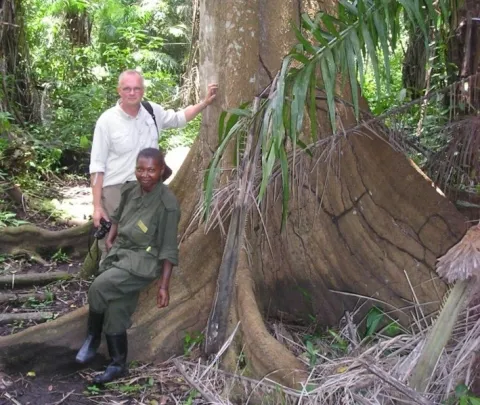
Jón Geir doing research in a tropical rain forest in Uganda.
This picture was taken in a tropical rain forest in Uganda where Jón Geir has done research. More than half of Uganda's forests have been destroyed in the last few years.

He was responsible for land use and conservation in a broad context, including nature conservation, hunting, energy development, forestry, soil reclamation, national parks and protected areas. “As director general, I was also a member of the Ministry’s board and worked closely with many ministers from across the political spectrum. My role also involved considerable international cooperation, especially within the Nordic countries, European partnerships, OECD, and the various forums under the United Nations umbrella. It was a time of significant change in the Icelandic public administration, with a lot of development, reforms and amendments to legislation, regulations, policies and policy instruments. I was involved in these changes and their implementation in the Ministry, working closely with its agencies and many different stakeholders,” says Jón Geir.

Policy must be based on the best available knowledge and advice

Jón Geir completed his PhD while working at the Ministry, after developing an interest in science and academia. “I was doing a lot of policy development and decision making in the areas of environment and natural resources and grew to appreciate even more the importance of grounding this work in the best available scholarly knowledge and advice. So I started working as a sessional lecturer and academic supervisor alongside my government role. Although the public administration on environmental and natural resources management has been an interesting and rewarding area to work in, I’ve always been interested in university teaching, supervising students and conducting research,” he explains.

The opportunity to make the move to academia came in 2020 when UI advertised for a full-time research scientist to work on the environment and natural resources programme. “It was a good time for a career change, after 15 years at the Ministry. My background in government and knowledge of policy making and the political system has been a huge asset in my academic career,” says Jón Geir, who has continued to play a role in official policy development alongside his work at UI. “For example, I was the chair of the steering committee for the 5th phase of Master Plan for Nature Protection and Energy Development, sat on a committee for developing a new national biodiversity policy, which delivered its findings last year, and I’m a member of the board for the Climate and Energy Fund,” says Jón Geir.

Jón Geir speaking at UI's Sustainability Forum 2026.
Jón Geir speaking at UI's Sustainability Forum in April this year.

Environment and natural resources is a growing research field

The environment and natural resources programme is interdisciplinary and unique in the Icelandic higher education sector for being offered jointly by all five UI schools. This means it is open to students who have undergraduate degrees from any school.

The subject has been growing steadily since UI first offered it 20 years ago and is now extremely popular with international students. “Over these 20 years, about 500 Master's students from around 60 different countries have graduated in from the ENR programme, although most graduates are from Iceland,” says Jón Geir.

The environment and natural resources programme is also a venue for growing research in the field. “We currently have around 25 doctoral students and 5 post-docs researching different aspects of the environment and natural resources all around the world. Studying environment and natural resources has proven to be excellent preparation for careers in most sectors, including in the private sector, institutions, universities and NGOs. Our students generally do very well after graduation. These issues are also particularly important for Iceland, which has a unique and challenging natural environment and lies on the periphery of the inhabitable world, but has nevertheless managed to develop a high standard of living based on its natural resources. So knowledge and skills in environment and natural resources management are absolutely vital for Iceland,” argues Jón Geir.

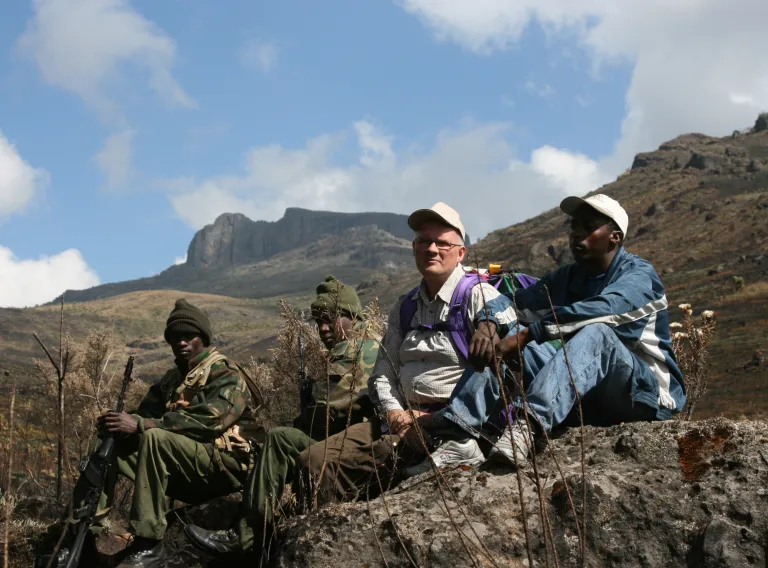
Jón Geir Pétursson on Mt Elgon in Eastern Africa.

Research and collaboration all over the world

Jón Geir’s own research has explored his own areas of study, in governance, political systems, policy instruments, policy development and routes to sustainability in environmental issues and natural resource management. “I research many kinds of natural resources. For example, current projects are investigating forests, conservation, land use, national parks and nature reserves, hunting, fishing and various other environmental issues such as pollution and climate change,” he says.

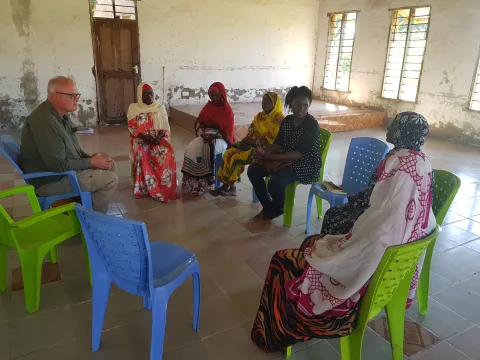
Jón Geir conducting an interview in Tanzania.
Jón Geir has done research among farmers and fishermen in many African countries. He is pictured here interviewing women in Tanzania.

These research projects are not solely confined to Iceland. “I’ve had opportunities to work on research, development and consultation projects in Africa. My doctoral research was conducted in Uganda and Kenya in East Africa and since then I’ve been involved with various projects in different African countries, dealing with a range of environmental and natural resource management issues, and development cooperation, climate issues and gender equality. Many of these projects have been connected with the UNESCO-GRÓ schools in Iceland, but related to the Icelandic and Norwegian governments' development work in Africa. I am also the representative for Icelandic higher education on the board of the Nordic Africa Institute in Uppsala in Sweden,” he says.

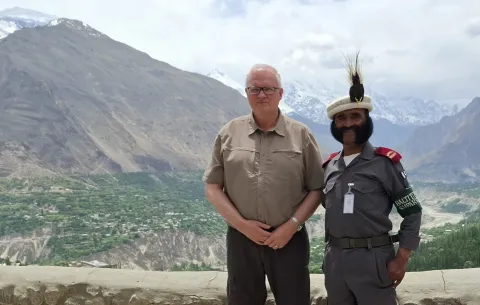
In recent years, Jón Geir has also engaged in research and policy development in the Hindu Kush Himalayan region, which is sometimes called the Third Pole, and is now supervising Master’s and doctoral students conducting research in the Karakoram mountains in Northern Pakistan, home to the largest glaciers in the region, e.g. around the mountain K2. “There are very exciting opportunities and mutual interest in cooperation between universities and institutions in the Himalayan countries, especially Pakistan, China, India and Nepal,” points out Jón Geir.

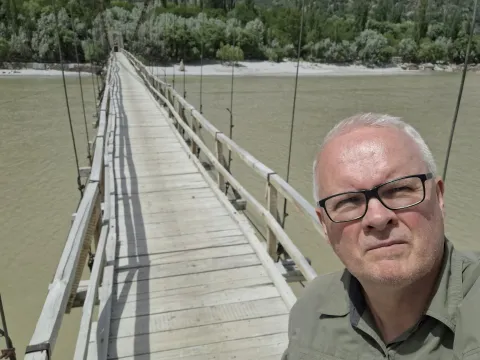
Jón Geir crossing the Indus River.
Jón Geir crossing the Indus River, Pakistan's lifeline. The river runs through the mountainous regions of Northern Pakistan and merges with other major rivers that originate in the three mountain ranges that merge there, Hindu-Kush, Himalaya and Karakoram

The Academy is an important link between scientists and society

In recognition of his remarkable career in government and academia, Jón Geir was granted the honour of membership in KSLA, one of the most prestigious academies in the Nordic countries in the fields of natural resources management, agriculture, forestry and environmental science.

The Academy is over 200 years old and membership is only offered to people who have been nominated for their important contributions to research, policy and/or professional developments in the field. “My work was considered important in the contemporary context, where challenges related to climate change, natural resource exploitation and sustainability require the integration of science, government and societal solutions. In my career I have endeavoured to improve understanding of how communities can manage natural resources in a responsible and sustainable way. I have researched political systems and the exploitation of natural resources all over the world and for decades played a leading role in policy making and management of various environmental and natural resources issues with the Nordic Council,” says Jón Geir.

Jón Geir Pétursson, professor of environment and sustainability studies at the University of Iceland at the KSLA induction ceremony.
Jón Geir smartly dressed at the KSLA induction ceremony where he accepted the award with King Carl XVI Gustaf of Sweden in attendance.

The Academy advises governments, issues scientific reports and collaborates with international organisations and specialist networks.  “So the Academy is an important link between scientists and society when it comes to the future management of natural resources and sustainability and I have every intention of taking an active role in its work over the next few years,” concludes Jón Geir. 

Jón Geir in the Hunza region in Pakistan with an interviewee.
Jón Geir in the Hunza region in Pakistan. With him is an interviewee from the Hunza tourism industry. Jón Geir worked on analysing the roles of different interested parties regarding the administrative structure of national parks.

Share

Tags
Did this help?

Why wasn't this information helpful

Limit to 250 characters.