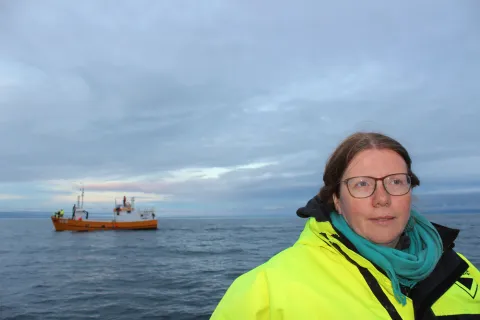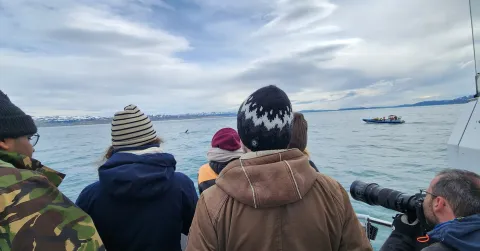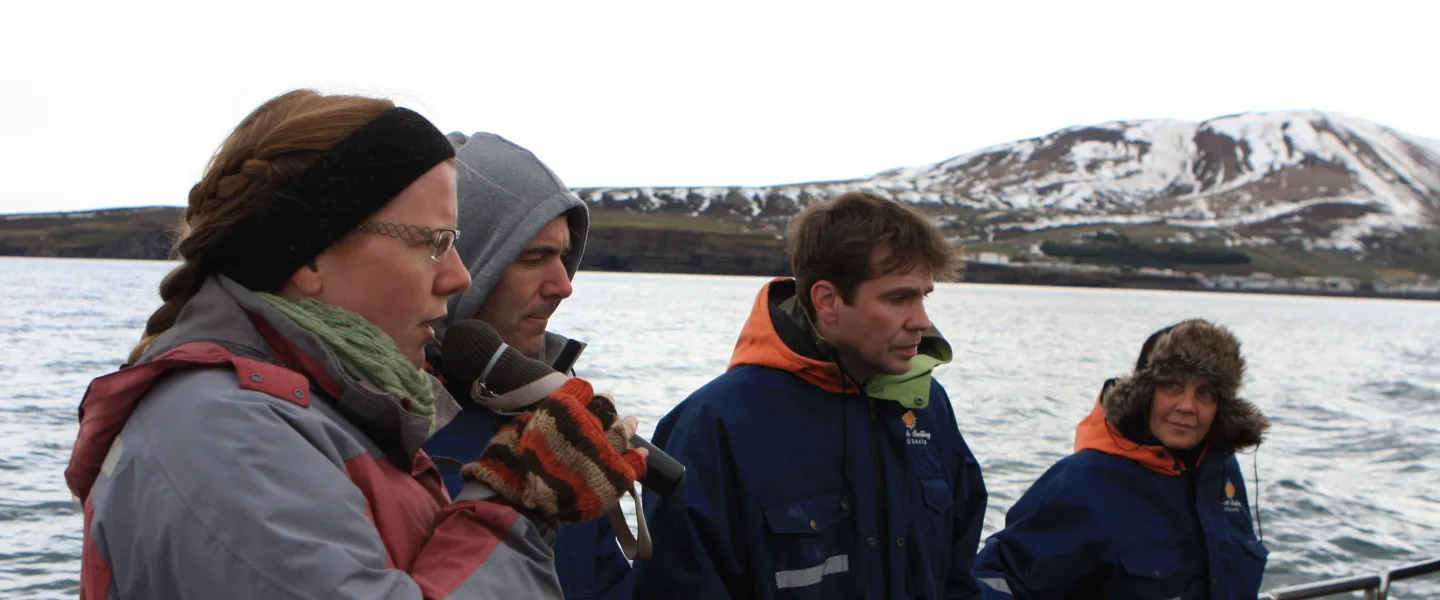
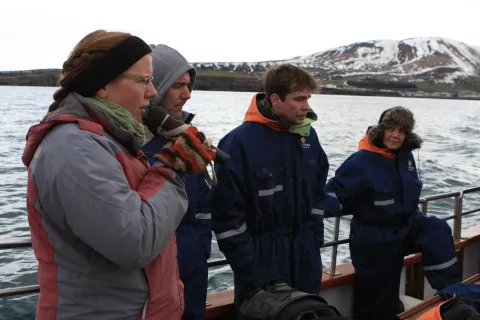
Marianne Rasmussen with a group of researchers.

What do Jaja Ding Dong and a humpback whale’s spout have in common?

A strange question, perhaps, but the answer is surprisingly simple: both have put Húsavík on the world map. Will Ferrell’s Eurovision film brought the town international fame in the world of the European Song Contest and greatly increased tourist interest in the area, while humpback whales have at the same time made Húsavík something of a home port for whale watching in Europe.

‘Whales are not only the largest animals on earth. They are also among the most important players in the ocean. Through their movements, feeding ecology, and biological behaviour, they affect nutrients in the sea, its ecosystems, and even the earth’s carbon cycle. That is why whale research is not only about individual species, but about the ocean itself, its rhythms, its energy flows, and the complex relationships that keep its ecosystems running.’ So says Marianne Helene Rasmussen, marine biologist and director of the University of Iceland Research Centre in Húsavík.

Conditions for whale research around Iceland are exceptionally favourable, and few places stand out quite like Skjálfandi Bay by Húsavík, where Marianne works. A wide variety of whales can regularly be seen there, even during the winter months, which surprises many people. This week, when we were travelling in Húsavík, a blue whale, the largest animal on earth, was spotted there, even though it was March and winter was far from over.
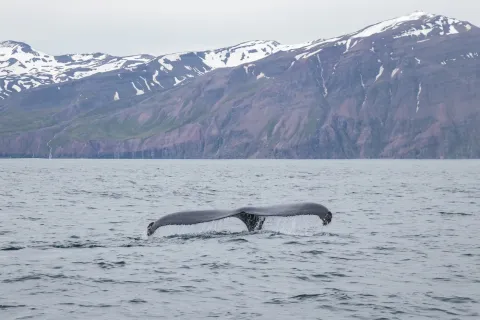
A blue whale shows its tail.
Conditions for whale research around Iceland are exceptionally favourable, and few places stand out quite like Skjálfandi Bay by Húsavík, where Marianne works.

Blue whales are migratory animals, and when they appear in Skjálfandi Bay, it is as if the sea itself is signalling that spring is on its way. In a sense, they are heralds of spring in the northern ocean, much like the golden plover is in the skies above.

Seeing a blue whale is a magnificent experience. But it also tells a story about a place where nature offers not only awe-inspiring moments but is also a source of research and a foundation of local livelihoods.

In that story, Marianne Helene Rasmussen plays a key role. She is one of the scientists who has contributed most to increasing our understanding of whales in the North Atlantic. Since the establishment of the University of Iceland’s research centre in 2007, she has led the development of multinational research there that has not only produced new knowledge but has also had a direct impact on whale watching, tourism, and the University of Iceland’s ties with the surrounding community.

Marianne’s story, however, is not the conventional story of a scientist setting a single goal and hitting the mark directly. It is much more interesting than that. It begins in a library in a Danish suburb, then travels through Finland, New Zealand, Denmark, Keflavík, and Húsavík. It unfolds among white-beaked dolphins and is connected to underwater sound recordings, seafaring, seasickness, and, of course, whale watching — where a passion for marine mammals keeps writing new chapters in the same life story.

The Child Who Wanted to Adopt a Whale

Marianne grew up in a suburb of Aarhus, Denmark. ‘I always dreamed of working with dolphins. I borrowed every book I could find from the local library and absolutely devoured everything I could get my hands on,’ she says with a smile. This is when the seed was planted, perhaps not with great drama, but with the quiet passion that often accompanies strong childhood interests.

‘One thing still stands out very clearly in my memory,” Marianne adds. ‘The World Wildlife Fund had a campaign where you could adopt a whale and also have a chance to win a trip to Andenes in Norway to see whales. I convinced my father to join the organisation. We never won the trip, and no whale was adopted, but the dream remained,’ Marianne says and laughs.

And although the child did not get what she had hoped for, as so often happens, Marianne eventually received much more than the chance to adopt a whale: she found her life’s work.

When Iceland First Entered the Story

After upper secondary school, Marianne wanted to travel and work abroad with a friend. ‘We first tried Norway, but we didn’t get any jobs,’ says Marianne. ‘My sister had seen a job advertisement in a Danish newspaper for work in Iceland. We applied in a burst of optimism and got jobs at the Grund nursing home in Reykjavík. This was in 1989, and we worked there for nine months.’
 

Marianne Rasmussen with a group of researchers.

The remarkable thing about this story is that Iceland entered the scientist’s life long before whales truly did. She had moved here, had begun to get to know the people and the country and its rhythm, the snowstorms and the summer light, but had not yet begun to imagine that her future would be tied to this country in the long term. She had no idea about Húsavík and Skjálfandi Bay, let alone marine mammal research.

‘I really wanted to see whales at that time. But it didn’t work out, since whale watching had not yet become part of Icelandic reality in the way it later did. Still, my interest kept growing, and I decided to begin studying biology at the University of Southern Denmark (SDU) in Odense.”

The First Dolphins

In 1993, Marianne got a job in Finland through a Nordic employment service. In Tampere, she visited a dolphinarium and saw live dolphins for the first time. It stirred something deeply that had been there ever since she first flipped through those books about dolphins.

‘I applied to do my final project in Tampere. At the same time, I also emailed scientists around the world to see whether I could participate in dolphin research. I got a yes from Tampere and did my BA project there in 1994. Shortly afterwards, an opportunity opened up for me in New Zealand, where I assisted with dolphin research and stayed for six months.’

At that point, things were truly underway for the young woman. No longer driven only by sincere enthusiasm, but now with growing experience, research connections, and direct contact with the animals that had fascinated her since childhood.

White-Beaked Dolphins and the Science that Begins with What No One Knows

After returning to Denmark, Marianne worked at Nordsoen Ocenarium in Hirtshals, where there was an exhibition on whales and dolphins of the North Sea. There, she encountered the most common dolphins of the North Sea and Danish waters. What fascinated her was not only the species itself, but also the fact that almost nothing was known about it. The scientist’s curiosity was already clearly visible.

‘I decided to make dolphins the subject of my master’s degree, and my supervisor was Lee Miller at the University of Southern Denmark. Since he worked within a bioacoustics research group, the sound production of white-beaked dolphins became the core of my research. But, to hear and record the sounds, of course, you first had to find the animals. White-beaked dolphins are among the largest dolphin species and grow to about three meters in length. They have a distinctive white beak or snout that stands out clearly from the darker colour of the head.’

It was by no means easy to find them. Marianne went on a 10-day research expedition in the North Sea, in an area believed to be particularly likely for spotting these small cetaceans in deeper waters. This time, however, not a single animal was seen.

There, Marianne encountered one of those aspects of research that is rarely mentioned in doctoral projects, let alone shown in nature documentaries or the news. The project was certainly well-defined, the equipment was in place, and the idea was well-grounded, but none of it mattered. The research subject simply refused to appear, and in a sense refused to cooperate with the scientist.

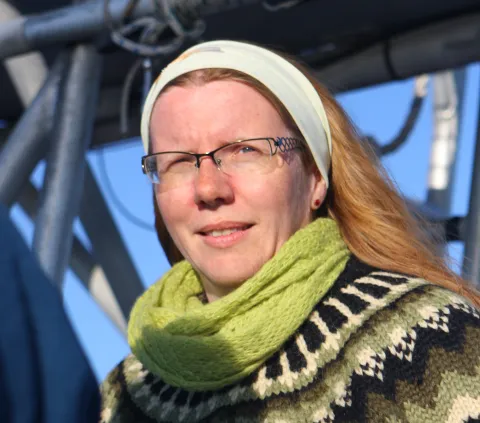
Marianne Rasmussen, whale researcher.
Marianne doing research in Skjalfandi Bay.

Húsavík and the Waiting for White-Beaked Dolphins

By this time, Marianne had written to the whale watching company Norðursigling in Húsavík after seeing on its website that white-beaked dolphins were seen on about 30 per cent of tours. She was invited to come and went to Húsavík in June 1997, stayed for three weeks, and went out into the bay on Knörrinn, which was then the company’s only boat.

It is easy to say that the white-beaked dolphins had much less interest in Marianne than she had in them. They simply kept evading her — and failed to appear. This is really one of the funniest parts of the story because it reveals both the scientist's persistence and the irony of research. Marianne had gone to the North Sea, come to Húsavík, and intended to study an animal that was supposed to be relatively accessible, but they quite literally refused to show themselves.

‘It was with the help of the Húsavík whale watching community’s network that the story took a new turn. People at Norðursigling knew of a woman in Keflavík, Helga Ingimundardóttir, who offered whale-watching and searched for dolphins. I went there and finally saw my first white-beaked dolphins. I returned to Keflavík later that same year to collect additional sound recordings. The woman in Keflavík then offered me a job as a whale watching guide, and in the summer of 1998, I returned to Iceland. It did not become just one summer, but ten,’ Marianne says with a laugh. That alone says more about her connection to Iceland, the ocean, and the whales than many other things.

Sound, Echo, and Names in the Sea

Marianne completed her master’s degree in 1999 and later began doctoral studies at the University of Southern Denmark with a grant from the Oticon Foundation. After finishing her PhD, she continued her research in Iceland, and in 2007, she received a phone call from the late Rögnvaldur Ólafsson, who at the time led the University of Iceland’s Institute of Research Centres. He offered her a position at a new University of Iceland research centre in Húsavík that was to focus on marine mammal research. The position was initially for one year but later became permanent. Marianne still works there today as a research professor and director.

One of Marianne’s main research fields concerns sounds in nature. Whales use sound to communicate, find food, and navigate the ocean, and with specialised underwater microphones, we can detect these signals and analyse the animals’ communication systems. In this way, we can track the movements and behaviour of whales, even when they are far below the surface,’ says Marianne.

Bioacoustics research sheds light on a world that is otherwise hidden from us. It shows not only how animals navigate and search for food, but also how they communicate with one another. ‘Some dolphin species have highly developed whistles in which individuals use distinctive sounds that may correspond to what we would call names for humans. It is hard to hear something like that without being filled with wonder.’

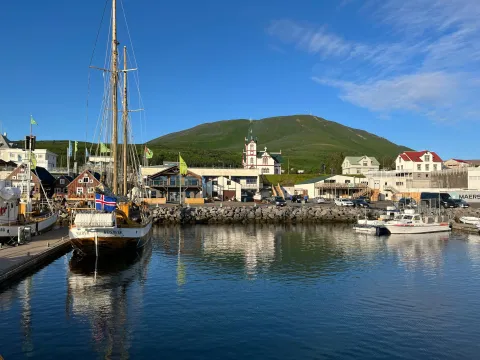
The small town of Húsavík in northern Iceland. Image by Henry Becker.
The small town of Húsavík in northern Iceland has become a popular destination for whale watching. IMAGE/Henry Becker/Unsplash

Whale watching is hugely popular in Húsavík

Over the past few decades, Húsavík has become one of the best-known whale-watching harbours in Europe, according to Marianne. Thousands of tourists come there every year to see whales in their natural environment. Whale research in Skjálfandi Bay has played an important role in that development.

‘Húsavík is often called the whale-watching capital of Europe, since many different whale species come here into the bay every year. Even so, we humans still have a long way to go before in understanding everything about these animals. That is probably exactly what makes the bay such a special research area: its ecosystem is known to a certain extent, but much remains hidden. The bay gives us a great deal, but it always holds something back.’

Systematic collection of data on whale behaviour and distribution has generated knowledge useful both for nature conservation and for business. It helps us understand when and where whales remain in the bay and how best to approach them without disturbing them.

‘In that way, science has helped shape more responsible and sustainable practices in whale watching,” Marianne says.

But the ties are even closer than that.

‘In 2025, thirty international students came to the research centre for internships. Many of them later applied for jobs with whale watching companies in the area. In this way, the companies get well-educated guides with solid knowledge of whales and marine ecosystems.’

This is where the university and working life meet in a very direct way. It may be one of the most interesting aspects of the work in Húsavík. The knowledge created at the research centre not only goes into books, academic articles, and conferences, but also out onto the dock, aboard whale watching boats, into the guided tours, and directly to those who want to better understand what they are seeing and experiencing in Skjálfandi Bay.

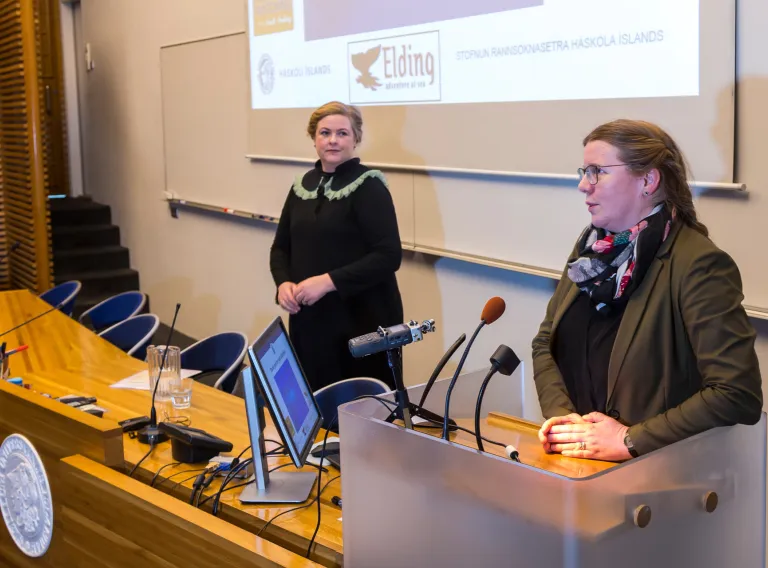
Marianne Rasmussen at her initiation ceremony as a scientist at the University of Iceland's Research Centre in Húsavík.

Skjálfandi Bay – a living laboratory

The research work in Húsavík is diverse and dynamic, drawing on both traditional fieldwork and new technologies. Interns take part in projects and gain valuable experience. Hydrophones are deployed in Skjálfandi Bay, and the recordings they collect are later used in many student projects and theses.

‘Skjálfandi Bay is the research centre’s most important study area. Humpback whales, minke whales, white-beaked dolphins, and various other dolphin species are regularly seen here, and focused research on blue whales has also been conducted here.’

Marianne is fortunate that, where she lives with her six-year-old son, there is a view over the harbour and the bay, and sometimes she continues her research in the evenings and on weekends simply by looking out the living room window.

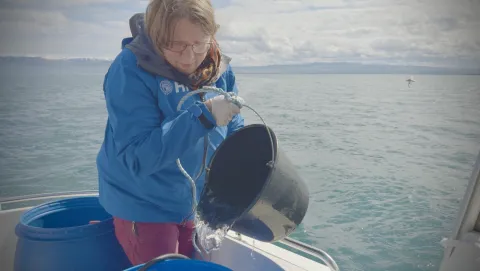
Marianne Rasmussen doing research out at sea.
Marianne and her colleagues have been developing an an innovative method for whale research based on so-called environmental DNA (eDNA).

Since 2012, Marianne has worked with Japanese colleagues who have brought special tags that are attached to whales with suction cups. At the same time, an innovative method for whale research based on so-called environmental DNA (eDNA) is also being developed. The method involves collecting water samples from places where humpback whales have dived only moments before. In those samples, minicells and DNA molecules left behind by whales can be found, for example, from skin, mucus, or faeces. In this way, it becomes possible to identify complex aspects of a whale’s life cycle and even its individual characteristics without disturbing it.

‘The use of drones has also increased enormously in whale research. With them, we can monitor the animals’ behaviour from the air and get closer to them than was previously possible, without disturbing their peace,’ Marianne says.

She and the research centre’s other scientists collect data on whale species, numbers, distribution, and behaviour, and through regular measurements, research, and field trips, an extensive database has been built up that is useful both for scientific research and for the management and protection of marine areas.

‘In this way, research carried out here at the centre showed that more than 25 per cent of humpback whales have at some point in their lives become entangled in fishing gear from fishing vessels here in Icelandic waters. This came out in research by Charla Jean Basran, who is now a postdoctoral researcher at the research centre,’ says Marianne. Basran is from British Columbia in Canada. Marianne says it hardly needs to be emphasised how important it is, both for fisheries and for the animals, to reduce such incidents.

But the research centre is not only a place where whales are observed. It is a place where new methods are developed, international ties are formed, and a new generation of scientists learns to listen — not only to those with more experience, but also to the ocean and the whales. Thus, traditional fieldwork, new technologies, international collaboration, and ongoing education come together in Húsavík, all based on the search for new knowledge.

Why does it matter to study whales?

Whales transport nutrients through the sea when they dive deep and return to the surface. Their waste brings nutrients back up, where they can be used by phytoplankton, which forms the base of the ocean food chain. This is a powerful reminder that whales are not just giant animals many of us admire from a distance. They are active participants in marine ecosystems and affect their surrounding environment. Studying them is therefore a way to study the ocean itself — its condition and health.

Despite decades of experience at sea and countless projects, tagging operations, and sound recordings, Marianne says the sense of wonder never disappears.

‘There is still always a moment when I look at a whale and think that this is incredible. One individual never behaves exactly like the next, and eye contact with a whale is always something very special.”

Students of Marianne Rasmussen's out at sea.
Scientists aren't the only ones fascinated by whales, they also work their charm on the general public.

And when Marianne is asked whether any one moment stands out in particular, she mentions an image that is almost too extraordinary to need explanation.

‘It is an absolutely indescribable experience to attach an acoustic tag to a blue whale from a six-meter Zodiac boat rolling on the surface beside a whale nearly thirty meters long.’

That is probably the heart of this whole story of the woman who fell in love with dolphins at a very young age. Research is organised, measurable, and usually highly disciplined. But it is also nourished by this sense of scientific wonder, by discovery, by this closeness — by the feeling that the world is bigger, deeper, and stranger than we thought.

Húsavík – Where Research and Experience Meet

The work of Marianne Helene Rasmussen and her colleagues in Húsavík shows clearly how research can have an impact far beyond academia. It increases knowledge of marine ecosystems, supports the protection of nature, and, at the same time, strengthens local businesses and community life. It builds international collaboration, creates opportunities for multinational students, and connects local experience with larger questions about the ocean and its future.

In this way, the University of Iceland Research Centre in Húsavík has contributed to increasing understanding of whales and marine ecosystems, while also strengthening Húsavík’s position as one of the most important centres of whale watching and whale research in the North Atlantic.

When a blue whale appears in Skjálfandi Bay in March, it reminds us that the ocean is alive all year round. In Marianne’s work, that fact is reflected in the perseverance, curiosity, and passion that drive her out to sea — even in unpleasant weather — in search of blue whales and other whales, to listen to them, understand them, and bring us new knowledge about them and the ocean to which they belong.

Marianne Rasmussen, whale researcher.
‘It is an absolutely indescribable experience to attach an acoustic tag to a blue whale from a six-meter Zodiac boat rolling on the surface beside a whale nearly thirty meters long,’ Marianne Rasmussen says.

Share

Tags
Did this help?

Why wasn't this information helpful

Limit to 250 characters.