
Þorsteinn Sæmundsson, adjunct professor at the University of Iceland.

Climate change and glacier retreat are significantly altering the landscape in certain parts of Iceland, posing hazards in some areas, according to Þorsteinn Sæmundsson, an adjunct professor at the University of Iceland. He is conducting research on how glacier retreat and permafrost thaw can affect mountain slope stability and the risks posed by landslides and potential sudden outburst floods from glacial lakes.

Glaciers are retreating, and as they do, the risk of landslides may increase. Landslides vary in size and type, from loose sediments falling from slopes to rockfalls, in which chunks of rock collapse, to large sections of mountainsides collapsing in rockslides or rock avalanches, and even to large sections of mountainsides falling into lakes in front of glacier termini. Such lakes have formed and continue to form in front of many outlet glaciers, especially along the southern part of Vatnajökull.
Another risk factor currently being studied, one that is more hidden and therefore harder to detect, involves changes in permafrost. Permafrost refers to ground, sediment or rock, that remains frozen year-round, but as the climate warms, it can begin to thaw.
“Where permafrost is present, the ice acts like a kind of glue. However, when it thaws, things can start to loosen, groundwater flow changes, and slopes can become unstable. This development can be dangerous for many reasons. It is worth keeping in mind that slopes we have until now considered stable may become unstable when these changes occur, as examples have shown,” Þorsteinn points out.

When outlet glaciers, such as those found in southern Iceland, retreat and thin, they cause various changes. In most cases, these glaciers have carved deeply into the bedrock and sediments. When they retreat, they often leave behind deep hollows, surrounded by steep, often unstable slopes. These hollows fill with meltwater from glaciers, forming glacial lakes.
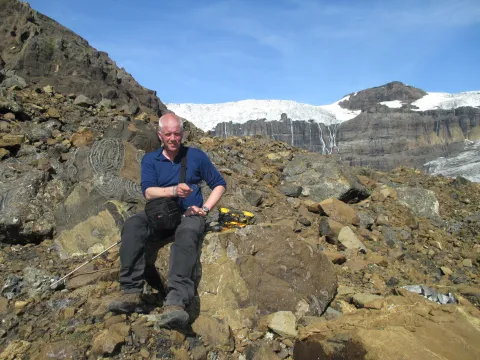
Þorsteinn Sæmundsson at Morsárjökull.
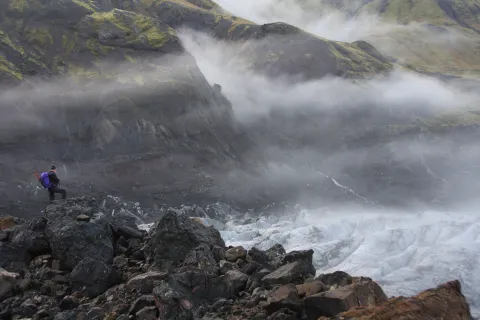
Þorsteinn on Morsárjökull glacier.

Although these natural wonders are incredibly beautiful, highly dangerous conditions can develop if landslides fall into the lakes, potentially triggering sudden outburst floods. This happened, for example, in 1967 when a large rockslide fell onto the glacier in Steinsholtsdalur in northern Eyjafjallajökull. Around 60 million cubic meters of rock fell onto the glacier and partly into the lake that had formed in front of it.

“It is estimated that the lake contained about 8 million cubic meters of water, equivalent to 8 million tons of water. During this event, part of the rockslide fell into the lake, filling it and displacing the water. As a result, the entire water mass surged out of the basin in a sudden, high-speed flood. For comparison, a standard freight truck can carry up to 40 tons of goods. It would therefore have taken 200,000 trucks to transport all the water released in this flood. The event resulted in the entire valley being inundated, and an enormous amount of sediment was carried with the flood, completely transforming the landscape of the valley,” Þorsteinn explains.

Increasingly Popular with Tourists

Glacial lakes are now popular tourist destinations, and infrastructure is being developed around them. Þorsteinn considers this risky.

“We need to stay grounded in these matters and consider what is happening today and how these places are likely to change in the near future, and identify the hazards that may arise,” he says. Alarm bells are ringing, and it is worth remembering that nature is “not going on vacation.”
According to Þorsteinn, it is necessary to increase research and monitoring of glacier retreat and mountain slope stability, and to educate more specialists in this field. Authorities and the public need to become more aware of these issues, too.

“Though it is unpleasant to say, authorities often only wake up when fatalities occur,” Þorsteinn says, adding that Icelanders must do better, because we already know that the danger exists today and will only increase with continued glacier retreat.

Þorsteinn Sæmundsson standing beside a glacier.
Þorsteinn during a research expedition.

Monitoring Since 1995

Þorsteinn has monitored and researched landslides since 1995. He previously worked at the Icelandic Meteorological Office, where the main focus was on avalanche hazards, the development of monitoring systems, and protective measures following the deadly avalanches in the Westfjords in 1994 and 1995. However, Þorsteinn says he has always been concerned about our lack of knowledge regarding landslides. He points out that large rockslides occurred throughout Iceland when glaciers retreated at the end of the last glacial period around 10,000 years ago. Similar conditions are forming today, though not on quite the same scale.

Þorsteinn emphasises the importance of increasing education and research and ensuring monitoring in areas considered potentially hazardous, but we must know where they are.

“Nature is changing greatly and rapidly in the ongoing climate changes, and we must stay alert,” he says, underscoring the importance of training more specialists in this field. Landslides and avalanches are the deadliest natural hazards on land in Iceland; therefore, it’s crucial to manage the situation carefully and maintain vigilant monitoring.

Not Just a Problem in Iceland

Þorsteinn says there is essentially no endpoint to the research and monitoring he conducts. It is a lifelong task to track these developments. The same applies worldwide, with warning signs appearing in many places, including Greenland, Norway, the Alps, and Alaska. “Significant changes are taking place in mountainous regions, with slopes deforming and collapsing due to climate change, both because of increased precipitation intensity and temperature changes,” he says.

Þorsteinn is far from finished researching the hazards associated with a warming climate and retreating glaciers. Further studies are being prepared, but he reiterates that, to conduct them properly, research funding must be increased, and expertise in this field strengthened at the University of Iceland.

“Icelandic nature is as dangerous as it is beautiful, and we must respect it and monitor it carefully,” he concludes.


Author of article: Þröstur Ingvarsson, journalism student at the University of Iceland.

Þorsteinn Sæmundsson, adjunct professor at the University of Iceland.
Þorsteinn Sæmundsson, Adjunct Professor at the University of Iceland conducts research on glacier retreat and permafrost. IMAGE/Kristinn Ingvarsson

Share

Tags
Did this help?

Why wasn't this information helpful

Limit to 250 characters.