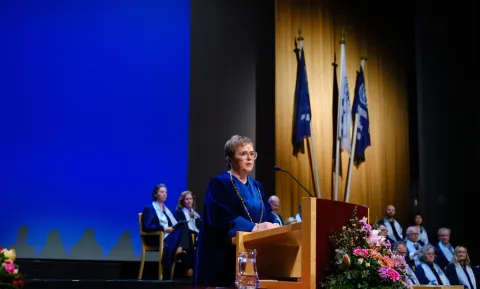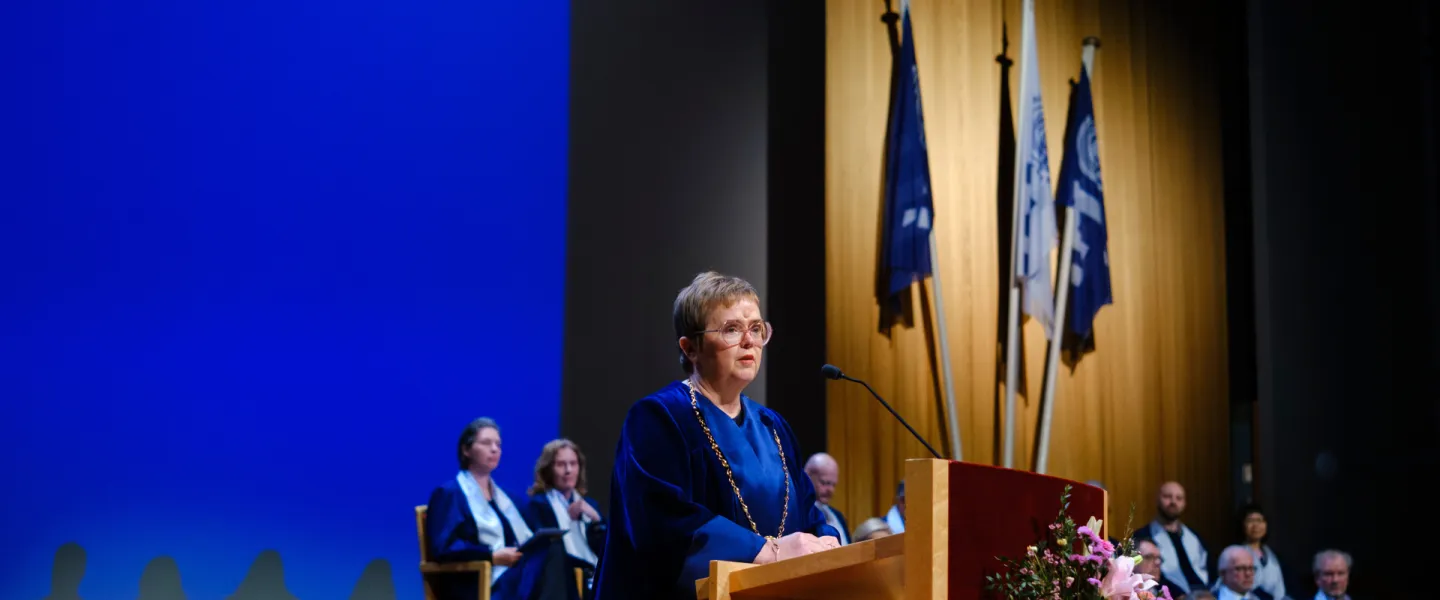
Silja Bára R. Ómarsdóttir, Rector of the University of Iceland, urged candidates to look to the future with both realism and optimism in her address at the graduation ceremony held in the University Cinema on Frebruary 20, where 445 candidates from both undergraduate and graduate programmes graduated.
Candidates were graduated from all the university’s schools; 175 from the School of Social Sciences, 56 from the School of Health Sciences, 53 from the School of Humanities, 85 from the School of Education, and 76 from the School of Engineering and Natural Sciences.
Silja Bára emphasised in her address that, despite an uncertain and fast-changing world, opportunities to have an impact were closer than many assumed, and that education wasn’t only a pathway to a career but also to personal growth and social responsibility.
“At a milestone like this, we look to the future,” Silja Bára said, “some of us undoubtedly full of anticipation, but others possibly with slight trepidation. The world you’re stepping into isn’t simple; rather, it is full of uncertainty, chaos and conflict; at least that’s how it appears in the news from around the world. It’s important to face this pragmatically – without looking away, but also without despair – because the world is nonetheless an inexhaustible fountain of adventures and possibilities.”
Silence, Thought and the Future World
This was the first time Silja Bára had delivered a speech at a graduation ceremony at the University of Iceland. It was both fitting and fun that she asked the candidates at the start of the speech to imagine themselves in the future as people rather than in any particular job role.
The annual University Day will take place next weekend, and Silja Bára mentioned that, on that day, she often gets the same question from prospective students: “What can I do if I study this?”
The Rector said this question was a sign of responsibility and a natural need to understand the connection between education and the future.
Silja Bára did mention, however, that in a world of rapid technological change, it is impossible to know for certain which jobs will exist in the future, and therefore it’s even more important that an education strengthens the individual. She emphasised that education not only opened up possibilities but would also help people grow personally in addition to giving them tools to better understand society and the world.
Technological Changes Call For Broad Education and Critical Thinking
In her address, the Rector also touched on the increased emphasis on STEM disciplines – mathematics, engineering, natural sciences and technology – and said that those study programmes were the key to innovation, sustainable development and the fight against modern challenges. “Another big problem we’re facing is increased polarisation and the decline of democracy in the world. To address those problems, technology alone won’t give us the solutions; we also need to build on experience and an understanding of human society and culture that gives us a compass for what we should do, why, and in which direction we should be heading. We cannot lose sight of what makes us grow as humans. Technology shapes the future – but it is humanity that gives it substance and meaning. Neither can exist without the other,” the Rector said.
She referenced the words of the renowned economist Mariana Mazzucato on the importance of diverse backgrounds of those who shape the future, and said that education should not only meet society's demands but also shape society's future for the benefit of us all.
Silja Bára emphasised specifically the role universities play in the development of democracy and suggested that democracy was not a given but an active process that needed constant attention. She said that universities served a key role in promoting critical thinking, creative freedom, and knowledge creation, and were at the forefront in defending democracy against all threats. “Hanna Arendt, one of the most influential thinkers of the 20th century, phrased it memorably when she said that the student years were the period of our lives when we faced the question of whether we loved the world enough to take responsibility for it – and influence how it will evolve in the future. If we shoulder that responsibility, it is clear that we must enable universities to attend to their three-part role of researching, educating and mediating in honour of redemptive knowledge.
Conversation Still an Important Tool for Knowledge Creation
Artificial intelligence has been one of the most conspicuous topics in discussions over the last months, and the Rector mentioned the radical changes now taking place, shaped by the birth and development of artificial intelligence.
Speaking about artificial intelligence and technological change, the Rector of the University of Iceland said that technology could streamline processes and open new opportunities. However, it could also demand more in terms of critical thinking, ethical judgement and humanity. Conversations between people with different backgrounds would still be one of the most important tools for knowledge creation.
In that context, she referenced the words of Einar Stefánsson, Professor Emeritus, “Bad decisions are made in private” and urged candidates to continue discussing their ideas, seek others’ opinions and learn from their mistakes.
Diverse Knowledge and Responsibility in the Future
The Rector said that diverse study programmes and research at the University of Iceland reflected the university’s unique role as a national university and mentioned the students’ remarkably diverse final theses as an example of the breadth of the university community.
Finally, Silja Bára thanked the candidates for their company for the past few years and urged them to take responsibility for society in the future. She said that their diplomas would be the key to unlocking new opportunities and a sign of transformation that enabled them to influence the world in a positive way.
“Walk out of here, not only with your diplomas in hand, but also with the belief that you can influence the world. It’ll never be better than the people who choose to take responsibility for it – and now it’s your turn.”