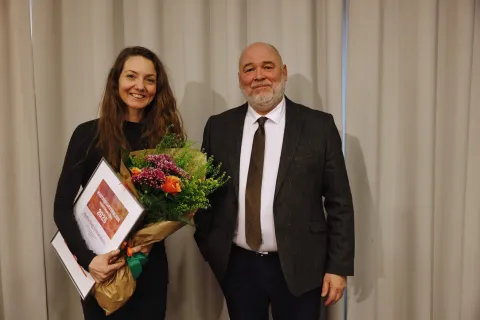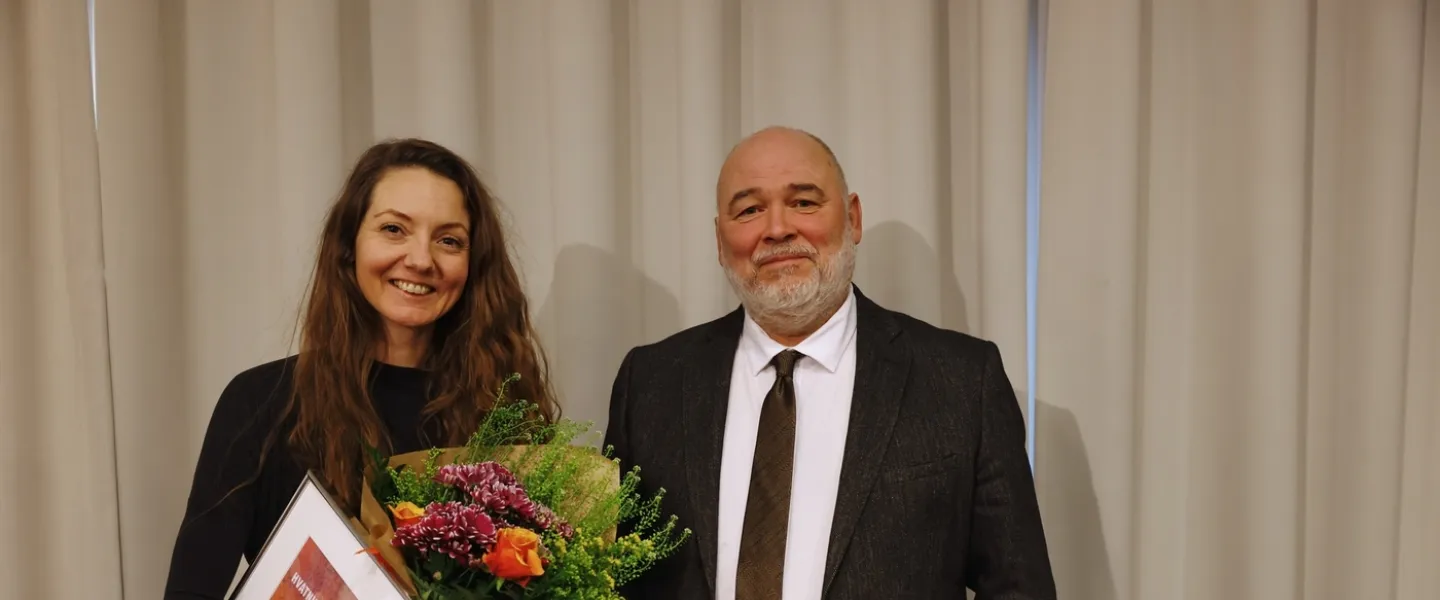
Hrefna Dögg Gunnarsdóttir, assistant professor at the Faculty of Law at the University of Iceland, received the Icelandic Centre for Research Motivation Award for Young Researchers last Thursday. The award is given to young scientists who, early in their careers, are believed to have excelled and raised expectations for scientific contributions that could strengthen the foundations of Icelandic society. Logi Einarsson, Minister of Culture, Innovation and Higher Education, presented Hrefna Dís with the award at the Icelandic Centre for Research (Rannís) research congress held at Hotel Reykjavik Natura.
As mentioned above, Hrefna Dögg is an assistant professor at the Faculty of Law at the University of Iceland, and her research focuses on health law and statutory requirements in science, including Environmental DNA science. Hrefna was born in 1984 and completed a bachelor's degree in law in 2011 and a master’s degree in 2012 from the University of Iceland. Additionally, she completed a master’s degree in disaster management from the University of Copenhagen in 2018. She then started her PhD at the University of Copenhagen and defended her thesis in 2023. Her thesis focused on statutory requirements for the transparent use of health data for scientific purposes.
Has Done Pioneering Research in Her Field
Before Hrefna Dögg started her PhD, she gained practical experience working as a solicitor at Réttur – Aðalsteinsson & Partners. After completing her PhD, she became a post-doctoral researcher at the University of Copenhagen, and in 2024, she was hired as an assistant professor at the Faculty of Law at the University of Iceland. Along with her position at UI, she has worked as a researcher at WELMA – Centre for Legal Studies in Welfare and Market in the Faculty of Law at the University of Copenhagen. She has also held the position of a visiting scholar at Harvard Law School in the US and at the Faculty of Law at Uppsala University in Sweden.
Hrefna Dögg has conducted research in health law, health data processing, large databases used for scientific purposes, privacy protection, biotechnology, and reciprocity in scientific research. In a short span of time, she has done pioneering work in her field, and her research, published by prestigious international publishers, has influenced international discussions on legal, ethical, and societal standards for new research methods in bioscience and the genetic sciences.