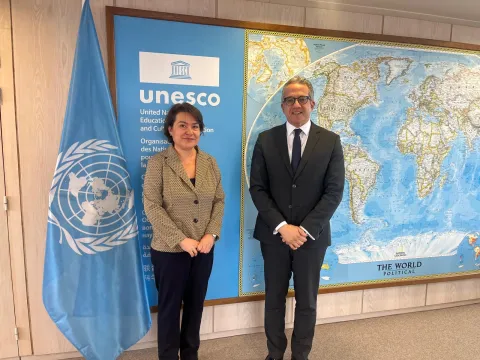
The Director of the Vigdís International Centre, Sofiya Zahova, met with UNESCO Director General Khaled El-Enany to mark the renewal of the agreement for the centre as a UNESCO Category 2 institution for eight years (2026-2033). They discussed cooperation and reaffirmed a shared commitment to linguistic diversity, multilingualism, and intercultural dialogue at a time when peace and dialogue are more crucial than ever.
The Vigdís Centre will continue to support UNESCO’s global efforts to ensure that languages continue to thrive in the digital era and that communities, especially in the Arctic and Nordic regions, can safeguard and transmit their linguistic heritage for generations to come.
Language is central to a nation’s culture and identity — a living treasure shaped by our past and evolving with our future. The renewed mandate of the Vigdís International Centre as a UNESCO Category 2 Centre reinforces our shared commitment to care for, respect, and actively support languages through research, education, and language technology. As a technologically advanced and curious nation, Iceland is proud to contribute to global efforts that ensure languages continue to grow, thrive, and remain living parts of culture in the digital age. - Logi Einarsson, Minister of Culture, Innovation and Higher Education
Category 2 Centres are autonomous institutions established under the auspices of UNESCO. They work in close collaboration with the organisation to contribute to its programs and priorities, while bringing specialised expertise, research, and regional knowledge to address global challenges. The renewal is an opportunity for cooperation to advance multilingualism, support research on endangered and lesser-used languages, and develop innovative initiatives to sustain linguistic and cultural diversity.
Multilingualism is at the heart of UNESCO’s mission to promote inclusive, knowledge-based societies. The renewal strengthens our collective efforts to protect linguistic diversity, advance intercultural dialogue, and ensure that all languages, especially those at risk, can thrive in the digital age. - Dr Tawfik Jelassi – Assistant Director General for Communication and Information, UNESCO
The Vigdís International Centre for Multilingualism and Intercultural Understanding was established in Reykjavík, Iceland, following the approval of UNESCO’s General Conference in 2011 as a Category 2 Centre under the auspices of UNESCO.
Through this renewed mandate, UNESCO and Vigdís will continue to work together to strengthen research, education, and practical solutions for multilingualism, fostering inclusive societies, intercultural dialogue, and respect among communities worldwide.