""

“We need to show more resolve in protecting liberal democracy, in particular as regards the importance of a functioning public sphere — a shared communicative space where people have access to reliable information and can argue with one another in a civil manner. This is a cornerstone of any functioning democracy,” says Maximilian Conrad, professor of political science at the University of Iceland’s Faculty of Political Science. He is the leader of the recently concluded Horizon Europe research project RECLAIM, which aimed to study the implications of post-truth politics for democracy in Europe and beyond. Policy briefs, podcasts, toolkits, video-explainers and scientific papers are among the many outcomes of the project that shed light on the threats facing liberal democracies and ways in which societies can tackle them.

The research project, fully named Reclaiming Liberal Democracy in the Postfactual Age, was awarded a grant of three million euros from the EU’s Horizon Europe programme in 2022. The aim of the project was to explore the phenomenon of post-truth politics as a political-cultural development and to provide means to respond to its negative effects , including — but not limited to — the proliferation of disinformation.

A possible existential threat to democracy

“This project is a response to developments that have been observable for well over a decade. The Brexit referendum and Donald Trump’s first election as US President strongly suggested a profound transformation characterised by a changing status of truth and facts in political discourse. That public opinion can be created even on the basis of claims that are evidently factually incorrect,” Maximilian says about the origin of the project. 

In the RECLAIM project, Maximilian and his colleagues set out to examine what this transformation means for liberal democracy more broadly. “Based on the findings of an earlier project on the post-truth delegitimisation of European integration, we drew inspiration to tackle this on a much broader scale and analyse post-truth politics as a challenge and, possibly, even as an existential threat to liberal democracy,” says Maximilian. At the start of the project, Maximilian further notes, many observers doubted that post-truth politics was a serious problem. “But we are seeing ever more clearly that this is indeed an existential threat to liberal democracy. Recent events in the United States provide a playbook for how liberal democracy may be abolished. And we would be foolish to think that this could not happen in Europe as well.”
""
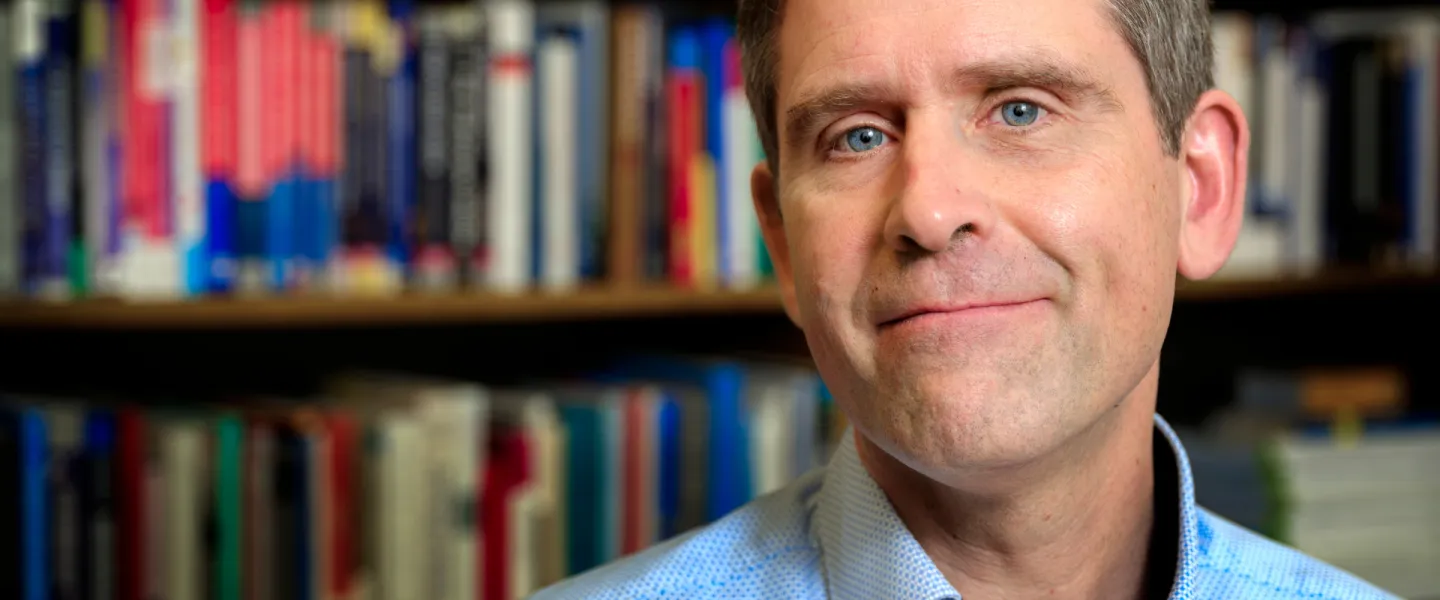
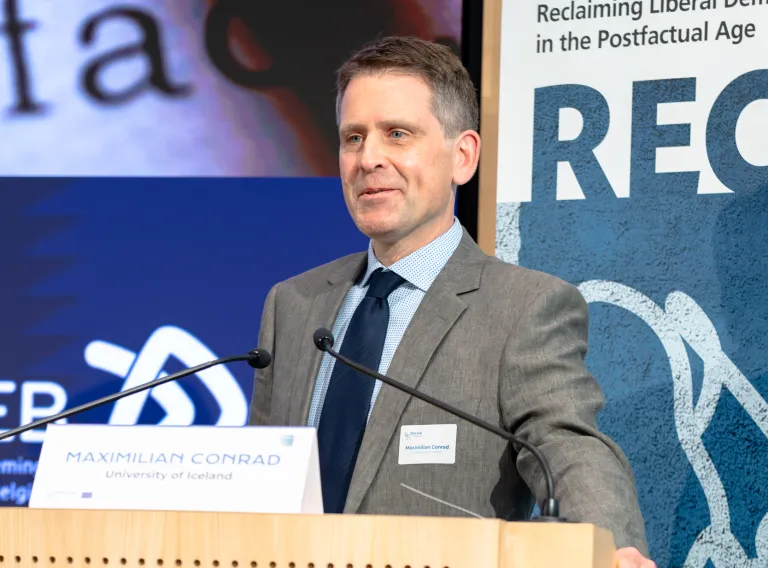
Maximilian Conrad, professor of political science at the University of Iceland.

AI comes into the equation

The RECLAIM project brought together a highly diverse group of scholars from a total of thirteen universities, research institutions and think tanks in Europe, with the Institute of International Affairs at the University of Iceland hosting the project. “Our consortium consisted of political scientists, political theorists, sociologists, media and communication scholars. The project was designed as an interdisciplinary effort,” says Max.

Asked if the project has changed in some way during the three-year grant period, Maximilian points to the emergence and effect of AI in the spread of disinformation. “When we started this project, we looked at social media as a main site where disinformation can be spread, but since then, generative artificial intelligence has become an ever more important issue. Social media still functions as an important vehicle for disinformation, but with generative artificial intelligence, it has become easier than ever to produce seemingly authentic disinformation,” Maximilian says.

How do we equip citizens for an increasingly manipulative information environment?

But how can we respond to this situation — and how do we strengthen public deliberation? Some answers to these questions can be found in the numerous findings and outputs from the RECLAIM project, which include various policy briefs, reports, books, podcasts, and video-explainers, all of which are open to both policy-makers and the wider public. 

The experts within the RECLAIM project have produced a total of six policy briefs with specific recommendations for policymakers. One of them is to empower European citizens through enhanced citizenship education and media literacy programmes. People need to be better able to discern facts from fiction on social media or, at least, to be aware of the risk of encountering false information on social media. “This is not only about mis- and disinformation. It's also about giving people, younger or older, an appreciation of the role of journalism in liberal-democratic societies. People need to understand not only that quality journalism — if done properly — gives them more reliable information, but more importantly, why that is the case. We need to get to a point where people understand what good journalism is, what it does and how it works — and why it provides the kind of contextualisation that you will not necessarily find on social media. This understanding will be key in rebuilding trust relationships between mainstream media and audiences,” Maximilian points out. 

Maximilian and his colleagues also argue that there needs to be better coordination and follow-through in citizenship education curricula across European countries. Although education policy is mostly organised at the national level, the EU can play an important coordinating role. The EU already monitors and analyses the performance of national education systems in various respects, both in member and participating non-member states, including Iceland. “This resource should by all means be used also in analysing how national and subnational education systems perform in preparing their citizens for an information environment that is evidently becoming more manipulative.”

The EU does not have to give into the demands of social media companies

A second recommendation is to regulate social media platforms. “We call for a new governance regime for social media and digital media companies. The European Union has considerable power to determine the conditions for the operation of social media companies within its internal market — and thus does not by any means have to give in to demands from people like Elon Musk, Mark Zuckerberg, or Jeff Bezos. As an internal market of almost 500 million people, it clearly has leverage to determine what social media companies are and aren’t allowed to do, regardless of Elon Musk’s absurd claims about ‘freedom of speech’ in Europe”. This also includes questions of algorithmic transparency, that is, a clear understanding of how algorithms function and how information is selected for users across different social media platforms. Similarly, Maximilian points out that the creation of social media councils — similar to the type of press councils that exist in many countries — should be created as a means of self-control.

""

The need to protect quality journalism

The third main policy recommendation is to protect quality journalism and provide funding opportunities for media that uphold journalistic standards. “Quality journalism is undergoing a crisis related to its fundamental business model, in large part because quality media have to compete with social media. Private mainstream media are in crisis also because their revenues are decreasing as people increasingly turn to social media for information. But then there is also the issue of ownership, which is important to consider in the context of declining trust in mainstream media. The independence of quality newspapers — and indeed media pluralism as such — is threatened when more and more outlets are owned by a small number of very big media companies,” Maximilian says.

This raises questions about ways to support quality journalism. “One of our policy briefs recommends that we consider ways of allocating a certain amount that every citizen can spend on quality journalistic publications. This raises many follow-up questions, but it would be one way of securing the economic basis of a pluralistic media landscape,” says Maximilian.

Populist politicians purposefully attacking journalism

Maximilian underlines that we are at a critical juncture regarding the status of quality media in Europe. Patterns of trust in the media are changing, and journalism does not seem to have the same kind of reputation as before. “To some extent, this calls for a bit of critical self-reflection on the part of the institution of journalism itself. Is journalism still living up to its own standards — which obviously also have to be reflected in people’s expectations towards the institution?” Maximilian asks. 

But crucially, mainstream media are also faced with a profoundly delegitimatory critique that stems from the political sphere. “Populist politicians — or politicians outside the political mainstream — are purposefully attacking journalism, claiming that they are all part of a corrupt liberal elite that is out of touch with the realities experienced by everyday people. And it is absolutely crucial to acknowledge and understand how such narratives are used as an instrument to actively undermine the credibility of mainstream journalism.”

In terms of media consumption, Maximilian argues that we also need to take the generational perspective into account. “For people our age, public-service broadcasters are still a completely standard source of news. It's still very normal to watch the news on RÚV in the evening. But that's a completely different story for younger generations, including many of my students, even at the master's level. We need to pay much more attention to how media consumption patterns are changing – and with what impact, especially in high-trust societies such as Iceland and the other Nordic countries,” Maximilian says. 

In another policy brief, Maximilian and his colleagues looked at the “weaponisation” of disinformation by external actors in Europe. “This is not only happening on the domestic level. Authoritarian regimes actively use disinformation campaigns to interfere in elections and undermine liberal democracies more broadly. This draws attention to the security dimension of post-truth politics, and the project is also relevant with that in mind,” he says.
 

""

Trust in mainstream media not dwindling all around Europe

Asked if the results of the project have surprised him in any way, Maximilian says that trust in mainstream and public service media is not dwindling as much as people often assume. “If you look at this over longer periods of time, it is gradually declining, and media sources that people use are also changing, with social media becoming a more important source of information. But that is not the case across the board,” says Maximilian and continues: “In the Nordic countries, but also in countries such as Ireland or the Netherlands, trust in media is changing, but not as profoundly as you might think. But there are also places where people have virtually no trust in media, or even in the news in general, especially in the south and southeast of Europe.” 

Some countries have very ambitious citizenship education programmes

Another surprising result, according to Maximilian, is that some countries already have very ambitious citizenship education programmes. “Our analysis of citizenship education curricula in different countries has shown that there are cases where crucial issues related to media literacy and critical thinking play a very important role” says Maximilian. 

In Bavaria, Germany, for instance, it is spelt out in detail exactly what specific objectives are to be achieved at what stage and through which specific measures. “There is an overarching framework that spells out the main goals of citizenship education — how to develop young people into competent participants in democracy. And as part of that, media literacy is emphasised heavily across school types and ages, starting very early. This gives kids a sense of what media are and how they function, but it also has them reflect on their own information sources and media consumption habits. This element of critical self-reflection is incredibly important,” Maximilian points out. 

This may be a form of best practice that could also be relevant in Iceland. “The Icelandic curriculum guide has undergone some profound changes and spells out important goals that citizenship education should achieve. Children are meant to acquire digital skills and critical thinking. But when it comes to spelling out the mechanisms through which these goals are meant to be achieved, there could and should be a much more explicit strategy — also in terms of evaluating the extent to which these goals are actually achieved in reality,” says Maximilian.

""
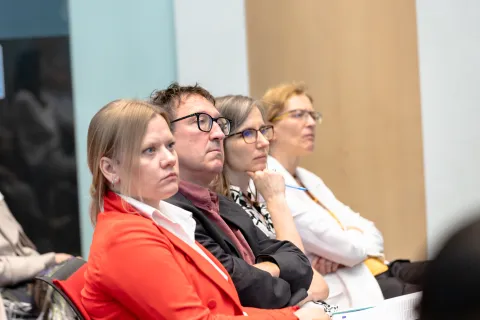
A diverse group of academics from European countries have collaborated on the RECLAIM project. IMAGE/Elza Löw and TEPSA (Trans European Policy Studies Association)

More at stake than the facts themselves

Although Europe is certainly facing quite a challenge fighting against disinformation and the rise of post-truth, not all is doom and gloom, according to Maximilian. “The good news is that we are starting to wake up to this new reality. In the field of citizenship education, there is an awareness that there needs to be a fundamental pivot towards media literacy and especially digital media literacy.” 

He also underlines that there is an increasing awareness that the task ahead is to address more than the ability to identify mis- and disinformation, and that a more comprehensive strategy is required to defend liberal democracy. “There is a clear need to re-emphasise democratic values and virtues such as mutual respect and tolerance for different groups and their worldviews. Democracy is clearly about more than elections. Democracy requires day-to-day debate, and this debate must take place in a civil manner and across ideological divides. And while there are indications of growing polarisation, the good news is that there is also an increasing awareness that there is more at stake than just the facts themselves.”

Some of the key publications not out yet

Although the RECLAIM project formally finished in September 2025, Maximilian and his colleagues still have a lot of work to do analysing all the data gathered. “All our formal deliverables were submitted by the end of the project, and a lot of the products of our work are currently in peer review or in production at the respective publishers. Therefore, some of the key works have not yet been published, including our summarising edited volume, which will be published in the spring. At the same time, the project has prompted many new questions. 

There is a lot at stake for liberal democracies in protecting the public sphere. “We need to be aware of the fundamental value of the public sphere as a shared space for communication where we can present our arguments and reconcile our differences. To do that, we need access to reliable information. This means that we need to have quality journalism that provides both information and contextualisation, but that also offers opinions and perspectives. And as citizens, we need to show respect and be willing to argue with one another — and especially with those with whom we disagree,” he concludes.

Learn more about the results of the RECLAIM project
 

Share

Tags
Did this help?

Why wasn't this information helpful

Limit to 250 characters.