""

What do the arctic charr, parasites in fish, fishing quota, a juvenile Atlantic cod and the flounder have in common? These are all topics in a podcast hosted by a group of former and current doctoral students at the University of Iceland, which is aimed at the general public.

The podcast is called Fiskaspjall (Fish Talk in English) and can be found on podcast platforms and YouTube. „We want to make research on fish in Iceland available to everybody. We hope that our passion will reach people across Iceland and inspire you to connect through fish science,” it says on the website Ice Fish Research, which the doctoral students have established both as a platform for their podcast and interesting content regarding research on fish.

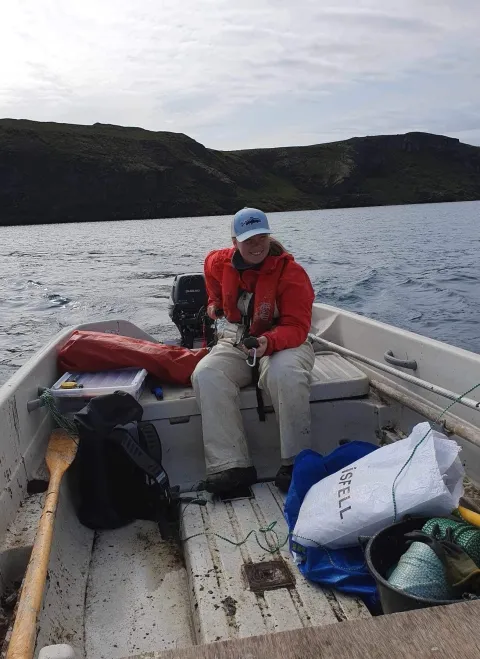
The idea to establish this communication platform arose at a science communication workshop hosted by the Icelandic ecological society following its 2024 conference. „We, founding members of ICE Fish Research, all attended the workshop. All of us were working on our PhD theses at the University of Iceland and had been thinking about how to share our work with the public. We were all so inspired and motivated that we decided then and there to join forces and start our own science communication platform, and already in May 2024, ICE Fish Research went live,“ says Alessandra Schnider, who founded the platform along with Lieke Ponsioen, Michelle Valliant and Theresa Henke. Later, Guðbjörg Ósk Jónsdóttir joined in. Guðbjörg, Michelle, and Lieke are currently working towards their PhD but Alessandra and Theresa finished their doctoral studies last year.

They are all young scientists who emphasise that they want to use the platform to introduce other young scientists and encourage them to share their research. „We primarily want to reach the public, especially young adults. We also want to increase visibility among Icelandic fish researchers and hopefully encourage discourse and collaboration,“ Guðbjörg says about the platform’s goal. 
 

""
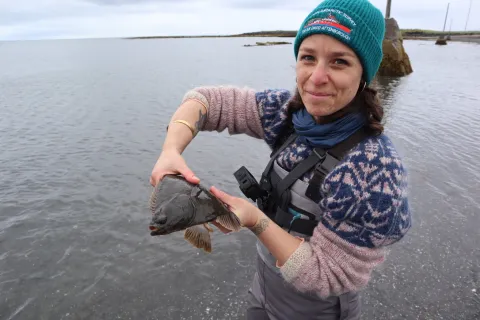
Alessandra Schnider completed her PhD from UI last year.

Fish are a very good species for various types of research

Fish are a big part of Iceland´s marine and freshwater ecosystems, and fishing has also laid the foundation for Iceland's prosperity today. The opportunities for fish research are therefore both abundant and diverse, as reflected in the podcast's topics, which cover the work of people working across Iceland in various institutions.

However, the status of fish species in these ecosystems isn't the only area that calls for research; so too do changes in the marine and freshwater environments due to increased human activity, which affect those species, their survival, and the invasion of new species. This is evident from the changing travelling patterns of the Icelandic hunting fish stock, coinciding with increasing sea temperatures, the arrival of the flounder in the Icelandic ecosystem, and the impact of fish farming on local salmon stocks.

Lieke points out that fish research is very important for various other reasons, e.g. to increase understanding of speciation (i.e. how populations evolve and become distinct species). “From an evolutionary perspective, fish are old and have evolved in many different shapes and forms, and inhabit a wide range of environments. This allows us to study many theoretical questions, for example, about how new species emerge”, she says.

Alessandra adds that to protect our ecosystems, we need to understand the different players and how they interact. „This is especially important as we are in a major biodiversity crisis. Fish are also an important food source, so to optimise farming and stabilise wild populations is vital to food security,” says Alessandra about the importance of fish research.

""
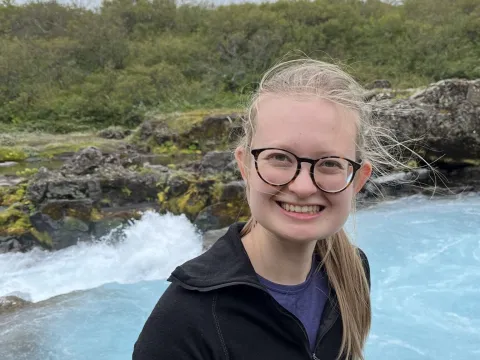
Lieke Ponsioen, a PhD student at UI.

Threespine stickleback and the arctic charr the main focus of their research

These young scientists’ interest in this type of research was sparked for various different reasons and their topics are also quite different.  “I am primarily interested in how the environment shapes the organism and how stressful environmental conditions can affect the next generation(s). During my master’s I studied vervet monkeys but for my PhD I moved on to threespine sticklebacks. They are much easier to work with experimentally because they are small, reproduce faster, and show substantial plasticity in many traits. This makes them exceptionally well-suited to study evolutionary questions,” says Alessandra.

Working with fish was never on Lieke´s radar, but during her bachelor studies, she had the opportunity to complete an internship studying arctic charr and brown trout at the University of Iceland. “It turned out I really liked the research surrounding the arctic charr in Thingvallavatn, as it is so variable and so many questions can be asked. So, I kept working on this system during my master’s at UI and later on for my PhD at UI as well. Throughout my studies, the species and the system stayed the same, but the research questions I am asking could not be more different. I have studied their phenotype, their evolution and development, and now I am looking at their behaviour. Working with the arctic charr in Thingvallvatn will never be boring.”

""
Guðbjörg Ósk, a PhD student at UI.

When Guðbjörg was wondering what she wanted to research for her master’s thesis, questions regarding evolution, adaptation and/or speciation came to mind. “I just needed to find a good system to study these questions. I ended up using arctic charr, because of their high intraspecific diversity. It was through working with the charr and getting to know all the passionate young and senior scientists working with fish that my interest in fish research only grew,” says Guðbjörg.

The Fiskaspjall podcast already has 15 episodes, and the women are planning to publish more this year. „We are planning a couple of bonus episodes for the spring 2026 before we come back for a second season in autumn 2026,” says Alessandra.

Listen to Fiskaspjall on:

Spotify
Patreon
YouTube

Follow ICE Fish Research on:

Facebook
Instagram
BlueSky
 

Share

Tags
Did this help?

Why wasn't this information helpful

Limit to 250 characters.