- Are you interested in artificial intelligence
- Are you interested in data?
- Do you enjoy statistics?
- Would you like to be able to prepare data for further analysis?
- Do you want to learn how to apply data analysis in practice?
Programme structure
The programme is 120 ECTS and is organised as two years of full-time study.
The programme is made up of:
- Courses, 30 - 60 ECTS
- Master's thesis, 60 - 90 ECTS
Organisation of teaching
The programme is taught in Icelandic and English.
The thesis may be written in Icelandic or English.
Main objectives
Upon completion of their studies, students should, among other things:
- have a solid understanding of classical statistical methods as well as machine learning techniques, including their strengths and limitations.
- be able to prepare data in the most common file formats for further statistical analysis.
- be able to familiarise themselves with a research topic, identify appropriate types of data needed to address relevant research questions, and assess potential sources of bias.
Other
Completing a Master's degree in chemistry allows you to apply for doctoral studies.
- Bachelor’s degree
- Applicants must have completed an introductory university-level course in statistics, equivalent to STÆ203G – Probability and Statistics, an introductory university-level course in mathematical analysis, equivalent to STÆ108G – Mathematics N, and a university-level course in linear algebra, equivalent to STÆ107G.
- All international applicants, whose native language is not English, are required to provide results of the TOEFL (79) or IELTS (6.5) tests as evidence of English proficiency.
- Applicants are asked to submit a letter of motivation, 1 pages, where they should state the reasons they want to pursue graduate work, their academic goals and a suggestion or outline for a final paper.
- Letters of recommendation (2) should be submitted. These should be from faculty members or others who are familiar with your academic work and qualified to evaluate your potential for graduate study. Please ask your referees to send their letters of recommendation directly to the University of Iceland electronically by e-mail (PDF file as attachment) to admission@hi.is
Students must complete all required courses with a minimum grade of 6.0 and earn at least 60 ECTS in total from coursework (both required and elective courses), also with a minimum grade of 6.0. In addition, students complete a 60-ECTS master’s thesis, which is assessed on a pass/fail basis.
- CV
- Statement of purpose
- Reference 1, Name and email
- Reference 2, Name and email
- Supervisor/supervising teacher at the University of Iceland
- Certified copies of diplomas and transcripts
Further information on supporting documents can be found here
Programme structure
Check below to see how the programme is structured.
This programme does not offer specialisations.
- Year unspecified
- Fall
- Machine Learning
- Applied Linear Statistical Models
- Mathematics for Finance II
- Introduction to deep neural networks
- Biostatistics II (Clinical Prediction Models )
- Not taught this semesterTime Series Analysis
- R Programming
- Theoretical Statistics
- Mathematics for Finance I
- Applied Linear Statistical Models
- Bayesian Data Analysis
- Not taught this semesterMixed Linear Models
- Thesis skills: project management, writing skills and presentation
- Spring 1
- Statistical Consulting
- Applied data analysis
- The AI lifecycle
- Biostatistics III (Survival analysis)
- Seminar on Machine Learning
- Not taught this semesterRandom Effects Models
- Introduction to Measure-Theoretic Probability
- Not taught this semesterStochastic Processes
- Not taught this semesterBusiness Intelligence
Machine Learning (REI505M)
An overview of some of the main concepts, techniques and algorithms in machine learning. Supervised learning and unsupervised learning. Data preprocessing and data visualization. Model evaluation and model selection. Linear regression, nearest neighbours, support vector machines, decision trees and ensemble methods. Deep learning. Cluster analysis and the k-means algorithm. The students implement simple algorithms in Python and learn how to use specialized software packages. At the end of the course, the students work on a practical machine learning project.
Applied Linear Statistical Models (STÆ312M)
The course focuses on simple and multiple linear regression as well as analysis of variance (ANOVA), analysis of covariance (ANCOVA) and binomial regression. The course is a natural continuation of a typical introductory course in statistics taught in various departments of the university.
We will discuss methods for estimating parameters in linear models, how to construct confidence intervals and test hypotheses for the parameters, which assumptions need to hold for applying the models and what to do when they are not met.
Students will work on projects using the statistical software R.
Mathematics for Finance II (HAG122M)
The course will cover the main points of statistics and pricing in finance. Emphasis is placed on introducing students to the use of numerical and mathematical methods to analyze, price and obtain information about financial instruments. Emphasis is placed on real examples where students are trained to solve tasks similar to those they may have to solve in the workplace.
The statistical part of the course will cover time series analysis. There, models such as auto regressive models (e. Auto regressive model, AR model) and models with moving averages (e. Moving-average model, MA model) will be introduced to play. Also the combination of ARMA, ARIMA and SARIMA models. Finally, conditional variance models or ARCH and GARCH models will be reviewed.
In the pricing section, we will cover binomial trees, Wiener processes, Ito's auxiliary theorem, the Black-Scoles-Merton model and the pricing of stock and currency options.
Introduction to deep neural networks (TÖL506M)
In this course we cover deep neural networks and methods related to them. We study networks and methods for image, sound and text analysis. The focus will be on applications and students will present either a project or a recent paper in this field.
Biostatistics II (Clinical Prediction Models ) (LÝÐ301F)
This course is a continuation of Biostatistics I and constitutes a practical guide to statistical analyses of student's own research projects. The course covers the following topics. Estimation of relative risk/odds ratios and adjusted estimation of relative risk/odds ratios, correlation and simple linear regression, multiple linear regression and logistic regression. This course is centered around two core principles that define its thematic focus: Prediction from Statistical Models
Students will learn to build models—such as logistic regression and Cox proportional hazards models—that estimate the probability of future medical events based on recorded data. Evaluation of Discrimination Capacity A key theme is assessing how well models distinguish between individuals with different outcomes, using metrics such as the Area Under the ROC Curve (AUC), concordance index, and related performance measures.
The course is based on lectures and practical sessions using R for statistical analyses.
Time Series Analysis (IÐN113F)
ARMAX and other similar time series models. Non-stationary time series. Correlation and spectral analysis. Parameter estimation, parametric and non-parametric approaches, Least Squares and Maximum Likelihood. Model validation methods. Models with time dependent parameters. Numerical methods for minimization. Outlier detection and interpolation. Introduction to nonlinear time series models. Discrete state space models. Discrete state space models. Extensive use of MATLAB, especially the System Identification Toolbox.
R Programming (MAS102M)
Students will perform traditional statistical analysis on real data sets. Special focus will be on regression methods, including multiple regression analysis. Students will apply sophisticated methods of graphical representation and automatic reporting. Students will hand in a projects where they apply the above mentioned methods on real datasets in order to answer research questions
Theoretical Statistics (STÆ313M)
Likelihood, Sufficient Statistic, Sufficiency Principle, Nuisance Parameter, Conditioning Principle, Invariance Principle, Likelihood Theory. Hypothesis Testing, Simple and Composite Hypothesis, The Neyman-Pearson Lemma, Power, UMP-Test, Invariant Tests. Permutation Tests, Rank Tests. Interval Estimation, Confidence Interval, Confidence, Confidence Region. Point Estimation, Bias, Mean Square Error. Assignments constitute 30% of the final grade.
Mathematics for Finance I (HAG122F)
The course will cover the main points of statistics and pricing in finance. Emphasis is placed on introducing students to the use of statistical and mathematical methods to analyze, price and obtain information about financial instruments. Emphasis is placed on real examples where students are trained to solve tasks similar to those they may have to solve in their jobs in the financial market.
In the statistical part of the course, ideas about continuous and sparse probability distributions, expected values, variance and standard deviation, confidence intervals, null hypotheses and linear regression analyses, both simple and multivariate, will be reviewed. The basic ideas of the Capital Asset Pricing Model (CAPM) will also be reviewed.
The pricing part of the course will deal with the pricing of futures contracts on shares, bonds and currency and interest rate swaps, the construction of interest rate curves, as well as the types and characteristics of options.
Applied Linear Statistical Models (STÆ312M)
The course focuses on simple and multiple linear regression as well as analysis of variance (ANOVA), analysis of covariance (ANCOVA) and binomial regression. The course is a natural continuation of a typical introductory course in statistics taught in various departments of the university.
We will discuss methods for estimating parameters in linear models, how to construct confidence intervals and test hypotheses for the parameters, which assumptions need to hold for applying the models and what to do when they are not met.
Students will work on projects using the statistical software R.
Bayesian Data Analysis (STÆ529M)
Goal: To train students in applying methods of Bayesian statistics for analysis of data. Topics: Theory of Bayesian inference, prior distributions, data distributions and posterior distributions. Bayesian inference for parameters of univariate and multivariate distributions: binomial; normal; Poisson; exponential; multivariate normal; multinomial. Model checking and model comparison: Bayesian p-values; deviance information criterion (DIC). Bayesian computation: Markov chain Monte Carlo (MCMC) methods; the Gibbs sampler; the Metropolis-Hastings algorithm; convergence diagnostistics. Linear models: normal linear models; hierarchical linear models; generalized linear models. Emphasis on data analysis using software, e.g. Matlab and R.
Mixed Linear Models (MAS104M)
NOTE: The course has a new number, LÝÐ0A1F, from the school year 2025-26.
The course is about the theory and application of random effects, or linear mixed models, and related models for correlated response variables. The course will cover methods for continuous and approximately normally distributed variables. A statistical model for such data has to describe both the expected value and the covariance between observations. The theory extends the theory of general linear models. Special software is needed for such an analysis and the necessary packages are provided in R, STATA, and SAS. The application will be based on R but other programs will be introduced for comparison.
The course will be taught between beginning of September and end of November, meeting once a week. The teaching will be in a flipped class manner. All the material (both notes and lectures) are online (see below) and it is expected that students will have viewed the material before class. In class the theory will be discussed and then students are expected to work on the application on their own computer.
Thesis skills: project management, writing skills and presentation (VON001F)
Introduction to the scientific method. Ethics of science and within the university community.
The role of the student, advisors and external examiner. Effective and honest communications.
Conducting a literature review, using bibliographic databases and reference handling. Thesis structure, formulating research questions, writing and argumentation. How scientific writing differs from general purpose writing. Writing a MS study plan and proposal. Practical skills for presenting tables and figures, layout, fonts and colors. Presentation skills. Project management for a thesis, how to divide a large project into smaller tasks, setting a work plan and following a timeline. Life after graduate school and being employable.
Statistical Consulting (LÝÐ201M)
Participants in the course will obtain training in practical statistics as used when providing general statistical counselling. The participants will be introduced to actual statistical projects by assisting students in various departments within the university. The participants will report on the projects in class, discuss options for solving the projects and subsequently assist the students with analyses using R and interpretation of results.
Applied data analysis (MAS202M)
The course focuses on statistical analysis using the R environment. It is assumed that students have basic knowledge of statistics and the statistical software R. Students will learn to apply a broad range of statistical methods in R (such as classification methods, resampling methods, linear model selection and tree-based methods). The course on 12 weeks and will be on "flipped" form. This means that no lectures will be given but students will read some material and watch videos before attending classes. Students will then work on assignments during the classes.
The AI lifecycle (REI603M)
In this course, we study the AI lifecycle, i.e. the productionisation of AI methods.
We explore the following parts of the lifecycle:
- Data collection and preparation
- Feature engineering
- Model training
- Model evaluation
- Model deployment
- Model serving
- Model monitoring
- Model maintenance
Three large projects will be handed out during the semester where students compete to solve AI problems.
Biostatistics III (Survival analysis) (LÝÐ079F)
The course covers methods for analysis of cohort studies using methods for time to event or survival analysis. It is based on the course Biostat III – Survival analysis for epidemiologists in R at the Karolinska Institutet: See (https://biostat3.net/index.html): "Topics covered include methods for estimating patient survival (life table and Kaplan-Meier methods), comparing survival between patient subgroups (log-rank test), and modelling survival (primarily Poisson regression, Cox proportional hazards model and flexible parametric models). The course addresses the concept of 'time' as a potential confounder or effect modifier and approaches to defining 'time' (e.g., time since entry, attained age, calendar time). The course will emphasise the basic concepts of statistical modelling in epidemiology, such as controlling for confounding and assessing effect modification."
Seminar on Machine Learning (TÖL028M)
In this course, students familiarize themselves with a particular topic in artificial intelligence (e.g. computer vision, natural language processing, data processing, generative modeling or other topics) by studying relevant academic literature and preparing a talk on this topic for their classmates.
Students can choose from a selection of topics provided by the teacher, or propose a topic that they are interested in on their own.
Besides learning about the subject matter of the talks, the goal of the course is to practice presentation skills.
The course starts on June 8th and will finish on August 17th.
Random Effects Models (STÆ004F)
The focus of this course is on Bayesian latent Gaussian models (BLGMs) which are a class of Bayesian hierarchical models and applications of these models. The main topics are three types of BLGMs: (i) Bayesian Gaussian—Gaussian models, (ii) BLGMs with a univariate link function, and (iii) BLGMs with a multivariate link function, as well as prior densities for BLGMs and posterior computation for BLGMs. In the first part of the course, the basics of these models is covered and homework assignments will be given on these topics. In the second part of the course, the focus is on a project, in which data are analyzed using BLGMs. Each student can contribute data that she or he wishes to analyze. The material in the course is based on a theoretical background. However, the focus on data analysis is strong, and computation and programming play a large role in the course. Thus, the course will be useful to students in their future projects involving data analysis.
Linear regression models, the multiple normal distribution, hierarchical models, fixed and random effect models, restricted maximum likelihood estimation, best linear unbiased estimators, Bayesian inference, statistical decision theory, Markov chains, Monte Carlo integration, importance sampling, Markov chain Monte Carlo, Gibbs sampling, the Metropolis-Hastings algorithm.
Introduction to Measure-Theoretic Probability (STÆ418M)
Probability based on measure-theory.
Subject matter: Probability, extension theorems, independence, expectation. The Borel-Cantelli theorem and the Kolmogorov 0-1 law. Inequalities and the weak and strong laws of large numbers. Convergence pointwise, in probability, with probability one, in distribution, and in total variation. Coupling methods. The central limit theorem. Conditional probability and expectation.
Stochastic Processes (STÆ415M)
Introduction to stochastic processes with main emphasis on Markov chains.
Subject matter: Hitting time, classification of states, irreducibility, period, recurrence (positive and null), transience, regeneration, coupling, stationarity, time-reversibility, coupling from the past, branching processes, queues, martingales, Brownian motion.
Business Intelligence (IÐN610M)
Business intelligence are the strategies and technologies companies use to collect, interpret and utilize data for decision support. This course goes beyond reports and dashboards and demonstrates how artificial intelligence can help us gain insights and recommend action. The course is comprised of five learning modules: 1.) regression and classification where data is segmented accoring to predetermined labels. 2.) semi- and un-labelled data where items are grouped based on similarity measures. 3.) Process mining. 4.) Natural language processing, and 5.) Data ethics. Within each learning module students prepare for class and work in teams on a business problem, followed by an individual assessment.
- Fall
- REI505MMachine LearningMandatory (required) course6A mandatory (required) course for the programme6 ECTS, creditsCourse Description
An overview of some of the main concepts, techniques and algorithms in machine learning. Supervised learning and unsupervised learning. Data preprocessing and data visualization. Model evaluation and model selection. Linear regression, nearest neighbours, support vector machines, decision trees and ensemble methods. Deep learning. Cluster analysis and the k-means algorithm. The students implement simple algorithms in Python and learn how to use specialized software packages. At the end of the course, the students work on a practical machine learning project.
Face-to-face learningPrerequisitesSTÆ312MApplied Linear Statistical ModelsMandatory (required) course6A mandatory (required) course for the programme6 ECTS, creditsCourse DescriptionThe course focuses on simple and multiple linear regression as well as analysis of variance (ANOVA), analysis of covariance (ANCOVA) and binomial regression. The course is a natural continuation of a typical introductory course in statistics taught in various departments of the university.
We will discuss methods for estimating parameters in linear models, how to construct confidence intervals and test hypotheses for the parameters, which assumptions need to hold for applying the models and what to do when they are not met.
Students will work on projects using the statistical software R.
Face-to-face learningPrerequisitesHAG122MMathematics for Finance IIElective course7,5Free elective course within the programme7,5 ECTS, creditsCourse DescriptionThe course will cover the main points of statistics and pricing in finance. Emphasis is placed on introducing students to the use of numerical and mathematical methods to analyze, price and obtain information about financial instruments. Emphasis is placed on real examples where students are trained to solve tasks similar to those they may have to solve in the workplace.
The statistical part of the course will cover time series analysis. There, models such as auto regressive models (e. Auto regressive model, AR model) and models with moving averages (e. Moving-average model, MA model) will be introduced to play. Also the combination of ARMA, ARIMA and SARIMA models. Finally, conditional variance models or ARCH and GARCH models will be reviewed.
In the pricing section, we will cover binomial trees, Wiener processes, Ito's auxiliary theorem, the Black-Scoles-Merton model and the pricing of stock and currency options.
Face-to-face learningPrerequisitesCourse taught in period IITÖL506MIntroduction to deep neural networksElective course6Free elective course within the programme6 ECTS, creditsCourse DescriptionIn this course we cover deep neural networks and methods related to them. We study networks and methods for image, sound and text analysis. The focus will be on applications and students will present either a project or a recent paper in this field.
Face-to-face learningPrerequisitesLÝÐ301FBiostatistics II (Clinical Prediction Models )Elective course6Free elective course within the programme6 ECTS, creditsCourse DescriptionThis course is a continuation of Biostatistics I and constitutes a practical guide to statistical analyses of student's own research projects. The course covers the following topics. Estimation of relative risk/odds ratios and adjusted estimation of relative risk/odds ratios, correlation and simple linear regression, multiple linear regression and logistic regression. This course is centered around two core principles that define its thematic focus: Prediction from Statistical Models
Students will learn to build models—such as logistic regression and Cox proportional hazards models—that estimate the probability of future medical events based on recorded data. Evaluation of Discrimination Capacity A key theme is assessing how well models distinguish between individuals with different outcomes, using metrics such as the Area Under the ROC Curve (AUC), concordance index, and related performance measures.The course is based on lectures and practical sessions using R for statistical analyses.
Face-to-face learningThe course is taught if the specified conditions are metPrerequisitesCourse taught first half of the semesterNot taught this semesterIÐN113FTime Series AnalysisElective course7,5Free elective course within the programme7,5 ECTS, creditsCourse DescriptionARMAX and other similar time series models. Non-stationary time series. Correlation and spectral analysis. Parameter estimation, parametric and non-parametric approaches, Least Squares and Maximum Likelihood. Model validation methods. Models with time dependent parameters. Numerical methods for minimization. Outlier detection and interpolation. Introduction to nonlinear time series models. Discrete state space models. Discrete state space models. Extensive use of MATLAB, especially the System Identification Toolbox.
Distance learningSelf-studyPrerequisitesCourse DescriptionStudents will perform traditional statistical analysis on real data sets. Special focus will be on regression methods, including multiple regression analysis. Students will apply sophisticated methods of graphical representation and automatic reporting. Students will hand in a projects where they apply the above mentioned methods on real datasets in order to answer research questions
Face-to-face learningPrerequisitesSTÆ313MTheoretical StatisticsElective course10Free elective course within the programme10 ECTS, creditsCourse DescriptionLikelihood, Sufficient Statistic, Sufficiency Principle, Nuisance Parameter, Conditioning Principle, Invariance Principle, Likelihood Theory. Hypothesis Testing, Simple and Composite Hypothesis, The Neyman-Pearson Lemma, Power, UMP-Test, Invariant Tests. Permutation Tests, Rank Tests. Interval Estimation, Confidence Interval, Confidence, Confidence Region. Point Estimation, Bias, Mean Square Error. Assignments constitute 30% of the final grade.
Face-to-face learningOnline learningThe course is taught if the specified conditions are metPrerequisitesHAG122FMathematics for Finance IElective course7,5Free elective course within the programme7,5 ECTS, creditsCourse DescriptionThe course will cover the main points of statistics and pricing in finance. Emphasis is placed on introducing students to the use of statistical and mathematical methods to analyze, price and obtain information about financial instruments. Emphasis is placed on real examples where students are trained to solve tasks similar to those they may have to solve in their jobs in the financial market.
In the statistical part of the course, ideas about continuous and sparse probability distributions, expected values, variance and standard deviation, confidence intervals, null hypotheses and linear regression analyses, both simple and multivariate, will be reviewed. The basic ideas of the Capital Asset Pricing Model (CAPM) will also be reviewed.
The pricing part of the course will deal with the pricing of futures contracts on shares, bonds and currency and interest rate swaps, the construction of interest rate curves, as well as the types and characteristics of options.
Face-to-face learningThe course is taught if the specified conditions are metPrerequisitesCourse taught in period ISTÆ312MApplied Linear Statistical ModelsElective course6Free elective course within the programme6 ECTS, creditsCourse DescriptionThe course focuses on simple and multiple linear regression as well as analysis of variance (ANOVA), analysis of covariance (ANCOVA) and binomial regression. The course is a natural continuation of a typical introductory course in statistics taught in various departments of the university.
We will discuss methods for estimating parameters in linear models, how to construct confidence intervals and test hypotheses for the parameters, which assumptions need to hold for applying the models and what to do when they are not met.
Students will work on projects using the statistical software R.
Face-to-face learningPrerequisitesSTÆ529MBayesian Data AnalysisElective course8Free elective course within the programme8 ECTS, creditsCourse DescriptionGoal: To train students in applying methods of Bayesian statistics for analysis of data. Topics: Theory of Bayesian inference, prior distributions, data distributions and posterior distributions. Bayesian inference for parameters of univariate and multivariate distributions: binomial; normal; Poisson; exponential; multivariate normal; multinomial. Model checking and model comparison: Bayesian p-values; deviance information criterion (DIC). Bayesian computation: Markov chain Monte Carlo (MCMC) methods; the Gibbs sampler; the Metropolis-Hastings algorithm; convergence diagnostistics. Linear models: normal linear models; hierarchical linear models; generalized linear models. Emphasis on data analysis using software, e.g. Matlab and R.
Face-to-face learningThe course is taught if the specified conditions are metPrerequisitesNot taught this semesterMAS104MMixed Linear ModelsElective course6Free elective course within the programme6 ECTS, creditsCourse DescriptionNOTE: The course has a new number, LÝÐ0A1F, from the school year 2025-26.
The course is about the theory and application of random effects, or linear mixed models, and related models for correlated response variables. The course will cover methods for continuous and approximately normally distributed variables. A statistical model for such data has to describe both the expected value and the covariance between observations. The theory extends the theory of general linear models. Special software is needed for such an analysis and the necessary packages are provided in R, STATA, and SAS. The application will be based on R but other programs will be introduced for comparison.
The course will be taught between beginning of September and end of November, meeting once a week. The teaching will be in a flipped class manner. All the material (both notes and lectures) are online (see below) and it is expected that students will have viewed the material before class. In class the theory will be discussed and then students are expected to work on the application on their own computer.Face-to-face learningPrerequisitesVON001FThesis skills: project management, writing skills and presentationElective course4Free elective course within the programme4 ECTS, creditsCourse DescriptionIntroduction to the scientific method. Ethics of science and within the university community.
The role of the student, advisors and external examiner. Effective and honest communications.
Conducting a literature review, using bibliographic databases and reference handling. Thesis structure, formulating research questions, writing and argumentation. How scientific writing differs from general purpose writing. Writing a MS study plan and proposal. Practical skills for presenting tables and figures, layout, fonts and colors. Presentation skills. Project management for a thesis, how to divide a large project into smaller tasks, setting a work plan and following a timeline. Life after graduate school and being employable.Face-to-face learningOnline learningPrerequisites- Spring 2
LÝÐ201MStatistical ConsultingMandatory (required) course6A mandatory (required) course for the programme6 ECTS, creditsCourse DescriptionParticipants in the course will obtain training in practical statistics as used when providing general statistical counselling. The participants will be introduced to actual statistical projects by assisting students in various departments within the university. The participants will report on the projects in class, discuss options for solving the projects and subsequently assist the students with analyses using R and interpretation of results.
Face-to-face learningPrerequisitesMAS202MApplied data analysisMandatory (required) course6A mandatory (required) course for the programme6 ECTS, creditsCourse DescriptionThe course focuses on statistical analysis using the R environment. It is assumed that students have basic knowledge of statistics and the statistical software R. Students will learn to apply a broad range of statistical methods in R (such as classification methods, resampling methods, linear model selection and tree-based methods). The course on 12 weeks and will be on "flipped" form. This means that no lectures will be given but students will read some material and watch videos before attending classes. Students will then work on assignments during the classes.
Face-to-face learningPrerequisitesREI603MThe AI lifecycleMandatory (required) course6A mandatory (required) course for the programme6 ECTS, creditsCourse DescriptionIn this course, we study the AI lifecycle, i.e. the productionisation of AI methods.
We explore the following parts of the lifecycle:
- Data collection and preparation
- Feature engineering
- Model training
- Model evaluation
- Model deployment
- Model serving
- Model monitoring
- Model maintenance
Three large projects will be handed out during the semester where students compete to solve AI problems.Face-to-face learningPrerequisitesLÝÐ079FBiostatistics III (Survival analysis)Elective course6Free elective course within the programme6 ECTS, creditsCourse DescriptionThe course covers methods for analysis of cohort studies using methods for time to event or survival analysis. It is based on the course Biostat III – Survival analysis for epidemiologists in R at the Karolinska Institutet: See (https://biostat3.net/index.html): "Topics covered include methods for estimating patient survival (life table and Kaplan-Meier methods), comparing survival between patient subgroups (log-rank test), and modelling survival (primarily Poisson regression, Cox proportional hazards model and flexible parametric models). The course addresses the concept of 'time' as a potential confounder or effect modifier and approaches to defining 'time' (e.g., time since entry, attained age, calendar time). The course will emphasise the basic concepts of statistical modelling in epidemiology, such as controlling for confounding and assessing effect modification."
Face-to-face learningThe course is taught if the specified conditions are metPrerequisitesTÖL028MSeminar on Machine LearningElective course2Free elective course within the programme2 ECTS, creditsCourse DescriptionIn this course, students familiarize themselves with a particular topic in artificial intelligence (e.g. computer vision, natural language processing, data processing, generative modeling or other topics) by studying relevant academic literature and preparing a talk on this topic for their classmates.
Students can choose from a selection of topics provided by the teacher, or propose a topic that they are interested in on their own.
Besides learning about the subject matter of the talks, the goal of the course is to practice presentation skills.
The course starts on June 8th and will finish on August 17th.
Face-to-face learningPrerequisitesNot taught this semesterSTÆ004FRandom Effects ModelsElective course8Free elective course within the programme8 ECTS, creditsCourse DescriptionThe focus of this course is on Bayesian latent Gaussian models (BLGMs) which are a class of Bayesian hierarchical models and applications of these models. The main topics are three types of BLGMs: (i) Bayesian Gaussian—Gaussian models, (ii) BLGMs with a univariate link function, and (iii) BLGMs with a multivariate link function, as well as prior densities for BLGMs and posterior computation for BLGMs. In the first part of the course, the basics of these models is covered and homework assignments will be given on these topics. In the second part of the course, the focus is on a project, in which data are analyzed using BLGMs. Each student can contribute data that she or he wishes to analyze. The material in the course is based on a theoretical background. However, the focus on data analysis is strong, and computation and programming play a large role in the course. Thus, the course will be useful to students in their future projects involving data analysis.
Linear regression models, the multiple normal distribution, hierarchical models, fixed and random effect models, restricted maximum likelihood estimation, best linear unbiased estimators, Bayesian inference, statistical decision theory, Markov chains, Monte Carlo integration, importance sampling, Markov chain Monte Carlo, Gibbs sampling, the Metropolis-Hastings algorithm.
Face-to-face learningPrerequisitesSTÆ418MIntroduction to Measure-Theoretic ProbabilityElective course10Free elective course within the programme10 ECTS, creditsCourse DescriptionProbability based on measure-theory.
Subject matter: Probability, extension theorems, independence, expectation. The Borel-Cantelli theorem and the Kolmogorov 0-1 law. Inequalities and the weak and strong laws of large numbers. Convergence pointwise, in probability, with probability one, in distribution, and in total variation. Coupling methods. The central limit theorem. Conditional probability and expectation.
Face-to-face learningThe course is taught if the specified conditions are metPrerequisitesNot taught this semesterSTÆ415MStochastic ProcessesElective course10Free elective course within the programme10 ECTS, creditsCourse DescriptionIntroduction to stochastic processes with main emphasis on Markov chains.
Subject matter: Hitting time, classification of states, irreducibility, period, recurrence (positive and null), transience, regeneration, coupling, stationarity, time-reversibility, coupling from the past, branching processes, queues, martingales, Brownian motion.Face-to-face learningThe course is taught if the specified conditions are metPrerequisitesNot taught this semesterIÐN610MBusiness IntelligenceElective course6Free elective course within the programme6 ECTS, creditsCourse DescriptionBusiness intelligence are the strategies and technologies companies use to collect, interpret and utilize data for decision support. This course goes beyond reports and dashboards and demonstrates how artificial intelligence can help us gain insights and recommend action. The course is comprised of five learning modules: 1.) regression and classification where data is segmented accoring to predetermined labels. 2.) semi- and un-labelled data where items are grouped based on similarity measures. 3.) Process mining. 4.) Natural language processing, and 5.) Data ethics. Within each learning module students prepare for class and work in teams on a business problem, followed by an individual assessment.
Face-to-face learningPrerequisitesAdditional information The University of Iceland collaborates with over 400 universities worldwide. This provides a unique opportunity to pursue part of your studies at an international university thus gaining added experience and fresh insight into your field of study.
Students generally have the opportunity to join an exchange programme, internship, or summer courses. However, exchanges are always subject to faculty approval.
Students have the opportunity to have courses evaluated as part of their studies at the University of Iceland, so their stay does not have to affect the duration of their studies.
People who complete this programme often work in a variety of roles where data analysis and statistical processing are key:
For example, as:
- Data Analyst
- Business Intelligence Analyst
- Data Scientist
- Research Analyst
- Operations Analyst
The list is not exhaustive
There is no specific student organisation for this programme, but students meet frequently in the Student Cellar.
Students' comments
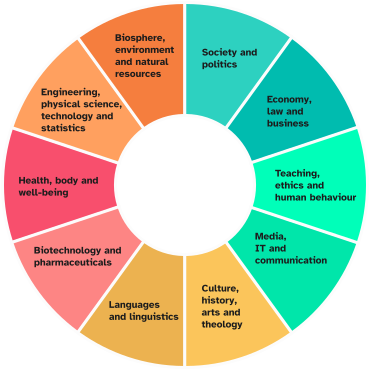
Students appreciate the University of Iceland for its strong academic reputation, modern campus facilities, close-knit community, and affordable tuition.Helpful content Study wheel
What interests you?
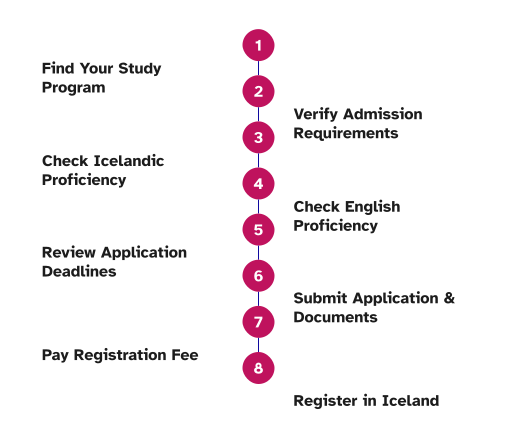
How to apply
Follow the path
Contact us If you still have questions, feel free to contact us.
Engineering and Natural SciencesWeekdays 9 am - 3:30 pmSchool of Engineering and Natural Sciences has facilities both in Tæknigarður and Askja.
Share