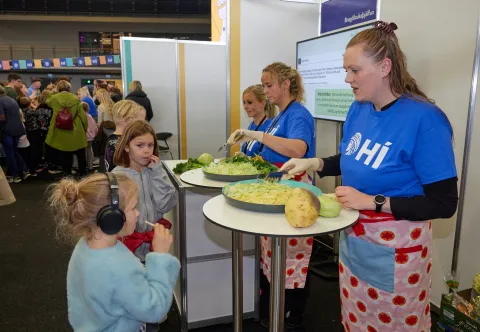
The initial findings of a doctoral study aimed at developing ways to reduce fussy eating in preschool children indicate that some of the children taking part in the study eat fewer than ten kinds of food. This is the first study of its kind in Iceland.
Berglind Lilja Guðlaugsdóttir, a PhD student at the School of Education, is working on the research under the supervision of Anna Sigríður Ólafsdóttir, professor of nutrition science at the same School. The study is based on the Taste Bud Training project, developed by Anna Sigríður in collaboration with Sigrún Þorsteinsdóttir, postdoctoral researcher at the School of Education. That project focused on developing family-centred techniques to tackle fussy eating in children aged 8-12 with and without neurodevelopmental disorders. “Our research is about fussy eating and eating habits in preschool children and using Taste Bud Training to prevent and/or reduce fussy eating, as well as influencing the food environment at home with the aim of increasing dietary variety, particularly the consumption of fruits and vegetables,” explains Berglind.
Berglind also helped with implementing the previous Taste Bud Training project. "That research yielded very positive results, reducing fussy eating, increasing dietary variety and improving challenging behaviour at meal times. That got me thinking about whether it would be possible to use the same methods for preschool-age children, which is the age range when fussy eating is at its peak,” says Berglind.
The early years have a huge impact on future health
Berglind points out that children with fussy eating frequently lack variety in their diets; in particular, they don’t eat enough fruits, vegetables and grains. “Fussy eating can also cause stress and anxiety for parents and children around meal times and parents and preschool staff often lack effective techniques to deal with the issue. Responding to fussy eating in the wrong way can make the problem worse,” says Berglind.
In addition to tackling fussy eating, she plans to investigate whether interventions such as Taste Bud Training can impact long-term childhood growth patterns. This research will be conducted in collaboration with primary healtcare clinics. "The early years of a child's life have a huge impact on future health and development and a varied and healthy diet is absolutely key. So this is a very important age,” argues Berglind, pointing out that there is a lack of research in this area, making it an exciting topic in an international scientific context.
Methods and learning material developed with preschool staff
Berglind has spent recent semesters carrying out her research in collaboration with four preschools both within and outside the capital area. Taste Bud Training became part of the daily routine for all age groups at these four preschools. “Children spend most of their day in preschool, so it was important to adapt the Taste Bud Training methods to the preschool environment,” explains Berglind, adding that the children’s families were also actively involved in the project and have a key role to play in changing food behaviours.