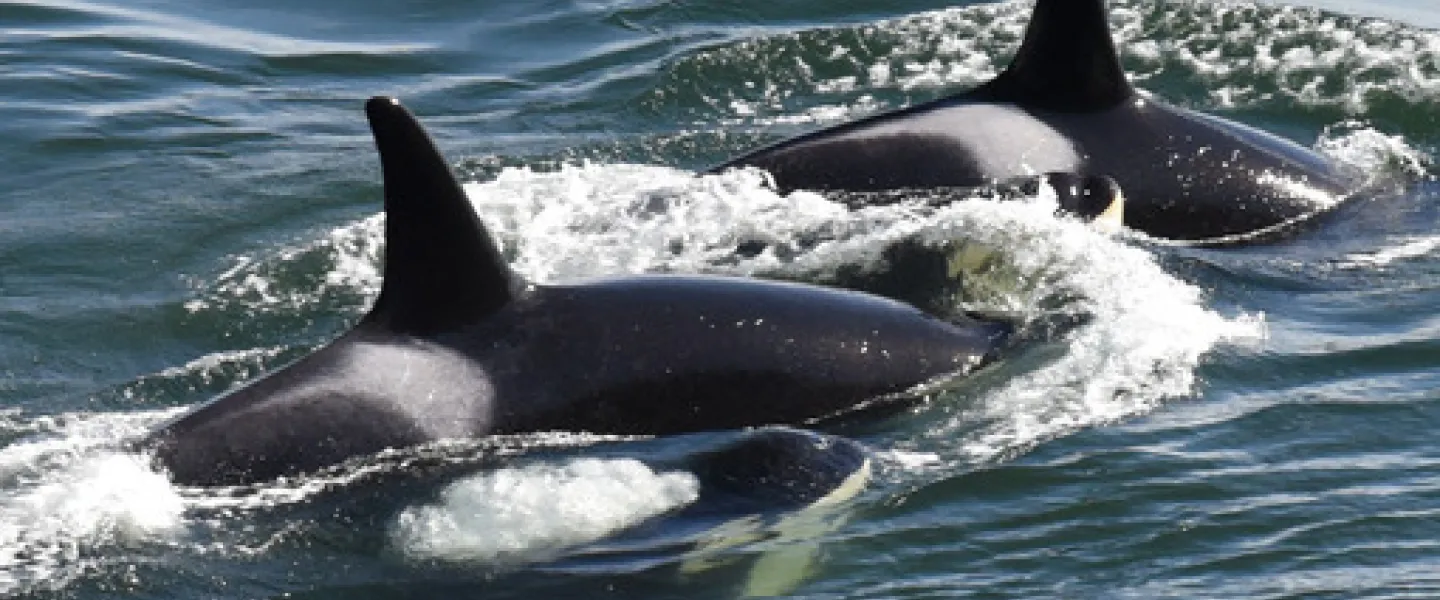
Killer whales in the sea

A team from the University of Iceland Research Centre in Húsavík, which observes biodiversity and the health of ecosystems in the waters north of Iceland, has confirmed that significant pollution caused by microplastics has been detected in the main feeding grounds of whales in the area. 

According to Belén García Ovidea, a doctoral student at the University of Iceland, this is the first time this kind of pollution has been measured and mapped in Icelandic waters – and the conclusions show that the pollution is much worse than expected. 

The team’s research is focused on the health of marine ecosystems and the impact of pollution on organisms, including whales, a key element in the ocean’s food chain. The team is also collecting data on the amount and distribution of microplastics on the ocean’s surface. 

The highest levels of microplastics measured by Grímsey

The team has observed microplastic pollution off North-East Iceland since 2019 and mapped its distribution in an area covering the seas around  Grimsey, Eyjafjörður and Skjálfandaflói. According to the scientists, the research showed that the highest levels of microplastics are measured in the most remote areas, for example, around Grímsey, an unexpected result. 

""

Whales likely to ingest large amounts of microplastics

Microplastics have, in a very short time, become one of the worst parts of plastic pollution in the ocean. When plastic breaks down into smaller particles, they can get into organisms, and they can form connections with various substances, including toxins that consequently are carried between species. 

Belén says that whales are especially sensitive in this context. “Whales sieve an enormous amount of seawater daily and are thus very likely to ingest both microplastics and the toxins tied to the particles.” 

According to her, such particles may accumulate in the digestive tract, disturb metabolism and impact the animals’ fertility – making the problem both biological and ecological. 

The first Icelandic database on microplastics in the ocean 

Because no comparable measurements have been made in the ocean around Iceland, the research team has developed the first Icelandic database on microplastic pollution on the ocean surface around Iceland. This work will provide the foundation for further research and provide a solid base for public action to protect the sea. 

Belén says that the situation is dire. “We need to react now. We have more than sufficient data.” 

Belén adds that the goal is to encourage the authorities to take real action against plastic pollution. She says that it is essential that Iceland and other Arctic countries implement more effective protective measures and set down a clear policy to protect the ocean. 

“My dream is that we will reach the international goal of protecting 30% of the sea before the year 2030,” she says. 

Belén’s supervisor in her doctoral project is Marianne Rasmussen, head of the University of Iceland Research Centre in Húsavík. 

Share

Tags
Did this help?

Why wasn't this information helpful

Limit to 250 characters.