David Reimer and Kolbrún Pálsdóttir

New research results from scholars at the University of Iceland indicate that children who were forced to leave their homes in Grindavík in November 2023 due to volcanic activity on the Reykjanes Peninsula evaluate their life satisfaction as lower than that of their peers around Iceland. They also experience a weaker connection with their schools. The results are based on data from the Icelandic Youth Survey, collected earlier this year, and will be presented at a conference at the University of Iceland on Tuesday, 18 November.

The town of Grindavík was evacuated due to volcanic activity on 10 November 2023. In an instant, the four thousand inhabitants, including a large number of children, were forced to find new homes. Very few have returned and uncertainty has affected the lives of families from Grindavík.

As part of the response to the natural disaster, the authorities established a temporary school in the capital area to ensure continued education for primary school children from Grindavík. In the spring of 2025, children from Grindavík were enrolled in at least 68 primary schools around the country.

An official committee, the Grindavík committee, has coordinated support for the people of Grindavík, providing psychosocial resources. Initial surveys on the adult population in Grindavís showed that the evacuees self-report worse mental health after the evacuation than before it. “We considered it important to systematically examine the the impact of this natural disaster on the well-being of children of Grindavík. We could do that by using excellet data from the Icelandic Youth Survey that allowed to identify whether children were evacuated from Grindavik,” says David Reimer, professor at the Schools of Education and Social Sciences, who is the leading author of this research on the children from Grindavík.

Scholars at the School of Education oversee the Icelandic Youth Survey. The survey is administered annually to all students in grades 6-10 in Icelandic primary schools. The goal is to gather data on the well-being and attitudes of children and youth to guide authorities in policy-making concerning this group. David points out that this is the first scientific study researching children in Grindavík. “International studies show that natural disasters can have an big impact on the well-being and life of children and that is why the response of the society and the surrounding environment is important.”
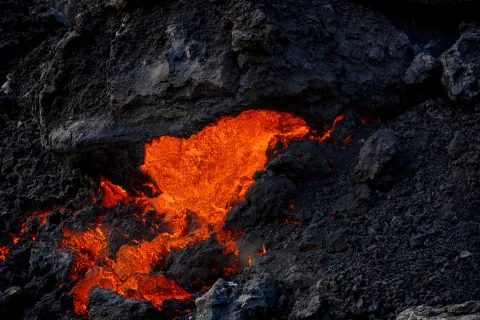
eldgos

The analyses show that:

  • Children who experienced forced relocation reported lower life satisfaction and school-belonging than their peers nationwide These symptoms could be traced to the forced evacuation.
  • This group also experienced more psychosomatic symptoms, such as, anxiety as well as head and stomach aches. They also reported a higher incidence of substance abuse than their peers. It is unclear whether this is caused by having to adapt to a new environment or by being forced to leave home suddenly.
  • The effects of the evacuation were independent of the children‘s evaluation of their self-reported families' social status, indicating that good social and economic standing are not protective factors concerning forced evacuation.
  • Girls from Grindavík evaluated their life happiness and social connections as worse than those of boys.

The researchers conclude that the evacuation had a profound and lasting impact on the town‘s children. The study underlines the importance of prioritising children‘s interests in reacting to natural disasters, and their well-being needs to be monitored for an extended period. The results also support the integration of services for children within municipalities, as well as ensuring that parents, children, and staff have access to counselling and support.

An article on the conclusions will be published soon.

“The study shows how powerful this experience was for children and youth and encourages grown-ups in their environment to be alert and thoughtful of their social and mental well-being,” says Kolbrún Þ. Pálsdóttir, Professor and Dean of the School of Education who is a member of the study team.

Kolbrún also points out that even though the study shows that the impact of the evacuation can still be found in the children’s outcomes, it must be kept in mind that children and youth who experience adversity can mature quickly and find ways to deal with challenges, thus acquiring skills that can prepare them for future life. “There are many things we do not know and require further study, for example, what the children of Grindavík consider to be the most helpful factors in the support they and their families have received, what opportunities they have gotten and what their expectations are for the future. “

The study will be presented at the conference on the Icelandic Youth survey in Veröld on Tuesday, 18 November, 2-4 PM. The conference is open to all and will also be streamed.

Further information on support for children from Grindavík:

A special team provides counselling and psychosocial support to people from Grindavík, overseeing services such as interviews with psychologists, trauma relief, and family counselling. The services can be obtained online on island.is/v/fyrir-grindavik, by e-mail radgjof@grn.is or on the phone number: 545 0200.

Share

Tags
Did this help?

Why wasn't this information helpful

Limit to 250 characters.