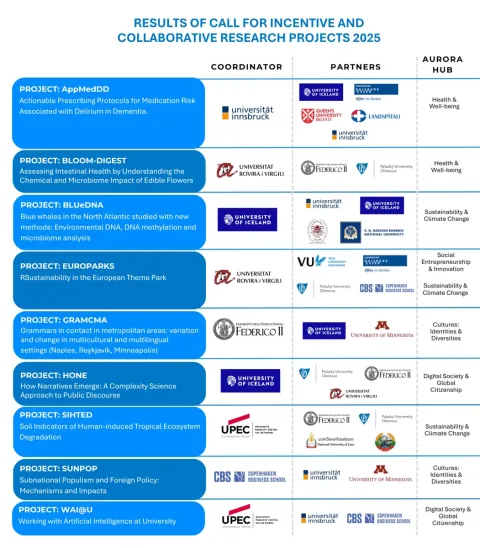
Academic staff and researchers from the University of Iceland (UI) are involved in four of the nine collaborative research projects within the Aurora Universities network that have recently been selected to receive funding for Incentive Research Collaboration. In addition, UI academic staff are leading one of the Thematic Schools that received funding in the same round. This is the second time the Aurora network has allocated these grants, following the first allocation last year.
The fundings aim to foster increased research collaboration among researchers across the Aurora Universities. Applications for collaborative research funding were sought in early 2025, with an emphasis on strengthening cooperation among both Early Career Researchers and experienced academics. Applications were assessed based on quality, originality, and feasibility, as well as whether the projects would contribute to the potential establishment of new research groups and Educational Hubs within Aurora. A total of 29 outstanding applications were received from all Aurora Universities, involving over a hundred academics from diverse disciplines. Nine collaborative research projects were selected, each receiving an average of €14,000 in funding, equivalent to approximately two million Icelandic Krona.
Icelandic academics prominent in incentive and collaborative research projects
As noted, four of the funded projects are linked to research at the University of Iceland, with Icelandic academics leading two of them.
Dr Freyja Jónsdóttir, an Associate Professor at the Faculty of Pharmaceutical Sciences, is participating in the research collaboration AppMedDD, alongside researchers from the University of Duisburg-Essen (Germany), Queen's University Belfast (Northern Ireland), and the University of Innsbruck (Austria), which leads the project. Dr Aðalsteinn Guðmundsson from Landspítali, University Hospital of Iceland, is also involved. The project falls within the Health and Well-being domain of Aurora, focusing on developing actionable prescribing protocols for medication risk associated with delirium in dementia.
Dr Marianne Rasmussen, Director of the UI Research Centre in Húsavík, leads the research collaboration BLUeDNA, utilising new methods to study blue whales in the North Atlantic which is under the Sustainability and Climate Change domain. Joining her in the project is Maria Refsgaard Iversen, who has conducted research at the University of Iceland, as well as researchers from the University of Innsbruck (Austria), the National Academy of Sciences of Ukraine, and Karazin Kharkiv National University in Ukraine.
Professor Þórhallur Eyþórsson from the Faculty of Languages and Cultures, is participating in the research collaboration GRAMCMA on the effects of multilingualism on urban grammar under the Cultures, Identities, and Diversities domain. The University of Naples Federico II (Italy) leads the collaboration, which also involves the University of Minnesota (USA).
Dr Elena Gallegari, a Postdoctoral Researcher in the School of Humanities, leads the research collaboration HONE, focusing on how narratives emerge in public discourse via a complexity science approach. This project also falls under Cultures, Identities, and Diversities domain. Researchers from Palacký University Olomouc (Czech Republic), the University of Naples Federico II (Italy), and Universitat Rovira i Virgili (Spain) are also part of the collaboration.
All nine funded projects can be reviewed on the Aurora website.