""
Language skills
required, minimum level of B2
Programme length
One and a half year.
Study mode
Face-to-face learning
Application status
International students:
Students with Icelandic or Nordic citizenship:
Overview

  • Do you have a background in business administration or economics?
  • Would you like a programme you can tailor to suit your interests?
  • Are you interested in acquiring a broad base of knowledge?

This programme is designed for students who have completed a BS in business administration or economics and want to pursue graduate studies in a chosen area of business administration.

An MS programme is at least 90 ECTS: 60 ECTS in courses and a thesis worth at least 30 ECTS.

Programme structure

The programme is 90 ECTS and is organised as one and a half years of full-time study. 

The programme is made up of:

  • Courses, 60 ECTS
  • Final project, at least 30 ECTS

Course topics include:

Students build close links with the business world through:

  • Guest lecturers
  • Visits
  • Sessional lecturers
  • Student organisations
  • Course assignments
  • Final projects are often completed in collaboration with businesses or institutions.

Organisation of teaching

Courses are taught in blocks of seven weeks. Two courses are taught during each block. Final exams are held in the eighth week.

Students can tailor the programme to suit their interests by choosing between a wide range of elective courses at the Faculty. There are only two mandatory courses on this programme; all others are electives.

This programme is taught in Icelandic but most textbooks are in English.

Main objectives

The programme aims to thoroughly prepare students for future careers. After completing the programme, students will be able to demonstrate knowledge of business administration and the ability to apply theoretical methods and draw conclusions from their findings.

Other

Completing the programme allows you to apply for doctoral studies.

are a BA, BS, or cand.oecon. degree in business administration, economics, or comparable. Applicants holding university degrees in other fields are considered to fulfil the requirements if they have completed a 60ECTS minor in business administration or economics. As a general rule, applicants shall have completed their undergraduate studies with a first-class GPA (7.25 or above).

90 ECTS credits have to be completed for the qualification including a thesis of 30 ECTS credits.

The following documents must accompany an application for this programme:
  • CV
  • Statement of purpose
  • Reference 1, Name and email
  • Reference 2, Name and email
  • Certified copies of diplomas and transcripts
  • Proof of English proficiency

Further information on supporting documents can be found here

Programme structure

Check below to see how the programme is structured.

This programme does not offer specialisations.

First year | Fall
Corporate and investment valuation (VIÐ187F)
Restricted elective course, conditions apply
7,5 ECTS, credits
Course Description

Valuation of companies and investment appraisal. The course covers the content of financial statements and their analysis in relation to business valuation and investment assessment. Various valuation methods suitable for different types of firms are reviewed, including operating companies, real estate companies, banks, insurance companies, and others.

Language of instruction: Icelandic
Face-to-face learning
Course taught in period II
First year | Fall
Applied Statistics (VIÐ1ADF)
A mandatory (required) course for the programme
7,5 ECTS, credits
Course Description

The goal of this course is to strengthen the statistics and methodology knowledge of the students to enable them to better understand research methods and research findings. State-of-the-art research will be reviewed and the statistics and methodology required to conduct this research will be discussed. Students will also conduct their own research project in preparation for analytical work in their professional life and their Master’s thesis.

Language of instruction: Icelandic
Face-to-face learning
Course taught in period II
First year | Fall
Business Ethics (VIÐ191F)
A mandatory (required) course for the programme
7,5 ECTS, credits
Course Description

The course addresses ethical challenges in business operations and how they manifest within companies and in their interactions with stakeholders, public authorities, and society at large. Emphasis is placed on students analysing, applying, evaluating, arguing for, and developing ethical solutions to real business issues based on theories in business ethics.
Teaching materials and assignments are based on realistic case studies, academic texts, and collaboration with industry partners. Students work systematically on identifying ethical dilemmas, applying theoretical approaches, evaluating different corporate responses, justifying their own ethical positions, and formulating practical proposals for processes and/or policies within complex societal contexts.
The course also emphasises that students develop a conscious and responsible attitude toward their own role as professionals and managers, in line with the University of Iceland’s values of social responsibility, equality, sustainability, and innovation, guided by sound ethical principles.
Students choose the course scope based on ECTS credits. The course may be taken as 7.5 ECTS, 6 ECTS (students from Philosophy), 3 ECTS, or 1.5 ECTS.
Please note that the course is taught in the first teaching block of the autumn semester, according to the block structure of the Master’s programme at the School of Business.

Language of instruction: Icelandic
Face-to-face learning
Course taught in period I
First year | Spring 1
Strategic Management (VIÐ265F)
Restricted elective course, conditions apply
7,5 ECTS, credits
Course Description

The course is designed, through lectures and discussion of the course material, to enable students to acquire knowledge of strategy and strategic management based on the diverse theoretical foundations that exist within the field. Through work with case studies and Icelandic real‑world examples, students are systematically encouraged to develop their skills and competencies in this area.

The course examines strategic management from several perspectives and across different types of organizations. Considerable attention is given to situational analysis and the assessment of both the external and internal environment, the formulation of strategy, and the practical implementation and progression of strategic work. The course delves into strategy from viewpoints including innovation, mergers, collaboration, power, and stakeholder interests.

The teaching approach reflects the understanding that learning is a process aimed at improving competence, where course content, context, and learning progression interact. All activities in the course are designed to support students in achieving the best possible learning outcomes — although success naturally depends on the student’s engagement and consistent effort.

Language of instruction: Icelandic
Face-to-face learning
Course taught in period III
First year | Spring 1
Qualitative research methods (VIÐ2A4F)
A mandatory (required) course for the programme
7,5 ECTS, credits
Course Description

The goal of the course is to give students insight into qualitative research methods, and their use in gathering and analysing data on the individual and organizational level. Students will be trained in defining a research problems and presenting them in a research question. Students will further plan and execute data gathering and analysing, as well as presenting the findings in a written report. Students will learn about the strengths and weaknesses of qualitative research so as to be able to choose the best method to study a given problem.

Language of instruction: Icelandic
Face-to-face learning
Prerequisites
Course taught in period III
Second year | Fall
MS Thesis (VIÐ431L)
A mandatory (required) course for the programme
0 ECTS, credits
Course Description

The topic of the master's thesis must be chosen after consulting the thesis advisor(s), who must be full-time faculty at the School of Business.

The thesis amounts to 30 credits and must be presented at a departmental seminar.

The thesis must be submitted online no later than the specified dates that are announced before each graduation. Grades for a master's thesis are awarded by the thesis advisor(s) and an outside reader.

Language of instruction: Icelandic
Self-study
Part of the total project/thesis credits
Second year | Spring 1
MS Thesis (VIÐ431L)
A mandatory (required) course for the programme
0 ECTS, credits
Course Description

The topic of the master's thesis must be chosen after consulting the thesis advisor(s), who must be full-time faculty at the School of Business.

The thesis amounts to 30 credits and must be presented at a departmental seminar.

The thesis must be submitted online no later than the specified dates that are announced before each graduation. Grades for a master's thesis are awarded by the thesis advisor(s) and an outside reader.

Language of instruction: Icelandic
Self-study
Part of the total project/thesis credits
Second year | Summer
MS Thesis (VIÐ431L)
A mandatory (required) course for the programme
0 ECTS, credits
Course Description

The topic of the master's thesis must be chosen after consulting the thesis advisor(s), who must be full-time faculty at the School of Business.

The thesis amounts to 30 credits and must be presented at a departmental seminar.

The thesis must be submitted online no later than the specified dates that are announced before each graduation. Grades for a master's thesis are awarded by the thesis advisor(s) and an outside reader.

Language of instruction: Icelandic
Self-study
Part of the total project/thesis credits
First year
  • Fall
  • VIÐ187F
    Corporate and investment valuation
    Restricted elective course
    7,5
    Restricted elective course, conditions apply
    7,5 ECTS, credits
    Course Description

    Valuation of companies and investment appraisal. The course covers the content of financial statements and their analysis in relation to business valuation and investment assessment. Various valuation methods suitable for different types of firms are reviewed, including operating companies, real estate companies, banks, insurance companies, and others.

    Face-to-face learning
    Prerequisites
    Course taught in period II
  • VIÐ1ADF
    Applied Statistics
    Mandatory (required) course
    7,5
    A mandatory (required) course for the programme
    7,5 ECTS, credits
    Course Description

    The goal of this course is to strengthen the statistics and methodology knowledge of the students to enable them to better understand research methods and research findings. State-of-the-art research will be reviewed and the statistics and methodology required to conduct this research will be discussed. Students will also conduct their own research project in preparation for analytical work in their professional life and their Master’s thesis.

    Face-to-face learning
    Prerequisites
    Course taught in period II
  • VIÐ191F
    Business Ethics
    Mandatory (required) course
    7,5
    A mandatory (required) course for the programme
    7,5 ECTS, credits
    Course Description

    The course addresses ethical challenges in business operations and how they manifest within companies and in their interactions with stakeholders, public authorities, and society at large. Emphasis is placed on students analysing, applying, evaluating, arguing for, and developing ethical solutions to real business issues based on theories in business ethics.
    Teaching materials and assignments are based on realistic case studies, academic texts, and collaboration with industry partners. Students work systematically on identifying ethical dilemmas, applying theoretical approaches, evaluating different corporate responses, justifying their own ethical positions, and formulating practical proposals for processes and/or policies within complex societal contexts.
    The course also emphasises that students develop a conscious and responsible attitude toward their own role as professionals and managers, in line with the University of Iceland’s values of social responsibility, equality, sustainability, and innovation, guided by sound ethical principles.
    Students choose the course scope based on ECTS credits. The course may be taken as 7.5 ECTS, 6 ECTS (students from Philosophy), 3 ECTS, or 1.5 ECTS.
    Please note that the course is taught in the first teaching block of the autumn semester, according to the block structure of the Master’s programme at the School of Business.

    Face-to-face learning
    Prerequisites
    Course taught in period I
  • Spring 2
  • VIÐ265F
    Strategic Management
    Restricted elective course
    7,5
    Restricted elective course, conditions apply
    7,5 ECTS, credits
    Course Description

    The course is designed, through lectures and discussion of the course material, to enable students to acquire knowledge of strategy and strategic management based on the diverse theoretical foundations that exist within the field. Through work with case studies and Icelandic real‑world examples, students are systematically encouraged to develop their skills and competencies in this area.

    The course examines strategic management from several perspectives and across different types of organizations. Considerable attention is given to situational analysis and the assessment of both the external and internal environment, the formulation of strategy, and the practical implementation and progression of strategic work. The course delves into strategy from viewpoints including innovation, mergers, collaboration, power, and stakeholder interests.

    The teaching approach reflects the understanding that learning is a process aimed at improving competence, where course content, context, and learning progression interact. All activities in the course are designed to support students in achieving the best possible learning outcomes — although success naturally depends on the student’s engagement and consistent effort.

    Face-to-face learning
    Prerequisites
    Course taught in period III
  • VIÐ2A4F
    Qualitative research methods
    Mandatory (required) course
    7,5
    A mandatory (required) course for the programme
    7,5 ECTS, credits
    Course Description

    The goal of the course is to give students insight into qualitative research methods, and their use in gathering and analysing data on the individual and organizational level. Students will be trained in defining a research problems and presenting them in a research question. Students will further plan and execute data gathering and analysing, as well as presenting the findings in a written report. Students will learn about the strengths and weaknesses of qualitative research so as to be able to choose the best method to study a given problem.

    Face-to-face learning
    Prerequisites
    Course taught in period III
  • Fall
  • VIÐ431L
    MS Thesis
    Mandatory (required) course
    0
    A mandatory (required) course for the programme
    0 ECTS, credits
    Course Description

    The topic of the master's thesis must be chosen after consulting the thesis advisor(s), who must be full-time faculty at the School of Business.

    The thesis amounts to 30 credits and must be presented at a departmental seminar.

    The thesis must be submitted online no later than the specified dates that are announced before each graduation. Grades for a master's thesis are awarded by the thesis advisor(s) and an outside reader.

    Self-study
    Prerequisites
    Part of the total project/thesis credits
  • Spring 2
  • VIÐ431L
    MS Thesis
    Mandatory (required) course
    0
    A mandatory (required) course for the programme
    0 ECTS, credits
    Course Description

    The topic of the master's thesis must be chosen after consulting the thesis advisor(s), who must be full-time faculty at the School of Business.

    The thesis amounts to 30 credits and must be presented at a departmental seminar.

    The thesis must be submitted online no later than the specified dates that are announced before each graduation. Grades for a master's thesis are awarded by the thesis advisor(s) and an outside reader.

    Self-study
    Prerequisites
    Part of the total project/thesis credits
  • Summer
  • VIÐ431L
    MS Thesis
    Mandatory (required) course
    0
    A mandatory (required) course for the programme
    0 ECTS, credits
    Course Description

    The topic of the master's thesis must be chosen after consulting the thesis advisor(s), who must be full-time faculty at the School of Business.

    The thesis amounts to 30 credits and must be presented at a departmental seminar.

    The thesis must be submitted online no later than the specified dates that are announced before each graduation. Grades for a master's thesis are awarded by the thesis advisor(s) and an outside reader.

    Self-study
    Prerequisites
    Part of the total project/thesis credits
Second year
  • Fall
  • VIÐ187F
    Corporate and investment valuation
    Restricted elective course
    7,5
    Restricted elective course, conditions apply
    7,5 ECTS, credits
    Course Description

    Valuation of companies and investment appraisal. The course covers the content of financial statements and their analysis in relation to business valuation and investment assessment. Various valuation methods suitable for different types of firms are reviewed, including operating companies, real estate companies, banks, insurance companies, and others.

    Face-to-face learning
    Prerequisites
    Course taught in period II
  • VIÐ1ADF
    Applied Statistics
    Mandatory (required) course
    7,5
    A mandatory (required) course for the programme
    7,5 ECTS, credits
    Course Description

    The goal of this course is to strengthen the statistics and methodology knowledge of the students to enable them to better understand research methods and research findings. State-of-the-art research will be reviewed and the statistics and methodology required to conduct this research will be discussed. Students will also conduct their own research project in preparation for analytical work in their professional life and their Master’s thesis.

    Face-to-face learning
    Prerequisites
    Course taught in period II
  • VIÐ191F
    Business Ethics
    Mandatory (required) course
    7,5
    A mandatory (required) course for the programme
    7,5 ECTS, credits
    Course Description

    The course addresses ethical challenges in business operations and how they manifest within companies and in their interactions with stakeholders, public authorities, and society at large. Emphasis is placed on students analysing, applying, evaluating, arguing for, and developing ethical solutions to real business issues based on theories in business ethics.
    Teaching materials and assignments are based on realistic case studies, academic texts, and collaboration with industry partners. Students work systematically on identifying ethical dilemmas, applying theoretical approaches, evaluating different corporate responses, justifying their own ethical positions, and formulating practical proposals for processes and/or policies within complex societal contexts.
    The course also emphasises that students develop a conscious and responsible attitude toward their own role as professionals and managers, in line with the University of Iceland’s values of social responsibility, equality, sustainability, and innovation, guided by sound ethical principles.
    Students choose the course scope based on ECTS credits. The course may be taken as 7.5 ECTS, 6 ECTS (students from Philosophy), 3 ECTS, or 1.5 ECTS.
    Please note that the course is taught in the first teaching block of the autumn semester, according to the block structure of the Master’s programme at the School of Business.

    Face-to-face learning
    Prerequisites
    Course taught in period I
  • Spring 2
  • VIÐ265F
    Strategic Management
    Restricted elective course
    7,5
    Restricted elective course, conditions apply
    7,5 ECTS, credits
    Course Description

    The course is designed, through lectures and discussion of the course material, to enable students to acquire knowledge of strategy and strategic management based on the diverse theoretical foundations that exist within the field. Through work with case studies and Icelandic real‑world examples, students are systematically encouraged to develop their skills and competencies in this area.

    The course examines strategic management from several perspectives and across different types of organizations. Considerable attention is given to situational analysis and the assessment of both the external and internal environment, the formulation of strategy, and the practical implementation and progression of strategic work. The course delves into strategy from viewpoints including innovation, mergers, collaboration, power, and stakeholder interests.

    The teaching approach reflects the understanding that learning is a process aimed at improving competence, where course content, context, and learning progression interact. All activities in the course are designed to support students in achieving the best possible learning outcomes — although success naturally depends on the student’s engagement and consistent effort.

    Face-to-face learning
    Prerequisites
    Course taught in period III
  • VIÐ2A4F
    Qualitative research methods
    Mandatory (required) course
    7,5
    A mandatory (required) course for the programme
    7,5 ECTS, credits
    Course Description

    The goal of the course is to give students insight into qualitative research methods, and their use in gathering and analysing data on the individual and organizational level. Students will be trained in defining a research problems and presenting them in a research question. Students will further plan and execute data gathering and analysing, as well as presenting the findings in a written report. Students will learn about the strengths and weaknesses of qualitative research so as to be able to choose the best method to study a given problem.

    Face-to-face learning
    Prerequisites
    Course taught in period III
  • Fall
  • VIÐ431L
    MS Thesis
    Mandatory (required) course
    0
    A mandatory (required) course for the programme
    0 ECTS, credits
    Course Description

    The topic of the master's thesis must be chosen after consulting the thesis advisor(s), who must be full-time faculty at the School of Business.

    The thesis amounts to 30 credits and must be presented at a departmental seminar.

    The thesis must be submitted online no later than the specified dates that are announced before each graduation. Grades for a master's thesis are awarded by the thesis advisor(s) and an outside reader.

    Self-study
    Prerequisites
    Part of the total project/thesis credits
  • Spring 2
  • VIÐ431L
    MS Thesis
    Mandatory (required) course
    0
    A mandatory (required) course for the programme
    0 ECTS, credits
    Course Description

    The topic of the master's thesis must be chosen after consulting the thesis advisor(s), who must be full-time faculty at the School of Business.

    The thesis amounts to 30 credits and must be presented at a departmental seminar.

    The thesis must be submitted online no later than the specified dates that are announced before each graduation. Grades for a master's thesis are awarded by the thesis advisor(s) and an outside reader.

    Self-study
    Prerequisites
    Part of the total project/thesis credits
  • Summer
  • VIÐ431L
    MS Thesis
    Mandatory (required) course
    0
    A mandatory (required) course for the programme
    0 ECTS, credits
    Course Description

    The topic of the master's thesis must be chosen after consulting the thesis advisor(s), who must be full-time faculty at the School of Business.

    The thesis amounts to 30 credits and must be presented at a departmental seminar.

    The thesis must be submitted online no later than the specified dates that are announced before each graduation. Grades for a master's thesis are awarded by the thesis advisor(s) and an outside reader.

    Self-study
    Prerequisites
    Part of the total project/thesis credits

The timetable shown below is for the current academic year and is FOR REFERENCE ONLY.

Changes may occur for the autumn semester in August and September and for the spring semester in December and January. You will find your final timetable in Ugla when the studies start.

Note! This timetable is not suitable for planning your work schedule if you are a part-time employee.


Additional information

The University of Iceland collaborates with over 400 universities worldwide. This provides a unique opportunity to pursue part of your studies at an international university thus gaining added experience and fresh insight into your field of study.

Students generally have the opportunity to join an exchange programme, internship, or summer courses. However, exchanges are always subject to faculty approval.

Students have the opportunity to have courses evaluated as part of their studies at the University of Iceland, so their stay does not have to affect the duration of their studies.

After completing the programme, students will be familiar with Icelandic and international business practices and in a strong position to apply for specialist jobs in the private or public sector, either in Iceland or abroad.

For example, graduates may work in:

  • Leadership
  • Management
  • Finance

This list is not exhaustive

  • MAESTRO is the organisation for Master's students at the University of Iceland Faculty of Business Administration and Faculty of Economics.
  • The role and purpose of MAESTRO is to advocate for members' interests and make their time at UI more enjoyable and productive. MAESTRO provides students with useful information, maintains a good working relationship with the University and faculties, as well as encouraging students to socialise together and build connections.
  • MAESTRO page on Facebook

More about the UI student's social life.

Student´s comments
""
Students appreciate the University of Iceland for its strong academic reputation, modern campus facilities, close-knit community, and affordable tuition.
Helpful content
Aurora Cooperation

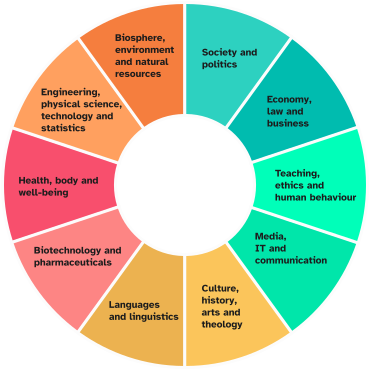
Study wheel

What interests you?

Aurora Cooperation

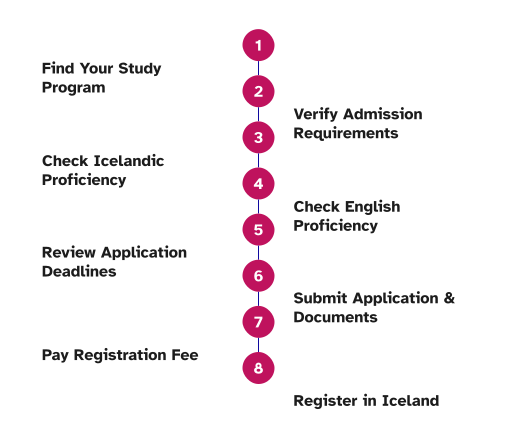
How to apply

Follow the path

Contact us

If you still have questions, feel free to contact us.

School of Social Sciences
Weekdays 9 am - 3 pm
Student and Teaching Service

The School office offers support to students and lecturers, providing guidance, counselling, and assistance with various matters. 

You are welcome to drop by at the office in Gimli or you can book an online meeting in Teams with the staff.

1920_KRI_gimli_200828_001.jpg

Share

Did this help?

Why wasn't this information helpful

Limit to 250 characters.