
Main building
Language skills
required, minimum level of B2
Programme length
One and a half year.
Study mode
Face-to-face learning
Application status
International students:
Students with Icelandic or Nordic citizenship:
Overview

  • Do you believe it is important that people experience their place of work as a positive environment?
  • Do you agree that employees are an essential resource for the running of a business?
  • Would you like to work in human resources?
  • Would you like to learn more about how businesses and institutions are run?
  • Do you want to develop your professional and personal skills in the area of human resources?

Every organisation relies on human resources to implement policy and ensure successful operations, quality services and customer loyalty.

This programme aims to combine practical and theoretical approaches in order to provide students with a more in-depth understanding of human resource management.

Programme structure

The programme is made up of:

  • Courses, 60 ECTS
  • Final project, 30 ECTS

Course topics include:

  • Employment relations
  • Work psychology
  • Human resource development
  • Labour law
  • International human resource management

Organisation of teaching

Students are expected to work independently from the start of the programme, to manage their own work and time and meet all set deadlines.

The programme is taught in 7-week blocks, which means there are two blocks per semester or four per year. This allows students to explore each topic in greater depth.

This programme is taught in Icelandic but most textbooks are in English.

Main objectives

After completing the programme, students will be equipped to handle demanding and complex work in the area of employment and human resources, in the public, private and non-profit sectors.

Other

Completing the programme allows you to apply for doctoral studies.

The requirements for admission are a BA, B.Ed or BS degree from university. As a general rule, applicants shall have completed their undergraduate studies with a first-class GPA (7.25 or above). Students are admitted to the programme based on their previous studies and work experience. Students who have not completed at least 36 ECTS in business administration or related field in their undergraduate studies shall, at the beginning of their studies, complete the preparatory course, VIÐ155M Introduction to Microeconomics and Corporate Finance, the course does not count towards degree. Of the 36 ECTS no less than 24 ECTS shall be in the following subjects or comparable: Finance, Introduction to Financial Accounting, Microeconomics, Methodology, Introduction to Human Resource Management, Introduction to Management, Introduction to Project Management, Computer Use and Spreadsheet, Business Law.

90 ECTS credits have to be completed for the qualification including a thesis of 30 ECTS credits.

The following documents must accompany an application for this programme:
  • CV
  • Statement of purpose
  • Reference 1, Name and email
  • Reference 2, Name and email
  • Certified copies of diplomas and transcripts
  • Proof of English proficiency

Further information on supporting documents can be found here

Programme structure

Check below to see how the programme is structured.

This programme does not offer specialisations.

First year | Fall
Leadership and Communication (VIÐ182F)
Restricted elective course, conditions apply
7,5 ECTS, credits
Course Description

In the foreground throughout the course is the role of the manager, at all levels of the hierarchy, its nature and its challenges. Human resource issues and communication are the focus area and connected to all of the course topics and assignments. The leadership role of the manager is examined; particularly in relation to general human resource management and the management of employees through reform projects and radical changes. Leadership is also examined in relation to successful teamwork and approaches to managing and solving conflicts and challenging human resource issues.

The main objective of the course is that the students gain knowledge of the meaning of the key concepts and a solid understanding of the theoretical principles, methods, and options that the manager can employ in order to successfully fulfil his/her role. Diverse teaching methods are used to encourage the interest, interaction, and participation of students.

Language of instruction: Icelandic
Face-to-face learning
Prerequisites
Course taught in period I
First year | Fall
Applied Statistics (VIÐ1ADF)
Restricted elective course, conditions apply
7,5 ECTS, credits
Course Description

The goal of this course is to strengthen the statistics and methodology knowledge of the students to enable them to better understand research methods and research findings. State-of-the-art research will be reviewed and the statistics and methodology required to conduct this research will be discussed. Students will also conduct their own research project in preparation for analytical work in their professional life and their Master’s thesis.

Language of instruction: Icelandic
Face-to-face learning
Course taught in period II
First year | Fall
Employee development and performance (VIÐ1ABF)
A mandatory (required) course for the programme
7,5 ECTS, credits
Course Description

The course focuses on performance management and the systematic development of diverse human resources as integrated aspects of people management and organizational performance. Emphasis is placed on the design, implementation and development of performance management systems as well as how regular and constructive feedback, encouragement, learning theories and professional development support the competence development, participation and productivity of employees. Training and career development programs, the relationship between performance appraisal and learning and development, and how managers can use performance data to support informed decision-making are discussed. Professional and responsible responses to performance problems are also addressed, including improvement plans, difficult conversations and professional interviews, as well as ethical and legal issues related to dismissals and retirement. The course also examines the impact of performance management, layoffs, and retirement on workplace culture and morale, and ways to reduce the negative impact of such processes in organizations.

Language of instruction: Icelandic
Face-to-face learning
Course taught in period II
First year | Fall
Introduction to Microeconomics and Corporate Finance (VIÐ155M)
A mandatory (required) course for the programme
6 ECTS, credits
Course Description

This course provides an introduction at a master's level to the theory and practice of bussines. The aim is to prepare students for a variety of management tasks, both in the private and public sectors.

The course consists of five introductory modules:
Finance
Business law
Accounting
Macro economics
Micro economics 

Organisation

The course is offered twice a year, in August and in January and students should complete the course in the first year of their master studies. Students who start the programme in the autumn should sit the course in August, but can postpone doing so until January. Those beginning in January should preferably take the course in January, but may postpone doing so until August.

The course opens on the 1st of each month and closes on the 31st. All course material will be available on the course website on Canvas on the 1st.

The course cannot be used for credits in the master's programmes.

Language of instruction: Icelandic
Online learning
Prerequisites
First year | Fall
Strategic Human Resource Management (VIÐ1AAF)
A mandatory (required) course for the programme
7,5 ECTS, credits
Course Description

The course focuses on human resource management as a strategic aspect of organizational operations. Emphasis is placed on how human resource planning is integrated into the overall strategy and goals of companies and institutions to support performance and competitiveness. Students work with talent management, metrics, and analytics to assess the impact of human resource management and support informed decision-making. On the basis of this knowledge, the focus is on international human resource management, where the adaptation of policies, procedures and human resources decisions in a multinational and culturally diverse and ever-changing work environment is discussed.

Language of instruction: Icelandic
Face-to-face learning
Course taught in period I
First year | Spring 1
Change Management and Strategy Execution (VIÐ2A5F)
Restricted elective course, conditions apply
7,5 ECTS, credits
Course Description

In this course, the main aspects of change management are covered, including the implementation of change, employee responses, the main barriers to change, and the restraining and driving forces at work in the change process. The course explores in depth the theories and methods on which change management is based, and discusses the most common solutions and approaches used in managing change. The roles of leaders, managers in general, and middle managers in change and crisis management will be examined. The course also addresses organizational culture and why it is an important factor in the change process. The course examines change management as a key element of strategic management and corporate governance. Emphasis is placed on the principal theories, models, and methods of change management, and on how they relate to strategy formulation, implementation, and follow-up within organizations. Students develop the ability to analyze and evaluate change processes in light of organizational design, execution, and human factors, including employee responses, organizational culture, and the driving and restraining forces that influence the success of change. Particular emphasis is placed on the role of leaders, managers, and boards of directors, and on their responsibility for strategic leadership, good corporate governance, and the credible implementation of change. In the course, students work with real-world examples and case studies, applying recognized change-management tools to translate strategic decisions into practical actions and organizational change. The course also covers crisis management and how to respond to unexpected shocks in a strategic and structured manner. Teaching is based on lectures, discussions, individual and group assignments, and aims to support critical thinking, practical skills, and independent analysis. The course requires active student participation and connects academic concepts to real-world challenges in managing change, with the goal of developing a coherent and practical approach to change management in a complex, constantly evolving operating environment.

Language of instruction: Icelandic
Face-to-face learning
Course taught in period IV
First year | Spring 1
Qualitative research methods (VIÐ2A4F)
Restricted elective course, conditions apply
7,5 ECTS, credits
Course Description

The goal of the course is to give students insight into qualitative research methods, and their use in gathering and analysing data on the individual and organizational level. Students will be trained in defining a research problems and presenting them in a research question. Students will further plan and execute data gathering and analysing, as well as presenting the findings in a written report. Students will learn about the strengths and weaknesses of qualitative research so as to be able to choose the best method to study a given problem.

Language of instruction: Icelandic
Face-to-face learning
Prerequisites
Course taught in period III
First year | Spring 1
Law and labour Market relations. (VIÐ2A0F)
A mandatory (required) course for the programme
7,5 ECTS, credits
Course Description

The course deals with relations between the social partners and the legal framework of the labour relationship, with a special emphasis on the Icelandic labour market. The aim of the course is to provide students with comprehensive theoretical and practical knowledge of labour market studies and labour law. The institutional structure of the labour market, the role and relations of the state, employers and unions, collective agreements, labour disputes and the right to strike are discussed. Furthermore, the rights and obligations of the parties to an employment relationship are reviewed, including employment relationship, wages, working hours, vacation, sick leave, equality, bullying and termination of the employment relationship. Emphasis is placed on students being able to analyze realistic cases, apply theoretical and legal knowledge, and make informed decisions in a professional context.

Language of instruction: Icelandic
Face-to-face learning
Course taught in period III
First year | Spring 1
Introduction to Microeconomics and Corporate Finance (VIÐ155M)
A mandatory (required) course for the programme
6 ECTS, credits
Course Description

This course provides an introduction at a master's level to the theory and practice of bussines. The aim is to prepare students for a variety of management tasks, both in the private and public sectors.

The course consists of five introductory modules:
Finance
Business law
Accounting
Macro economics
Micro economics 

Organisation

The course is offered twice a year, in August and in January and students should complete the coure in the first year of their master studies. Students that start the programme in the autumn should sit the course in August, but can postpone doing so until January. Those beginning in January should preferably take the course in January, but may postpone doing so until August.

The course opens on the 1st of each month and closes on the 31st. All course material will be available on the course website on Canvas on the 1st.

The course cannot be used for credits in the master's programmes.

Language of instruction: Icelandic
Online learning
Prerequisites
First year | Spring 1
Work psychology, recruitment and digital technology (VIÐ2A1F)
A mandatory (required) course for the programme
7,5 ECTS, credits
Course Description

The course covers the basic principles of occupational psychology in recruitment and career selection in a contemporary work environment. Emphasis is placed on how theoretical concepts and models of work psychology can be used in the analysis of jobs, the definition of qualification requirements and the design of targeted recruitment and selection processes. Recruitment is discussed as a strategic and professional process, where selection, evaluation, and decision-making are based on systematic analysis, measurable criteria, and professional evaluation. Students are also introduced to the structure of the employer brand, talent management, and the connection of recruitment to the long-term needs of organizations. The course discusses the use of digital technology, data analytics, and artificial intelligence in recruitment to support decision-making, among other things, to increase efficiency and reduce bias. Special emphasis is placed on students understanding both the possibilities and limitations of such solutions. At the same time, ethical, legal and professional issues related to recruitment, use of data and digital technology are discussed, as well as the responsibility of human resource managers in the handling of information and decision-making.

Language of instruction: Icelandic
Face-to-face learning
Course taught in period IV
Second year | Year unspecified
MS Thesis (MAU431L, MAU431L, MAU431L)
A mandatory (required) course for the programme
0/0/0 ECTS, credits
Course Description

The topic of the master's thesis must be chosen after consulting the thesis advisor(s), who must be full-time faculty at the School of Business.

The thesis must equal 30 credits and coursework shall equal 60 credits. The thesis must be presented at a departmental seminar.The thesis must be submitted online no later than the specified dates before each graduation. Grades for a master's thesis are awarded by the thesis advisor(s) and an external examiner.

Please note! According to the rules of the University of Iceland, all MS theses must be open after they have been submitted to the University Library. If a student wishes for its MS thesis be closed for a certain period of time, after graduation, they need the approval of their supervisor and the dean of the department. Maximum closure is 5 years. It is preferable to apply for the authorization before writing the thesis.

Application for closing master's thesis.

Language of instruction: Icelandic
Self-study
Part of the total project/thesis credits
Second year | Year unspecified
MS Thesis (MAU431L, MAU431L, MAU431L)
A mandatory (required) course for the programme
0/0/0 ECTS, credits
Course Description

The topic of the master's thesis must be chosen after consulting the thesis advisor(s), who must be full-time faculty at the School of Business.

The thesis must equal 30 credits and coursework shall equal 60 credits. The thesis must be presented at a departmental seminar.The thesis must be submitted online no later than the specified dates before each graduation. Grades for a master's thesis are awarded by the thesis advisor(s) and an external examiner.

Please note! According to the rules of the University of Iceland, all MS theses must be open after they have been submitted to the University Library. If a student wishes for its MS thesis be closed for a certain period of time, after graduation, they need the approval of their supervisor and the dean of the department. Maximum closure is 5 years. It is preferable to apply for the authorization before writing the thesis.

Application for closing master's thesis.

Language of instruction: Icelandic
Self-study
Part of the total project/thesis credits
Second year | Year unspecified
MS Thesis (MAU431L, MAU431L, MAU431L)
A mandatory (required) course for the programme
0/0/0 ECTS, credits
Course Description

The topic of the master's thesis must be chosen after consulting the thesis advisor(s), who must be full-time faculty at the School of Business.

The thesis must equal 30 credits and coursework shall equal 60 credits. The thesis must be presented at a departmental seminar.The thesis must be submitted online no later than the specified dates before each graduation. Grades for a master's thesis are awarded by the thesis advisor(s) and an external examiner.

Please note! According to the rules of the University of Iceland, all MS theses must be open after they have been submitted to the University Library. If a student wishes for its MS thesis be closed for a certain period of time, after graduation, they need the approval of their supervisor and the dean of the department. Maximum closure is 5 years. It is preferable to apply for the authorization before writing the thesis.

Application for closing master's thesis.

Language of instruction: Icelandic
Self-study
Part of the total project/thesis credits
First year
  • Fall
  • VIÐ182F
    Leadership and Communication
    Restricted elective course
    7,5
    Restricted elective course, conditions apply
    7,5 ECTS, credits
    Course Description

    In the foreground throughout the course is the role of the manager, at all levels of the hierarchy, its nature and its challenges. Human resource issues and communication are the focus area and connected to all of the course topics and assignments. The leadership role of the manager is examined; particularly in relation to general human resource management and the management of employees through reform projects and radical changes. Leadership is also examined in relation to successful teamwork and approaches to managing and solving conflicts and challenging human resource issues.

    The main objective of the course is that the students gain knowledge of the meaning of the key concepts and a solid understanding of the theoretical principles, methods, and options that the manager can employ in order to successfully fulfil his/her role. Diverse teaching methods are used to encourage the interest, interaction, and participation of students.

    Face-to-face learning
    Prerequisites
    Course taught in period I
  • VIÐ1ADF
    Applied Statistics
    Restricted elective course
    7,5
    Restricted elective course, conditions apply
    7,5 ECTS, credits
    Course Description

    The goal of this course is to strengthen the statistics and methodology knowledge of the students to enable them to better understand research methods and research findings. State-of-the-art research will be reviewed and the statistics and methodology required to conduct this research will be discussed. Students will also conduct their own research project in preparation for analytical work in their professional life and their Master’s thesis.

    Face-to-face learning
    Prerequisites
    Course taught in period II
  • VIÐ1ABF
    Employee development and performance
    Mandatory (required) course
    7,5
    A mandatory (required) course for the programme
    7,5 ECTS, credits
    Course Description

    The course focuses on performance management and the systematic development of diverse human resources as integrated aspects of people management and organizational performance. Emphasis is placed on the design, implementation and development of performance management systems as well as how regular and constructive feedback, encouragement, learning theories and professional development support the competence development, participation and productivity of employees. Training and career development programs, the relationship between performance appraisal and learning and development, and how managers can use performance data to support informed decision-making are discussed. Professional and responsible responses to performance problems are also addressed, including improvement plans, difficult conversations and professional interviews, as well as ethical and legal issues related to dismissals and retirement. The course also examines the impact of performance management, layoffs, and retirement on workplace culture and morale, and ways to reduce the negative impact of such processes in organizations.

    Face-to-face learning
    Prerequisites
    Course taught in period II
  • VIÐ155M
    Introduction to Microeconomics and Corporate Finance
    Mandatory (required) course
    6
    A mandatory (required) course for the programme
    6 ECTS, credits
    Course Description

    This course provides an introduction at a master's level to the theory and practice of bussines. The aim is to prepare students for a variety of management tasks, both in the private and public sectors.

    The course consists of five introductory modules:
    Finance
    Business law
    Accounting
    Macro economics
    Micro economics 

    Organisation

    The course is offered twice a year, in August and in January and students should complete the course in the first year of their master studies. Students who start the programme in the autumn should sit the course in August, but can postpone doing so until January. Those beginning in January should preferably take the course in January, but may postpone doing so until August.

    The course opens on the 1st of each month and closes on the 31st. All course material will be available on the course website on Canvas on the 1st.

    The course cannot be used for credits in the master's programmes.

    Online learning
    Prerequisites
  • VIÐ1AAF
    Strategic Human Resource Management
    Mandatory (required) course
    7,5
    A mandatory (required) course for the programme
    7,5 ECTS, credits
    Course Description

    The course focuses on human resource management as a strategic aspect of organizational operations. Emphasis is placed on how human resource planning is integrated into the overall strategy and goals of companies and institutions to support performance and competitiveness. Students work with talent management, metrics, and analytics to assess the impact of human resource management and support informed decision-making. On the basis of this knowledge, the focus is on international human resource management, where the adaptation of policies, procedures and human resources decisions in a multinational and culturally diverse and ever-changing work environment is discussed.

    Face-to-face learning
    Prerequisites
    Course taught in period I
  • Spring 2
  • VIÐ2A5F
    Change Management and Strategy Execution
    Restricted elective course
    7,5
    Restricted elective course, conditions apply
    7,5 ECTS, credits
    Course Description

    In this course, the main aspects of change management are covered, including the implementation of change, employee responses, the main barriers to change, and the restraining and driving forces at work in the change process. The course explores in depth the theories and methods on which change management is based, and discusses the most common solutions and approaches used in managing change. The roles of leaders, managers in general, and middle managers in change and crisis management will be examined. The course also addresses organizational culture and why it is an important factor in the change process. The course examines change management as a key element of strategic management and corporate governance. Emphasis is placed on the principal theories, models, and methods of change management, and on how they relate to strategy formulation, implementation, and follow-up within organizations. Students develop the ability to analyze and evaluate change processes in light of organizational design, execution, and human factors, including employee responses, organizational culture, and the driving and restraining forces that influence the success of change. Particular emphasis is placed on the role of leaders, managers, and boards of directors, and on their responsibility for strategic leadership, good corporate governance, and the credible implementation of change. In the course, students work with real-world examples and case studies, applying recognized change-management tools to translate strategic decisions into practical actions and organizational change. The course also covers crisis management and how to respond to unexpected shocks in a strategic and structured manner. Teaching is based on lectures, discussions, individual and group assignments, and aims to support critical thinking, practical skills, and independent analysis. The course requires active student participation and connects academic concepts to real-world challenges in managing change, with the goal of developing a coherent and practical approach to change management in a complex, constantly evolving operating environment.

    Face-to-face learning
    Prerequisites
    Course taught in period IV
  • VIÐ2A4F
    Qualitative research methods
    Restricted elective course
    7,5
    Restricted elective course, conditions apply
    7,5 ECTS, credits
    Course Description

    The goal of the course is to give students insight into qualitative research methods, and their use in gathering and analysing data on the individual and organizational level. Students will be trained in defining a research problems and presenting them in a research question. Students will further plan and execute data gathering and analysing, as well as presenting the findings in a written report. Students will learn about the strengths and weaknesses of qualitative research so as to be able to choose the best method to study a given problem.

    Face-to-face learning
    Prerequisites
    Course taught in period III
  • VIÐ2A0F
    Law and labour Market relations.
    Mandatory (required) course
    7,5
    A mandatory (required) course for the programme
    7,5 ECTS, credits
    Course Description

    The course deals with relations between the social partners and the legal framework of the labour relationship, with a special emphasis on the Icelandic labour market. The aim of the course is to provide students with comprehensive theoretical and practical knowledge of labour market studies and labour law. The institutional structure of the labour market, the role and relations of the state, employers and unions, collective agreements, labour disputes and the right to strike are discussed. Furthermore, the rights and obligations of the parties to an employment relationship are reviewed, including employment relationship, wages, working hours, vacation, sick leave, equality, bullying and termination of the employment relationship. Emphasis is placed on students being able to analyze realistic cases, apply theoretical and legal knowledge, and make informed decisions in a professional context.

    Face-to-face learning
    Prerequisites
    Course taught in period III
  • VIÐ155M
    Introduction to Microeconomics and Corporate Finance
    Mandatory (required) course
    6
    A mandatory (required) course for the programme
    6 ECTS, credits
    Course Description

    This course provides an introduction at a master's level to the theory and practice of bussines. The aim is to prepare students for a variety of management tasks, both in the private and public sectors.

    The course consists of five introductory modules:
    Finance
    Business law
    Accounting
    Macro economics
    Micro economics 

    Organisation

    The course is offered twice a year, in August and in January and students should complete the coure in the first year of their master studies. Students that start the programme in the autumn should sit the course in August, but can postpone doing so until January. Those beginning in January should preferably take the course in January, but may postpone doing so until August.

    The course opens on the 1st of each month and closes on the 31st. All course material will be available on the course website on Canvas on the 1st.

    The course cannot be used for credits in the master's programmes.

    Online learning
    Prerequisites
  • VIÐ2A1F
    Work psychology, recruitment and digital technology
    Mandatory (required) course
    7,5
    A mandatory (required) course for the programme
    7,5 ECTS, credits
    Course Description

    The course covers the basic principles of occupational psychology in recruitment and career selection in a contemporary work environment. Emphasis is placed on how theoretical concepts and models of work psychology can be used in the analysis of jobs, the definition of qualification requirements and the design of targeted recruitment and selection processes. Recruitment is discussed as a strategic and professional process, where selection, evaluation, and decision-making are based on systematic analysis, measurable criteria, and professional evaluation. Students are also introduced to the structure of the employer brand, talent management, and the connection of recruitment to the long-term needs of organizations. The course discusses the use of digital technology, data analytics, and artificial intelligence in recruitment to support decision-making, among other things, to increase efficiency and reduce bias. Special emphasis is placed on students understanding both the possibilities and limitations of such solutions. At the same time, ethical, legal and professional issues related to recruitment, use of data and digital technology are discussed, as well as the responsibility of human resource managers in the handling of information and decision-making.

    Face-to-face learning
    Prerequisites
    Course taught in period IV
  • Year unspecified
  • MAU431L, MAU431L, MAU431L
    MS Thesis
    Mandatory (required) course
    0/0/0
    A mandatory (required) course for the programme
    0/0/0 ECTS, credits
    Course Description

    The topic of the master's thesis must be chosen after consulting the thesis advisor(s), who must be full-time faculty at the School of Business.

    The thesis must equal 30 credits and coursework shall equal 60 credits. The thesis must be presented at a departmental seminar.The thesis must be submitted online no later than the specified dates before each graduation. Grades for a master's thesis are awarded by the thesis advisor(s) and an external examiner.

    Please note! According to the rules of the University of Iceland, all MS theses must be open after they have been submitted to the University Library. If a student wishes for its MS thesis be closed for a certain period of time, after graduation, they need the approval of their supervisor and the dean of the department. Maximum closure is 5 years. It is preferable to apply for the authorization before writing the thesis.

    Application for closing master's thesis.

    Self-study
    Prerequisites
    Part of the total project/thesis credits
  • MAU431L, MAU431L, MAU431L
    MS Thesis
    Mandatory (required) course
    0/0/0
    A mandatory (required) course for the programme
    0/0/0 ECTS, credits
    Course Description

    The topic of the master's thesis must be chosen after consulting the thesis advisor(s), who must be full-time faculty at the School of Business.

    The thesis must equal 30 credits and coursework shall equal 60 credits. The thesis must be presented at a departmental seminar.The thesis must be submitted online no later than the specified dates before each graduation. Grades for a master's thesis are awarded by the thesis advisor(s) and an external examiner.

    Please note! According to the rules of the University of Iceland, all MS theses must be open after they have been submitted to the University Library. If a student wishes for its MS thesis be closed for a certain period of time, after graduation, they need the approval of their supervisor and the dean of the department. Maximum closure is 5 years. It is preferable to apply for the authorization before writing the thesis.

    Application for closing master's thesis.

    Self-study
    Prerequisites
    Part of the total project/thesis credits
  • MAU431L, MAU431L, MAU431L
    MS Thesis
    Mandatory (required) course
    0/0/0
    A mandatory (required) course for the programme
    0/0/0 ECTS, credits
    Course Description

    The topic of the master's thesis must be chosen after consulting the thesis advisor(s), who must be full-time faculty at the School of Business.

    The thesis must equal 30 credits and coursework shall equal 60 credits. The thesis must be presented at a departmental seminar.The thesis must be submitted online no later than the specified dates before each graduation. Grades for a master's thesis are awarded by the thesis advisor(s) and an external examiner.

    Please note! According to the rules of the University of Iceland, all MS theses must be open after they have been submitted to the University Library. If a student wishes for its MS thesis be closed for a certain period of time, after graduation, they need the approval of their supervisor and the dean of the department. Maximum closure is 5 years. It is preferable to apply for the authorization before writing the thesis.

    Application for closing master's thesis.

    Self-study
    Prerequisites
    Part of the total project/thesis credits
Second year
  • Fall
  • VIÐ182F
    Leadership and Communication
    Restricted elective course
    7,5
    Restricted elective course, conditions apply
    7,5 ECTS, credits
    Course Description

    In the foreground throughout the course is the role of the manager, at all levels of the hierarchy, its nature and its challenges. Human resource issues and communication are the focus area and connected to all of the course topics and assignments. The leadership role of the manager is examined; particularly in relation to general human resource management and the management of employees through reform projects and radical changes. Leadership is also examined in relation to successful teamwork and approaches to managing and solving conflicts and challenging human resource issues.

    The main objective of the course is that the students gain knowledge of the meaning of the key concepts and a solid understanding of the theoretical principles, methods, and options that the manager can employ in order to successfully fulfil his/her role. Diverse teaching methods are used to encourage the interest, interaction, and participation of students.

    Face-to-face learning
    Prerequisites
    Course taught in period I
  • VIÐ1ADF
    Applied Statistics
    Restricted elective course
    7,5
    Restricted elective course, conditions apply
    7,5 ECTS, credits
    Course Description

    The goal of this course is to strengthen the statistics and methodology knowledge of the students to enable them to better understand research methods and research findings. State-of-the-art research will be reviewed and the statistics and methodology required to conduct this research will be discussed. Students will also conduct their own research project in preparation for analytical work in their professional life and their Master’s thesis.

    Face-to-face learning
    Prerequisites
    Course taught in period II
  • VIÐ1ABF
    Employee development and performance
    Mandatory (required) course
    7,5
    A mandatory (required) course for the programme
    7,5 ECTS, credits
    Course Description

    The course focuses on performance management and the systematic development of diverse human resources as integrated aspects of people management and organizational performance. Emphasis is placed on the design, implementation and development of performance management systems as well as how regular and constructive feedback, encouragement, learning theories and professional development support the competence development, participation and productivity of employees. Training and career development programs, the relationship between performance appraisal and learning and development, and how managers can use performance data to support informed decision-making are discussed. Professional and responsible responses to performance problems are also addressed, including improvement plans, difficult conversations and professional interviews, as well as ethical and legal issues related to dismissals and retirement. The course also examines the impact of performance management, layoffs, and retirement on workplace culture and morale, and ways to reduce the negative impact of such processes in organizations.

    Face-to-face learning
    Prerequisites
    Course taught in period II
  • VIÐ155M
    Introduction to Microeconomics and Corporate Finance
    Mandatory (required) course
    6
    A mandatory (required) course for the programme
    6 ECTS, credits
    Course Description

    This course provides an introduction at a master's level to the theory and practice of bussines. The aim is to prepare students for a variety of management tasks, both in the private and public sectors.

    The course consists of five introductory modules:
    Finance
    Business law
    Accounting
    Macro economics
    Micro economics 

    Organisation

    The course is offered twice a year, in August and in January and students should complete the course in the first year of their master studies. Students who start the programme in the autumn should sit the course in August, but can postpone doing so until January. Those beginning in January should preferably take the course in January, but may postpone doing so until August.

    The course opens on the 1st of each month and closes on the 31st. All course material will be available on the course website on Canvas on the 1st.

    The course cannot be used for credits in the master's programmes.

    Online learning
    Prerequisites
  • VIÐ1AAF
    Strategic Human Resource Management
    Mandatory (required) course
    7,5
    A mandatory (required) course for the programme
    7,5 ECTS, credits
    Course Description

    The course focuses on human resource management as a strategic aspect of organizational operations. Emphasis is placed on how human resource planning is integrated into the overall strategy and goals of companies and institutions to support performance and competitiveness. Students work with talent management, metrics, and analytics to assess the impact of human resource management and support informed decision-making. On the basis of this knowledge, the focus is on international human resource management, where the adaptation of policies, procedures and human resources decisions in a multinational and culturally diverse and ever-changing work environment is discussed.

    Face-to-face learning
    Prerequisites
    Course taught in period I
  • Spring 2
  • VIÐ2A5F
    Change Management and Strategy Execution
    Restricted elective course
    7,5
    Restricted elective course, conditions apply
    7,5 ECTS, credits
    Course Description

    In this course, the main aspects of change management are covered, including the implementation of change, employee responses, the main barriers to change, and the restraining and driving forces at work in the change process. The course explores in depth the theories and methods on which change management is based, and discusses the most common solutions and approaches used in managing change. The roles of leaders, managers in general, and middle managers in change and crisis management will be examined. The course also addresses organizational culture and why it is an important factor in the change process. The course examines change management as a key element of strategic management and corporate governance. Emphasis is placed on the principal theories, models, and methods of change management, and on how they relate to strategy formulation, implementation, and follow-up within organizations. Students develop the ability to analyze and evaluate change processes in light of organizational design, execution, and human factors, including employee responses, organizational culture, and the driving and restraining forces that influence the success of change. Particular emphasis is placed on the role of leaders, managers, and boards of directors, and on their responsibility for strategic leadership, good corporate governance, and the credible implementation of change. In the course, students work with real-world examples and case studies, applying recognized change-management tools to translate strategic decisions into practical actions and organizational change. The course also covers crisis management and how to respond to unexpected shocks in a strategic and structured manner. Teaching is based on lectures, discussions, individual and group assignments, and aims to support critical thinking, practical skills, and independent analysis. The course requires active student participation and connects academic concepts to real-world challenges in managing change, with the goal of developing a coherent and practical approach to change management in a complex, constantly evolving operating environment.

    Face-to-face learning
    Prerequisites
    Course taught in period IV
  • VIÐ2A4F
    Qualitative research methods
    Restricted elective course
    7,5
    Restricted elective course, conditions apply
    7,5 ECTS, credits
    Course Description

    The goal of the course is to give students insight into qualitative research methods, and their use in gathering and analysing data on the individual and organizational level. Students will be trained in defining a research problems and presenting them in a research question. Students will further plan and execute data gathering and analysing, as well as presenting the findings in a written report. Students will learn about the strengths and weaknesses of qualitative research so as to be able to choose the best method to study a given problem.

    Face-to-face learning
    Prerequisites
    Course taught in period III
  • VIÐ2A0F
    Law and labour Market relations.
    Mandatory (required) course
    7,5
    A mandatory (required) course for the programme
    7,5 ECTS, credits
    Course Description

    The course deals with relations between the social partners and the legal framework of the labour relationship, with a special emphasis on the Icelandic labour market. The aim of the course is to provide students with comprehensive theoretical and practical knowledge of labour market studies and labour law. The institutional structure of the labour market, the role and relations of the state, employers and unions, collective agreements, labour disputes and the right to strike are discussed. Furthermore, the rights and obligations of the parties to an employment relationship are reviewed, including employment relationship, wages, working hours, vacation, sick leave, equality, bullying and termination of the employment relationship. Emphasis is placed on students being able to analyze realistic cases, apply theoretical and legal knowledge, and make informed decisions in a professional context.

    Face-to-face learning
    Prerequisites
    Course taught in period III
  • VIÐ155M
    Introduction to Microeconomics and Corporate Finance
    Mandatory (required) course
    6
    A mandatory (required) course for the programme
    6 ECTS, credits
    Course Description

    This course provides an introduction at a master's level to the theory and practice of bussines. The aim is to prepare students for a variety of management tasks, both in the private and public sectors.

    The course consists of five introductory modules:
    Finance
    Business law
    Accounting
    Macro economics
    Micro economics 

    Organisation

    The course is offered twice a year, in August and in January and students should complete the coure in the first year of their master studies. Students that start the programme in the autumn should sit the course in August, but can postpone doing so until January. Those beginning in January should preferably take the course in January, but may postpone doing so until August.

    The course opens on the 1st of each month and closes on the 31st. All course material will be available on the course website on Canvas on the 1st.

    The course cannot be used for credits in the master's programmes.

    Online learning
    Prerequisites
  • VIÐ2A1F
    Work psychology, recruitment and digital technology
    Mandatory (required) course
    7,5
    A mandatory (required) course for the programme
    7,5 ECTS, credits
    Course Description

    The course covers the basic principles of occupational psychology in recruitment and career selection in a contemporary work environment. Emphasis is placed on how theoretical concepts and models of work psychology can be used in the analysis of jobs, the definition of qualification requirements and the design of targeted recruitment and selection processes. Recruitment is discussed as a strategic and professional process, where selection, evaluation, and decision-making are based on systematic analysis, measurable criteria, and professional evaluation. Students are also introduced to the structure of the employer brand, talent management, and the connection of recruitment to the long-term needs of organizations. The course discusses the use of digital technology, data analytics, and artificial intelligence in recruitment to support decision-making, among other things, to increase efficiency and reduce bias. Special emphasis is placed on students understanding both the possibilities and limitations of such solutions. At the same time, ethical, legal and professional issues related to recruitment, use of data and digital technology are discussed, as well as the responsibility of human resource managers in the handling of information and decision-making.

    Face-to-face learning
    Prerequisites
    Course taught in period IV
  • Year unspecified
  • MAU431L, MAU431L, MAU431L
    MS Thesis
    Mandatory (required) course
    0/0/0
    A mandatory (required) course for the programme
    0/0/0 ECTS, credits
    Course Description

    The topic of the master's thesis must be chosen after consulting the thesis advisor(s), who must be full-time faculty at the School of Business.

    The thesis must equal 30 credits and coursework shall equal 60 credits. The thesis must be presented at a departmental seminar.The thesis must be submitted online no later than the specified dates before each graduation. Grades for a master's thesis are awarded by the thesis advisor(s) and an external examiner.

    Please note! According to the rules of the University of Iceland, all MS theses must be open after they have been submitted to the University Library. If a student wishes for its MS thesis be closed for a certain period of time, after graduation, they need the approval of their supervisor and the dean of the department. Maximum closure is 5 years. It is preferable to apply for the authorization before writing the thesis.

    Application for closing master's thesis.

    Self-study
    Prerequisites
    Part of the total project/thesis credits
  • MAU431L, MAU431L, MAU431L
    MS Thesis
    Mandatory (required) course
    0/0/0
    A mandatory (required) course for the programme
    0/0/0 ECTS, credits
    Course Description

    The topic of the master's thesis must be chosen after consulting the thesis advisor(s), who must be full-time faculty at the School of Business.

    The thesis must equal 30 credits and coursework shall equal 60 credits. The thesis must be presented at a departmental seminar.The thesis must be submitted online no later than the specified dates before each graduation. Grades for a master's thesis are awarded by the thesis advisor(s) and an external examiner.

    Please note! According to the rules of the University of Iceland, all MS theses must be open after they have been submitted to the University Library. If a student wishes for its MS thesis be closed for a certain period of time, after graduation, they need the approval of their supervisor and the dean of the department. Maximum closure is 5 years. It is preferable to apply for the authorization before writing the thesis.

    Application for closing master's thesis.

    Self-study
    Prerequisites
    Part of the total project/thesis credits
  • MAU431L, MAU431L, MAU431L
    MS Thesis
    Mandatory (required) course
    0/0/0
    A mandatory (required) course for the programme
    0/0/0 ECTS, credits
    Course Description

    The topic of the master's thesis must be chosen after consulting the thesis advisor(s), who must be full-time faculty at the School of Business.

    The thesis must equal 30 credits and coursework shall equal 60 credits. The thesis must be presented at a departmental seminar.The thesis must be submitted online no later than the specified dates before each graduation. Grades for a master's thesis are awarded by the thesis advisor(s) and an external examiner.

    Please note! According to the rules of the University of Iceland, all MS theses must be open after they have been submitted to the University Library. If a student wishes for its MS thesis be closed for a certain period of time, after graduation, they need the approval of their supervisor and the dean of the department. Maximum closure is 5 years. It is preferable to apply for the authorization before writing the thesis.

    Application for closing master's thesis.

    Self-study
    Prerequisites
    Part of the total project/thesis credits

The timetable shown below is for the current academic year and is FOR REFERENCE ONLY.

Changes may occur for the autumn semester in August and September and for the spring semester in December and January. You will find your final timetable in Ugla when the studies start.

Note! This timetable is not suitable for planning your work schedule if you are a part-time employee.


Additional information

The University of Iceland collaborates with over 400 universities worldwide. This provides a unique opportunity to pursue part of your studies at an international university thus gaining added experience and fresh insight into your field of study.

Students generally have the opportunity to join an exchange programme, internship, or summer courses. However, exchanges are always subject to faculty approval.

Students have the opportunity to have courses evaluated as part of their studies at the University of Iceland, so their stay does not have to affect the duration of their studies.

After completing the programme, students will be better equipped for various positions that involve managing other employees within businesses and institutions.

Graduates go on to pursue a wide range of careers, for example as:

  • Human resource managers
  • Educational managers
  • Specialists within interest groups
  • Freelance consultants
  • Recruitment officers

This list is not exhaustive.

More about the UI student's social life.

Student´s comments
Portrait photo of Heiðdís Lóa Óskarsdóttir
My positive experience in HR management at UI provided broad knowledge, independence, creative thinking, and resilience. The programme's strengths include skilled teachers, diverse teaching methods, and engaging projects. It will be valuable in my career.
Helpful content
Aurora Cooperation

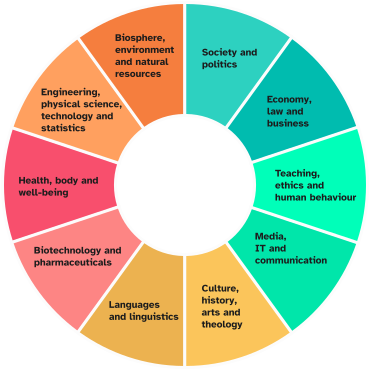
Study wheel

What interests you?

Aurora Cooperation

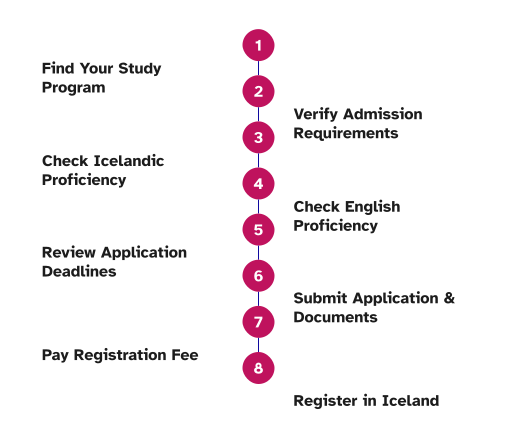
How to apply

Follow the path

Contact us

If you still have questions, feel free to contact us.

School of Social Sciences
Weekdays 9 am - 3 pm
Student and Teaching Service

The School office offers support to students and lecturers, providing guidance, counselling, and assistance with various matters. 

You are welcome to drop by at the office in Gimli or you can book an online meeting in Teams with the staff.

1920_KRI_gimli_200828_001.jpg

Share

Did this help?

Why wasn't this information helpful

Limit to 250 characters.