- Are you interested in the cultures of Ancient Greece and the Roman Empire?
- Do you want to get a better understanding of the literature, history, religion and philosophy of this period?
- Do you want to study two subjects?
- Do you want a minor that will complement a major in history, comparative literature, philosophy, Icelandic, linguistics or religious studies?
Classical studies is taught as a minor as part of a BA degree. A BA programme generally takes three years to complete. A minor is the equivalent of one year of study (60 ECTS) alongside a major (120 ECTS) in another subject. The programme can be completed in a single academic year or spread across more than one year.
It is made up of courses in different subjects at the School of Humanities: literature, philosophy, history and classical languages.
Classical studies is about exploring the cultures of Ancient Greece and Ancient Rome. The main focus is on their history, literature, philosophy and languages. Classical studies is a combination of history, literary studies, philosophy and linguistics.
Course topics include:
- Latin (both Classical and Medieval Latin)
- Ancient Greek (from Homer to the 1st Century AD)
- Ancient philosophy
- Ancient history and historiography
- Ancient literature (Greek and Roman)
- Mythology and religion
Objectives
The programme provides students with a general knowledge and understanding of Roman and/or Ancient Greek language, history, philosophy and culture, their unique position and impact on European history and culture.
Programme structure
The programme in classical studies is an interdisciplinary introduction to the foundations of Western civilisation. Students are introduced to the two languages, Ancient Greek and Latin, which are the key to understanding classical culture and its legacy. Knowledge of these languages enables students to independently explore the discipline.
Other courses provide a general insight into the main aspects of the culture, but none require an in-depth knowledge of classical languages since they are taught at several different departments. Students will acquire knowledge of the foundations of all humanities subjects.
About classical studies
Classical studies cover a long period of history, at least thirteen centuries. The discipline spans the period from the 8th century BC, when the Greek states were emerging and Homer's epics were written, up until the fall of the Roman Empire in around 500 AD.
But classical studies is not just about the classical period itself; students also explore the legacy of classical culture, how it was understood and kept alive: in the classical languages themselves, literature or philosophy, in the medieval period in the West or the East, and in the modern age.
Icelandic matriculation examination (stúdentspróf) or equivalent qualification. Further information can be found in article 18, regulation on admission requirements for undergraduate study no. 331/2022.
The minor in Classical Studies is an interdisciplinary introduction to the foundations of Western civilisation. Students will require a certain level of knowledge of Latin and Ancient Greek; the courses Ancient Greek I and Latin I are mandatory. Elective courses provide a general insight into the primary aspects of the culture, though none of them require an in-depth knowledge of ancient languages, and are taken from different subjects, e.g. philosophy, history and literature, as well as Greek and Latin.
Programme structure
Check below to see how the programme is structured.
This programme does not offer specialisations.
- Year unspecified
- Fall
- Latin I: Beginner's Course
- Ancient Greek I: Beginner's Course
- The Ancient Novel
- The World of Ancient Greece: History and Society
- Introduction to the Old Testament
- The Greek of the New Testament
- Ancient Philosophy
- Death and Rebirth - Introduction to Late Medieval Europe - World History I
- Not taught this semesterIntruduction to Classical Studies
- Making History
- Spring 1
- The History of Early Christianity
- Not taught this semesterThe World of Rome: History and Society
- Medieval literature
- Medieval Latin
- Latin II: A Selection of Latin Texts
- Ancient Greek II
- Prehistory
- Ancient Greek Literature
- Ethics
- History of Linguistics
- Medieval Latin
- Greek and Roman Historians and Historiography
- Not taught this semesterThe History of Rome
- Not taught this semesterAncient Greece
Latin I: Beginner's Course (KLM101G)
This course is a beginner’s course in Latin. No prior knowledge of Latin is assumed at the outset. It introduces the basics of Latin grammar and syntax. Chosen passages will be read in Latin, translated and thoroughly analysed. Teaching consists of 24 lectures on particular aspects of the Latin language and assigned readings.
This course is taught in Icelandic but students can get permission of the instructor to complete assignments and exams in English.
Ancient Greek I: Beginner's Course (KLM102G)
This course is a beginner’s course in Ancient Greek. It introduces the basics of grammar and syntax of the Attic dialect. No prior knowledge of Greek is assumed at the outset. Reading knowledge of Ancient Greek will be prioritized and chosen passages will be read in Greek, translated and thoroughly analysed. Teaching consists of both lectures on particular aspects of the Greek language and assigned readings. It is essential that students read the assigned materials before each lecture.
This course is taught in Icelandic but students can get permission of the instructor to complete assignments and exams in English.
The Ancient Novel (KLM304G)
This course is an introduction to the novel in classical antiquity. Prose fiction appeared in the 1st century and developed further into late antiquity. There are various relations to older genres of literature, such as Greek and Roman comedies and satires. In this course the student will be introduced to the major authors of the ancient novel and their works and we will discuss their relations to other Greek and Latin literature.
Knowledge of Latin is not required, but students Classics may choose to work on a supervised independent study project (5 ECTS, or 10 ECTS) focusing on the original text in connection to the course. The supervised independent study projects which are available to students with reading knowledge of Latin or Greek are intended to strengthen their proficiency in Latin and train them in the reading of original texts.
The World of Ancient Greece: History and Society (KLM115G)
This course is an introduction to the history of Ancient Greek civilization, with an emphasis on Ancient Greek culture and world view, from earliest times to the Roman period.
Introduction to the Old Testament (GFR104G)
A Survey of the History of Israel in Old Testament times. The Faith of the OT depicted in terms of historical development, but also in relation to the social, politacal and religious situation in the contemporary peoples and cultures of the Ancient Near East. The origin and the main characteristics of the individual books of the OT discussed. The afterlife of some OT texts also discussed.
The Greek of the New Testament (GFR212G)
The primary purpose of this course is to provide students with a basis on which to read and interpret the texts of the New Testament independently. The main elements of the grammatical structure of ancient Greek will be studied and text examples from the New Testament and other early Christian texts will be read for that purpose. Special emphasis will be put on the knowledge and use of ancient Greek within the fields of theology and religious studies.
Ancient Philosophy (HSP104G)
A survey of ancient philosophy, based upon a close reading of primary texts from the works of the Presocratics, Plato and Aristotle, and their Hellenistic successors. The primary aim is to offer an overview of the development of ancient philosophy. A secondary aim is to offer an insight into the importance of the history of philosophy for philosophy, and deepen the students' competence in reading philosophical works from the ancient world. At the completion of the course, the students should be acquainted with the main periods and individual thinkers of ancient philosophy, their views and arguments. They should be able to give an account of these views, support it with references to the primary sources, and compare the views of different philosophers. Further, they should have gained an insight into the importance of the history of philosophy for philosophy and the historical origins of classical philosophical problems.
Death and Rebirth - Introduction to Late Medieval Europe - World History I (SAG115G)
Introductory course on the history of late medieval Europe. Taught in Icelandic; please see full course description in Icelandic
Intruduction to Classical Studies (KLM103G)
The course is an introduction to Classical Studies. It will deal with the history of the discipline as well as its subject matter and methods: Students will be introduced to classical philology and the various branches of Classical Studies, such as the history, literature, and philosophy of classical antiquity. The course will, moreover, address issues concerning the use of sources, methodology, and conventions in Classics. Students will be introduced to major resources. Knowledge of the classical languages is not required.
Making History (SAG101G)
This course introduces students to some of the basic skills that they will use in the study of history. The special character of history and its relationship with other fields of study will be discussed. The students will be introduced to the sources and methods used in historical research and the writing and presenting of historical work. - Students must register for the course in the beginning of their history study (first or second semester, depending on whether they start in January or September).
The History of Early Christianity (GFR211G)
The course contains a discussion of the beginnings of Early Christianity as well as of its historical and ideological background. Special emphasis will be given to the roots of Christianity in early Judaism. Attention will also be paid to the ideological roots of Christianity in Hellenistic thought. Early Christian literature will be discussed with emphasis on a historical approach to the sources. Included is a general discussion of the nature and form of writings of this sort. In this way, a basis will be laid for a qualified interpretation of and research into Early Christian literature.
The World of Rome: History and Society (KLM216G)
The course introduces students to Roman social history. The period from 201 BCE to 180 CE will be emphasized. The main points of Roman history will be briefly discussed, as well as Roman institutions, the Roman social fabric,family life and gender roles, slavery, education, culture, religion, entertainment and daily life. In addition to secondary reading material, some ancient sources will be read in translation (English or Icelandic). No knowledge of Latin is assumed or required.
Medieval literature (ÍSL206G)
The course focuses on the various ways in which medieval texts can be studied, referring to both medieval or modern literary theory. The characteristics of medieval textual culture will be discussed, as well as medieval attitudes to fact and fiction, entertainment and edification. Texts representing all of the most important genres of Icelandic medieval literature will be read.
Medieval Latin (KLM203G)
In this course we will read selections from medieval literature broadly conceived (from the end og the 4th century to the end of the 15th century): poetry and historiography, philosophy and theology. Texts will be analysed grammatically and discussed materially as needed.
The course will be taught in Icelandic, but students whose native language is not Icelandic may complete assignments and exams in English.
Latin II: A Selection of Latin Texts (KLM201G)
The course is a continuation of LAT101G Latin I. Students will read a selection of Latin texts by various authors.
This course is taught in Icelandic but students can get permission of the instructor to complete assignments and exams in English.
Ancient Greek II (KLM202G)
The course is a continuation of KLM102G Ancient Greek I. The first part of the course resumes coverage of grammar and syntax of Ancient Greek (Attic) where Ancient Greek I left off. During the second half of the course, students will read a selection of Ancient Greek texts by different authors from various periods.
Students can get permission of the instructor to complete assignments and exams in English.
Prehistory (FOR204G)
Prehistory deals with the cultural history of humankind from the persepctive of material culture, from the first tools of around 2,5 million years ago up to the end of the Iron Age (c. 0-800 AD), i.e. the period for which there are no written sources. This course will cover the basic aspects of prehistory, including chronology and definitions of prehistoric society. In addition, the course will look at different aspects of prehistoric social life such as subsistence patterns, burial customs, craft and technology, trade and livelihood. Emphasis will be placed on human evolution in a global context and on later prehistoric Europe (c. 10.000 BC-800 AD). By the end of the course, the students will be expected to have collated a glossary of terms for prehistoric archaeology and understand the main outlines of prehistoric chronology and European prehistory.
Ancient Greek Literature (ABF201G)
A survey of Classical Greek literature, including a study of several important literary works from Homer to the late Classical period.
Ethics (HSP202G)
This course provides an overview of three principal moral theories: Aristotle's virtue ethics as presented in his Nichomachean Ethics, Kant's deontoloical ethics as presented in his Groundwork for the Metaphysics of Morals and John Stuart Mill's rule ethics as presented in his Utilitarianism.
History of Linguistics (AMV205G)
The major aspects of the history of linguistics traced from the antiquity through the middle ages till the beginning of the 19th Century. The Old Icelandic grammatical treatises. The major aspects of the history of linguistics in the 19th and 20th century. Emphasis is placed on the theories and discoveries that have been most influential in the development of ideas and methods in linguistics.
Medieval Latin (KLM203G)
In this course we will read selections from medieval literature broadly conceived (from the end og the 4th century to the end of the 15th century): poetry and historiography, philosophy and theology. Texts will be analysed grammatically and discussed materially as needed.
The course will be taught in Icelandic, but students whose native language is not Icelandic may complete assignments and exams in English.
Greek and Roman Historians and Historiography (KLM204G)
This course introduces Ancient Greek and Roman historiography, tracing its beginning and development, and discusses its scope, aims and methods. Among authors who will be discussed are Herodotus, Thucydides, Xenophon, Polybius, Cato, Sallust, Livy, Plutarch, Suetonius, Tacitus, Ammianus Marcellinus and others. Readings will include excerpts from ancient texts in translation.
The History of Rome (SAG271G)
Introductory course on the history of Rome. Taught in Icelandic; please see full course description in Icelandic.
Ancient Greece (SAG413G)
This course offers an overview over the history of Ancient Greece from the Minoan period till the time of the Hellenistic Kingdoms.
- Fall
- KLM101GLatin I: Beginner's CourseMandatory (required) course10A mandatory (required) course for the programme10 ECTS, creditsCourse Description
This course is a beginner’s course in Latin. No prior knowledge of Latin is assumed at the outset. It introduces the basics of Latin grammar and syntax. Chosen passages will be read in Latin, translated and thoroughly analysed. Teaching consists of 24 lectures on particular aspects of the Latin language and assigned readings.
This course is taught in Icelandic but students can get permission of the instructor to complete assignments and exams in English.Face-to-face learningPrerequisitesKLM102GAncient Greek I: Beginner's CourseMandatory (required) course10A mandatory (required) course for the programme10 ECTS, creditsCourse DescriptionThis course is a beginner’s course in Ancient Greek. It introduces the basics of grammar and syntax of the Attic dialect. No prior knowledge of Greek is assumed at the outset. Reading knowledge of Ancient Greek will be prioritized and chosen passages will be read in Greek, translated and thoroughly analysed. Teaching consists of both lectures on particular aspects of the Greek language and assigned readings. It is essential that students read the assigned materials before each lecture.
This course is taught in Icelandic but students can get permission of the instructor to complete assignments and exams in English.Face-to-face learningPrerequisitesCourse DescriptionThis course is an introduction to the novel in classical antiquity. Prose fiction appeared in the 1st century and developed further into late antiquity. There are various relations to older genres of literature, such as Greek and Roman comedies and satires. In this course the student will be introduced to the major authors of the ancient novel and their works and we will discuss their relations to other Greek and Latin literature.
Knowledge of Latin is not required, but students Classics may choose to work on a supervised independent study project (5 ECTS, or 10 ECTS) focusing on the original text in connection to the course. The supervised independent study projects which are available to students with reading knowledge of Latin or Greek are intended to strengthen their proficiency in Latin and train them in the reading of original texts.
Face-to-face learningPrerequisitesKLM115GThe World of Ancient Greece: History and SocietyElective course10Free elective course within the programme10 ECTS, creditsCourse DescriptionThis course is an introduction to the history of Ancient Greek civilization, with an emphasis on Ancient Greek culture and world view, from earliest times to the Roman period.
PrerequisitesGFR104GIntroduction to the Old TestamentElective course10Free elective course within the programme10 ECTS, creditsCourse DescriptionA Survey of the History of Israel in Old Testament times. The Faith of the OT depicted in terms of historical development, but also in relation to the social, politacal and religious situation in the contemporary peoples and cultures of the Ancient Near East. The origin and the main characteristics of the individual books of the OT discussed. The afterlife of some OT texts also discussed.
Face-to-face learningPrerequisitesGFR212GThe Greek of the New TestamentElective course10Free elective course within the programme10 ECTS, creditsCourse DescriptionThe primary purpose of this course is to provide students with a basis on which to read and interpret the texts of the New Testament independently. The main elements of the grammatical structure of ancient Greek will be studied and text examples from the New Testament and other early Christian texts will be read for that purpose. Special emphasis will be put on the knowledge and use of ancient Greek within the fields of theology and religious studies.
Face-to-face learningPrerequisitesCourse DescriptionA survey of ancient philosophy, based upon a close reading of primary texts from the works of the Presocratics, Plato and Aristotle, and their Hellenistic successors. The primary aim is to offer an overview of the development of ancient philosophy. A secondary aim is to offer an insight into the importance of the history of philosophy for philosophy, and deepen the students' competence in reading philosophical works from the ancient world. At the completion of the course, the students should be acquainted with the main periods and individual thinkers of ancient philosophy, their views and arguments. They should be able to give an account of these views, support it with references to the primary sources, and compare the views of different philosophers. Further, they should have gained an insight into the importance of the history of philosophy for philosophy and the historical origins of classical philosophical problems.
Face-to-face learningPrerequisitesSAG115GDeath and Rebirth - Introduction to Late Medieval Europe - World History IElective course5Free elective course within the programme5 ECTS, creditsCourse DescriptionIntroductory course on the history of late medieval Europe. Taught in Icelandic; please see full course description in Icelandic
Face-to-face learningPrerequisitesCourse taught first half of the semesterNot taught this semesterKLM103GIntruduction to Classical StudiesElective course10Free elective course within the programme10 ECTS, creditsCourse DescriptionThe course is an introduction to Classical Studies. It will deal with the history of the discipline as well as its subject matter and methods: Students will be introduced to classical philology and the various branches of Classical Studies, such as the history, literature, and philosophy of classical antiquity. The course will, moreover, address issues concerning the use of sources, methodology, and conventions in Classics. Students will be introduced to major resources. Knowledge of the classical languages is not required.
Face-to-face learningPrerequisitesCourse DescriptionThis course introduces students to some of the basic skills that they will use in the study of history. The special character of history and its relationship with other fields of study will be discussed. The students will be introduced to the sources and methods used in historical research and the writing and presenting of historical work. - Students must register for the course in the beginning of their history study (first or second semester, depending on whether they start in January or September).
Face-to-face learningPrerequisites- Spring 2
GFR211GThe History of Early ChristianityElective course10Free elective course within the programme10 ECTS, creditsCourse DescriptionThe course contains a discussion of the beginnings of Early Christianity as well as of its historical and ideological background. Special emphasis will be given to the roots of Christianity in early Judaism. Attention will also be paid to the ideological roots of Christianity in Hellenistic thought. Early Christian literature will be discussed with emphasis on a historical approach to the sources. Included is a general discussion of the nature and form of writings of this sort. In this way, a basis will be laid for a qualified interpretation of and research into Early Christian literature.
Face-to-face learningPrerequisitesNot taught this semesterKLM216GThe World of Rome: History and SocietyElective course10Free elective course within the programme10 ECTS, creditsCourse DescriptionThe course introduces students to Roman social history. The period from 201 BCE to 180 CE will be emphasized. The main points of Roman history will be briefly discussed, as well as Roman institutions, the Roman social fabric,family life and gender roles, slavery, education, culture, religion, entertainment and daily life. In addition to secondary reading material, some ancient sources will be read in translation (English or Icelandic). No knowledge of Latin is assumed or required.
Face-to-face learningPrerequisitesÍSL206GMedieval literatureElective course10Free elective course within the programme10 ECTS, creditsCourse DescriptionThe course focuses on the various ways in which medieval texts can be studied, referring to both medieval or modern literary theory. The characteristics of medieval textual culture will be discussed, as well as medieval attitudes to fact and fiction, entertainment and edification. Texts representing all of the most important genres of Icelandic medieval literature will be read.
Face-to-face learningPrerequisitesCourse DescriptionIn this course we will read selections from medieval literature broadly conceived (from the end og the 4th century to the end of the 15th century): poetry and historiography, philosophy and theology. Texts will be analysed grammatically and discussed materially as needed.
The course will be taught in Icelandic, but students whose native language is not Icelandic may complete assignments and exams in English.
Face-to-face learningPrerequisitesKLM201GLatin II: A Selection of Latin TextsElective course10Free elective course within the programme10 ECTS, creditsCourse DescriptionThe course is a continuation of LAT101G Latin I. Students will read a selection of Latin texts by various authors.
This course is taught in Icelandic but students can get permission of the instructor to complete assignments and exams in English.Face-to-face learningPrerequisitesCourse DescriptionThe course is a continuation of KLM102G Ancient Greek I. The first part of the course resumes coverage of grammar and syntax of Ancient Greek (Attic) where Ancient Greek I left off. During the second half of the course, students will read a selection of Ancient Greek texts by different authors from various periods.
Students can get permission of the instructor to complete assignments and exams in English.Face-to-face learningPrerequisitesCourse DescriptionPrehistory deals with the cultural history of humankind from the persepctive of material culture, from the first tools of around 2,5 million years ago up to the end of the Iron Age (c. 0-800 AD), i.e. the period for which there are no written sources. This course will cover the basic aspects of prehistory, including chronology and definitions of prehistoric society. In addition, the course will look at different aspects of prehistoric social life such as subsistence patterns, burial customs, craft and technology, trade and livelihood. Emphasis will be placed on human evolution in a global context and on later prehistoric Europe (c. 10.000 BC-800 AD). By the end of the course, the students will be expected to have collated a glossary of terms for prehistoric archaeology and understand the main outlines of prehistoric chronology and European prehistory.
Face-to-face learningPrerequisitesABF201GAncient Greek LiteratureElective course10Free elective course within the programme10 ECTS, creditsCourse DescriptionA survey of Classical Greek literature, including a study of several important literary works from Homer to the late Classical period.
Face-to-face learningPrerequisitesCourse DescriptionThis course provides an overview of three principal moral theories: Aristotle's virtue ethics as presented in his Nichomachean Ethics, Kant's deontoloical ethics as presented in his Groundwork for the Metaphysics of Morals and John Stuart Mill's rule ethics as presented in his Utilitarianism.
Face-to-face learningPrerequisitesAMV205GHistory of LinguisticsElective course10Free elective course within the programme10 ECTS, creditsCourse DescriptionThe major aspects of the history of linguistics traced from the antiquity through the middle ages till the beginning of the 19th Century. The Old Icelandic grammatical treatises. The major aspects of the history of linguistics in the 19th and 20th century. Emphasis is placed on the theories and discoveries that have been most influential in the development of ideas and methods in linguistics.
Face-to-face learningPrerequisitesCourse DescriptionIn this course we will read selections from medieval literature broadly conceived (from the end og the 4th century to the end of the 15th century): poetry and historiography, philosophy and theology. Texts will be analysed grammatically and discussed materially as needed.
The course will be taught in Icelandic, but students whose native language is not Icelandic may complete assignments and exams in English.
Face-to-face learningPrerequisitesKLM204GGreek and Roman Historians and HistoriographyElective course10Free elective course within the programme10 ECTS, creditsCourse DescriptionThis course introduces Ancient Greek and Roman historiography, tracing its beginning and development, and discusses its scope, aims and methods. Among authors who will be discussed are Herodotus, Thucydides, Xenophon, Polybius, Cato, Sallust, Livy, Plutarch, Suetonius, Tacitus, Ammianus Marcellinus and others. Readings will include excerpts from ancient texts in translation.
Face-to-face learningPrerequisitesNot taught this semesterSAG271GThe History of RomeElective course10Free elective course within the programme10 ECTS, creditsCourse DescriptionIntroductory course on the history of Rome. Taught in Icelandic; please see full course description in Icelandic.
Face-to-face learningPrerequisitesNot taught this semesterSAG413GAncient GreeceElective course10Free elective course within the programme10 ECTS, creditsCourse DescriptionThis course offers an overview over the history of Ancient Greece from the Minoan period till the time of the Hellenistic Kingdoms.
Face-to-face learningPrerequisitesAdditional information The University of Iceland collaborates with over 400 universities worldwide. This provides a unique opportunity to pursue part of your studies at an international university thus gaining added experience and fresh insight into your field of study.
Students generally have the opportunity to join an exchange programme, internship, or summer courses. However, exchanges are always subject to faculty approval.
Students have the opportunity to have courses evaluated as part of their studies at the University of Iceland, so their stay does not have to affect the duration of their studies.
An education in Greek, Latin and classical studies (or classics) can lead to a wide range of career opportunities.
The study of classics or classical languages provides students with training in a unique blend of skills in different academic fields: languages and linguistics, history and literature.
Due to the diversity of the subject, students learn to think both analytically and holistically. They also gain language skills and an understanding of the nature of different sources, how to approach sources critically and close read a variety of texts. The programme offers a humanities education par excellence.
Classical studies at the University of Iceland aligns with the fundamental role of a university: to develop students intellectually and train them in critical thinking, precision and good working practices.
An education in this area can open up opportunities in:
- Research
- Teaching
- Journalism
- Writing
- Publishing
- Tourism
- Politics
This list is not exhaustive.
- The student organisation for Greek and Latin students is called Carpe Diem and was established in 1976.
- Carpe Diem has organised an annual gala for students and teaching staff and runs a chat group on Facebook for former and current students as well as teaching staff.
- Carpe Diem appoints representatives to take part in an annual consultation on course offerings.
Students' comments
One of the things that attracted me to studying the classical languages, Latin and Greek, is how varied the studies are. In my studies in Iceland, and as an exchange student at Glasgow University I have taken courses on all aspects concerning antiquity, Latin, Greek, linguistics, literature, history, philosophy, and art. The degree thus provides a good foundation in a broad field, and in many ways, I think classical languages is the most interdisciplinary programme offered at the University of Iceland. The teachers are very enthusiastic about their field and always ready to assist students and talk to them.
Studying classics offered deep insights into ancient Greek and Roman culture, language, philosophy, and literature. I highly recommend it to anyone fascinated by these influential civilisations and their impact on the modern world.
Since I can remember, I have had a great interest in Ancient Greece and Rome. In my studies of classical languages, Latin and Greek, I have gained a deeper understanding of the language and culture of these civilizations. The programme is diverse, covering the languages and the rich cultural heritage of the Ancient Greeks and Romans. The teachers are highly knowledgeable in their field and always ready to assist students. I believe that anyone interested in classical antiquity and its influences on the present should be able to find something suitable among the many courses available.
I chose classical languages to read original philosophical texts. My interest in ancient cultures and languages grew, as did my fascination with Icelandic. The programme is both challenging and enjoyable, with supportive teachers. I highly recommend it.Helpful content Study wheel
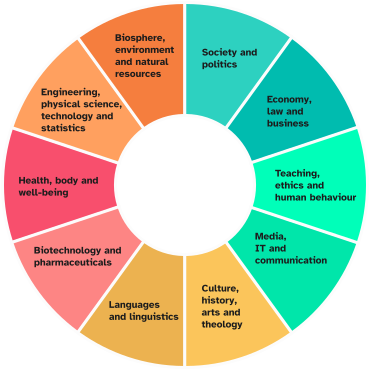
What interests you?
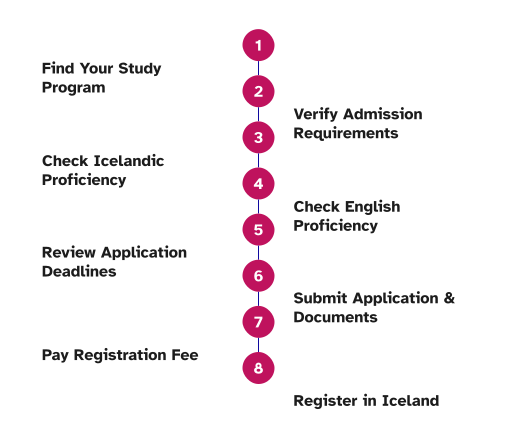
How to apply
Follow the path
Contact us If you still have questions, feel free to contact us.
School of HumanitiesWeekdays: 10-12 am and 1-3 pmGeneral Service and Social MediaThe Service Desk is a point of access for all services. You can drop in at the University Centre or use the WebChat at the bottom right of this page.
Follow the School of Humanities on Instagram, Youtube
and Facebook
Share