
""
Language skills
required, minimum level of B2
Programme length
Two years.
Study mode
Face-to-face learning Distance learning
Application status
International students:
Students with Icelandic or Nordic citizenship:
Overview

  • Have you qualified as a certified master in a trade?
  • Are you interested in working with young people?
  • Do you want to teach your trade in upper secondary schools?
  • Do you want an enjoyable and rewarding career?
  • Do you want to learn more about pedagogy?
  • Do you want to help young people learn?

The programme is designed for people who want to study part time alongside employment. It can be completed in two years (four semesters). Teaching is both face to face and through distance learning, with mandatory attendance for face-to-face blocks.

Face-to-face blocks are twice per semester; otherwise study is very flexible. In the second year, students do placements at an upper secondary school under the guidance of mentor teachers. Attendance is compulsory for placements in schools.

Course topics include:

  • Pedagogy
  • Curriculum studies
  • School-workplace connectivity

Other:

Upon graduation from a teacher's program at an Icelandic university, a teacher must have a competency in Icelandic that corresponds to a minimum of C1 in the European Language Framework.

Here you can see the Language Framework of the Council of Europe.

Applicants have to fulfill legal provisions no. 95/2019  regarding subject studies in a vocational subject (letter of master's certification in a trade, vocational/industrial training, technological studies, engineering studies or other equivalent studies). A two-year training in the field is required for those with vocational training.

Applicants who have completed a qualification equivalent to Icelandic upper‑secondary school examination from a foreign school must also pass a special Icelandic entrance examination.

Students complete mandatory courses, 40 ECTS of which 6 ECTS are completed at the field of teaching. Furtermore students complete 20 ECTS of elective courses.

Programme structure

Check below to see how the programme is structured.

This programme does not offer specialisations.

First year | Fall
Academic writing and critical reading (ÍET102G)
A mandatory (required) course for the programme
5 ECTS, credits
Course Description

The main objective of the course is to prepare students for reading, writing and communicating academic texts.

The course will cover various types of scholarly material and its representation. Students will familiarise themselves with different aspects of academic writing and learn to distinguish between different genres. Students will be trained in independent and critical reading of different texts. Copyright, plagiarism, and fake news will also be discussed.

Students will acquire skills in working with academic texts, such as abstracts and summaries and in using sources when writing their own texts. They will also receive instructions in making bibliographies and using citation systems. Students will also be trained to use source material in their own writing and to distinguish their own voice from the source. 

Language of instruction: Icelandic
Face-to-face learning
First year | Fall
Teaching vocational subjects (KEN101G)
A mandatory (required) course for the programme
10 ECTS, credits
Course Description

The aim of the course is to enable students to create new knowledge about learning and teaching in trade schools. Participants increase their understanding of its uniqueness and critically examine their own attitudes towards what the learning and teaching these subjects entails.

CONTENT / SUBJECT MATTER:
Trends in theories and the practice of learning and teaching. How do people learn and how can a teacher help people learn? What is good teaching? Curricula and their creation, writing learning outcomes, creating lesson plans, learning assessment and the use of information technology in teaching. These subjects will be examined in the light of pedagogy, sociology, psychology and philosophy.

METHOD:
The course will be taught in a format called "HyFlex". This means that participants can choose whether to attend school, participate via teleconferencing in real time or listen to recordings and actively participate in the collaboration of participants online between regular meetings.

The course has two obligatory "whole day face to face sessions" where all participants work together for a whole day in the school premises in relation to the course content. Important decisions about the course will be made there, the participants get to know each other well and activities support their cooperation in the course. In  this and allo real-time sessions we use methods that are useful in all teaching so that participants experience a variety og teaching methods that they can then use when planning their studies and teaching.

There are weekly face to face sessions the school premises with the possibility of online participation.

Between meetings and the whole day sessions, collaboration takes place on the course website, e.g. through written discussions on the course discussion threads.

Language of instruction: Icelandic
Face-to-face learning
Distance learning
Attendance required in class
First year | Spring 1
Curriculum of vocational subjects, materials and assessment (KEN203G)
A mandatory (required) course for the programme
10 ECTS, credits
Course Description

I

Language of instruction: Icelandic
Face-to-face learning
Distance learning
Attendance required in class
Second year | Fall
Vocational pedagogy – part 1 (KEN302G, KEN303G)
A mandatory (required) course for the programme
5 ECTS, credits
Course Description

The aim of this course is to deepen the students understanding of the pedagogy of vocational subjects and allow them to connect their own practical experience to topics, theories, and research on pedagogy and educational science.

Language of instruction: Icelandic
Distance learning
Prerequisites
Attendance required in class
Second year | Fall
Vocational teaching – practicum part 1 (KEN302G, KEN303G)
A mandatory (required) course for the programme
5 ECTS, credits
Course Description

The aim of the course is to provide students with training in vocational teaching at schools and assist them in developing their own theory of practice and professional identity as vocational teachers.

Language of instruction: Icelandic
Distance learning
Prerequisites
Attendance required in class
Second year | Fall
Individuality, special education and teaching in a diverse classroom (KEN103G)
A mandatory (required) course for the programme
5 ECTS, credits
Course Description

The module is organized as flipped classroom. Every other week students acquire information from videos and reading material. And every other week there will be real-time classroom or online activities. Students who are not able to participate in real-time activities will have to rely on self-study (journaling). Students can complete this module as distance learning.

Objective and course description

The object of this module is for students to gain practical and theoretical knowledge of policy planning, ideology, and support services for students with various learning needs in upper secondary schools.

The official education policy of inclusive education will be introduced together with the idea of universal design for learning, as well as laws and regulations that apply to students in upper secondary schools. In the module’s discussions, emphasis will be placed on the support services that secondary schools offer to students. The diversity of upper secondary school students will be discussed and explained how teachers can accommodate students on an individual basis. The participants in this module will also examine the causes and consequences of high drop-out rates in upper secondary schools.

Language of instruction: Icelandic
Face-to-face learning
Distance learning
Second year | Spring 1
Vocational pedagogy – part 2 (KEN402G, KEN403G)
A mandatory (required) course for the programme
5 ECTS, credits
Course Description

The aim of this course is to deepen the students understanding of the pedagogy of vocational subjects and allow them to connect their own practical experience to topics, theories, and research on pedagogy and educational science.

Language of instruction: Icelandic
Distance learning
Prerequisites
Attendance required in class
Second year | Spring 1
Vocational teaching – practicum part 2 (KEN402G, KEN403G)
A mandatory (required) course for the programme
5 ECTS, credits
Course Description

The aim of the course is to provide students with training in vocational teaching at schools and assist them in developing their own theory of practice and professional identity as vocational teachers.

Language of instruction: Icelandic
Distance learning
Prerequisites
Attendance required in class
Year unspecified | Year unspecified
Design as a Source for Creativity (LVG104G)
Free elective course within the programme
10 ECTS, credits
Course Description

The course is an introduction to design and craft education: Design and woodwork, Textiles and design and Health promotion and home economics. Project ideas are adapted to different subjects of the course. Emphasis is placed on knowledge and skills aspects from idea to completion in all work components of the course. Students work on subjects that are suitable for school work and record work processes in photographs, drawings and in text form.

Language of instruction: Icelandic
Face-to-face learning
Attendance required in class
Not taught this semester
Year unspecified | Year unspecified
Silversmithing (LVG306G)
Free elective course within the programme
10 ECTS, credits
Course Description

Aim: To learn traditional methods in silversmithing. 

General Description: The course main goal is to help student develop their basic skill and knowledge in silversmith, in order to enable them to make simple things and jewelleries from silver, copper, and brass. They will also learn to organise a course for the elementary school students with simple projects for beginners. The course main goal is to help student develop their basic skill and knowledge in silversmith, in order to enable them to make simple things and jewelleries from silver, copper, and brass. They will also learn to organise a course for the elementary school students with simple projects for beginners. 

Course Content:

  1. Students learn to use hand tools for silversmith
  2. Students learn to organise a classroom for silversmith
  3. Students learn to methods for making jewelleries and applied artefacts from silver, copper, and brass. 

Working Methods: Craft activities and lectures. 

Support material: Websites and photocopies from the teacher

Language of instruction: Icelandic
Face-to-face learning
Distance learning
Attendance required in class
Year unspecified | Year unspecified
Icelandic in the classroom I (ÍET103G)
Free elective course within the programme
5 ECTS, credits
Course Description

This course will focus on Icelandic culture and literature in a broad understanding, as well as how both factor into language use and linguistic world of different subjects within the school system.

This will include a discussion of basic concepts of literary theory, discourse analysis and cultural studies, and a variety of methods and media in teaching will be introduced, which can increase understanding and interest among elementary school students in their own culture as well as other cultures. 

Students will have the opportunity to read literary fiction from both past and present and put it into context with their own experiences as well as their future approach to teaching different school subjects.

A variety of texts will be discussed, both fiction as well as practical/didactic texts and recreational texts, with the goal that students realize and appreciate that language is the tool we use in all our daily lives and studies regardless of subject. The deep layers of meaning found in all manner of texts will be analyzed, and students will be given the proper tools to scrutinize texts in their surroundings in an independent and critical manner.

This course will focus on interweaving of different elementary school subjects and how Icelandic is the subject that binds all other subjects together, emphasizing the teacher’s role of teaching in Icelandic, rather than teaching Icelandic as a subject. For this reason a special focus will be placed on how Icelandic provides a base for the teaching of several other subjects, including social studies, mathematics, natural sciences, foreign languages, and not least art subjects, e.g. visual arts and drama.

Language of instruction: Icelandic
Face-to-face learning
Attendance required in class
Year unspecified | Year unspecified
Introduction to Design and Craft (LVG203G)
Free elective course within the programme
5 ECTS, credits
Course Description

This is a basic course in wood work. Students learn to used hand tools and machines, they design and make artefact from wood and learn about old craft traditions. The course is base on practical work, lectures and seminars. This is a basic course in wood work. Students learn to used hand tools and machines, they design and make artefact from wood and learn about old craft traditions. The course is base on practical work, lectures and seminars.

Support material: Websites and photocopies from the teacher.

Literature: Collins Complete Woodworkers Manual and photocopies from the teacher.

Language of instruction: Icelandic
Face-to-face learning
Distance learning
Attendance required in class
Year unspecified | Year unspecified
Learning and Teaching Mathematics (SNU101G)
Free elective course within the programme
5 ECTS, credits
Course Description

In the course teacher students are introduced to the main goals of teaching mathematics in compulsory schools. The emphasis is both on content and the process of teaching and learning.

Emphasis is put on problem solving and inquiry based approach to learning and teaching. The teacher students will study how different approaches in teaching affect learning. Consideration is given to the role of the teacher and competances to be expected.

Students use ICT in their own learning and in connection with the teaching of mathematics.

Language of instruction: Icelandic
Face-to-face learning
Attendance required in class
Year unspecified | Year unspecified
Designing and making from glass (LVG601G)
Free elective course within the programme
5 ECTS, credits
Course Description

This course aim is to train students in using different techniques to form artefacts from glass, for example by using the Tiffanies method, form a glass in an oven and make mosaic pictures. The course emphasis is on artistic design and construction of jewelleries and applied artefacts. Examples of projects are window decorations, bowls and sculptures. This course aim is to train students in using different techniques to form artefacts from glass, for example by using the Tiffanies method, form a glass in an oven and make mosaic pictures. The course emphasis is on artistic design and construction of jewelleries and applied artefacts. Examples of projects are window decorations, bowls and sculptures.

Support material: Websites and photocopies from the teacher.

Language of instruction: Icelandic
Face-to-face learning
Distance learning
Year unspecified | Year unspecified
Green Woodwork and Whittling (LVG015G)
Free elective course within the programme
5 ECTS, credits
Course Description

The aim is to teach students how local woods can be used as a basis for craft and other school activities. 

The course focuses on teaching students about using local woods as a basis for education and utilising wet wood for craft. It, also, shows students how knowledge of woods and woodland and knowledge from various subject areas can be link together, in order to make the woods a basis for educational activities. It, furthermore, deals with the possibilities linking together human beings and nature, within an educational context, in order to meet different needs of students. 

Students in Design and Craft having exchange at schools will undertake specific projects in order to prepare them for their teacher training.

Language of instruction: Icelandic
Face-to-face learning
Distance learning
Attendance required in class
Not taught this semester
Year unspecified | Year unspecified
Computer games, virtual worlds, and game culture (SNU019G)
Free elective course within the programme
5 ECTS, credits
Course Description

Computer games in education and teaching will be discussed, with a special emphasis on gaming worlds and online games and open online playgrounds and the connection of such games to education and leisure activities. Game culture will be examined, classification systems and characteristics of computer games, their importance in leisure culture and their connection to social issues. In particular, gender equality perspectives in video games and video game culture will be examined, as well as various issues, for example related to gender, addiction and/or gambling addiction. Tools will be used to build educational games/educational games and the possibilities of gamification in education will be discussed. Learning games in various types of computer environments will be discussed, such as 3D worlds on the Internet and games that use smart computers or phones.

Language of instruction: Icelandic
Distance learning
Year unspecified | Year unspecified
Technology, creativity and communication in communication and school work (SNU104G)
Free elective course within the programme
10 ECTS, credits
Course Description

How can the field of information and technology education be described, and what is meant when discussing innovation education or innovation in education? What is the reference to when discussing the information and knowledge society, information and technological literacy, digital content creation and multimedia, media literacy or pluralism, digital communication and learning communities, digital citizenship and participation in a democratic society, technology and programming suitable for children and young people, design thinking and entrepreneurship education, playing with ideas, problem-solving and collaborative creativity?

When did digital equipment first enter Icelandic primary schools, what has been the development since then and where is it heading? What obstacles and opportunities do technological advances in communication and schooling entail? What is also the history of innovation education in primary schools and how does it relate to ideas about new times, collaboration and solution-oriented working methods? What are the components of information technology, innovation and digital media in policy making and the curriculum and how are they related to other fields of study, key competences and basic aspects of education?

In this introductory course, we examine the above-mentioned topics in a domestic and international context while giving students the opportunity to work on practical and creative projects, test technical possibilities and digital tools that offer interesting opportunities in learning and teaching. Students improve their skills in this field and look to the practical possibilities in the field and the opportunities that lie in new technology for conceptual work, communication and professional development. Emphasis is placed on the formation of a strong learning community that takes an active part in the course, tackles challenges and shares ideas and experiences in lively educational camps and through digital dissemination online.

Language of instruction: Icelandic
Face-to-face learning
Attendance required in class
Year unspecified | Year unspecified
Integration and creative approach in teaching (GKY102G)
Free elective course within the programme
10 ECTS, credits
Course Description

The primary focus of the course will be on teaching natural and social sciences and on how these subjects can be integrated through the Storyline approach. Special issues and tasks will be chosen within the natural and social sciences and integrated with other subject areas. Teaching materials, equipment, and the teaching environment that support learning and teaching will be explored, and appropriate assessment methods will be introduced and discussed. Students will learn to apply information technology tools and a creative approach in teaching and learning.

Language of instruction: Icelandic
Face-to-face learning
Attendance required in class
Year unspecified | Year unspecified
Mathematics in Teacher Education (SNU204G)
Free elective course within the programme
5 ECTS, credits
Course Description

The teacher students strengthen their knowledge of selected mathematical topics, including number theory and geometry.

The course also treats numeration systems and basic arithmetic.

Emphasis is put on problem solving and inquiry-based approach to learning and teaching. The teacher students reflect on how different approaches in teaching affect students understanding of mathematical concepts.

Language of instruction: Icelandic
Face-to-face learning
Attendance required in class
Year unspecified | Year unspecified
Creative play and technology (SNU003G)
Free elective course within the programme
10 ECTS, credits
Course Description

The course focuses on play and creative work with children involving digital devices and technology. Students review and discuss different sources on creative work digital technologies at the preschool and premium school level. They get acquainted with demonstrative examples of practice in selected schools and look for fruitful ways to apply information technologies and digital media in educational activities with young pupils. Students wrestle with animation, drawing and creative editing of photos with digital tools in relation to digital storytelling. Pioneers in programming designed for children are introduced as well as tools to create simple materials, stories and games with visual programming systems designed for young users. Students also get to try out a selection of digital devices and pedagogical technology sets designed for the young. Some of these activities involve making and artistic expressions in different materials. Students get to design and draw objects for laser cutting and 3-dimensional printing, as well reflect on entrepreneurship and inventive learning as pedagogial focus areas in education. They describe their efforts and experimental work with technical sets and equipment in pictures, videos and texts displayed on websites set up with templates of their own choice.

Language of instruction: Icelandic
Distance learning
Year unspecified | Year unspecified
Teaching about motion, forces, energy and environment (SNU008G)
Free elective course within the programme
5 ECTS, credits
Course Description

The main objective of this introductory course is to educate students about motion, forces, and energy to prepare them for teaching these subjects in Icelandic compulsory school. Participants are expected to develop a thorough scientific understanding of these issues and scientific concepts related to them such as simple machines, motion, velocity, acceleration, force, inertia, mass, lows of motion, the gravitational forces, frictional forces, adding forces, work, power, various energy forms such as kinetic energy, gravitational energy, elastic energy, transformation of energy from one form to another, conservation of energy, useable energy, energy in nature, and energy in society. Besides they will be taught how to illustrate these concepts in practice by carrying out simple experiments. Emphasis will also be paid to the ideas young people have about these concepts and phenomena and how they may be helped to develop those ideas toward scientific understanding. Approaching these issues the participants will be encouraged to inquire into their own understandings of these phenomena and concepts and develop those understandings and their practical teaching competences.

Language of instruction: Icelandic
Distance learning
Not taught this semester
Year unspecified | Year unspecified
Innovation education and creative teaching (SNU025G)
Free elective course within the programme
5 ECTS, credits
Course Description

In the course, students will be introduced to the theories and tools that support cultivating creativity and innovation in the classroom. The course empowers participants to apply teaching methods that encourage curiosity, creativity and design thinking in their students. The basics of innovation education, design thinking, and challenge-based learning, will be discussed, as well as how these theories and methods can be used when teaching various age groups in diverse fields, e.g. related to art, technology and social studies. The course will review methods to promote entrepreneurial thinking, promote resilience, and encourage collaboration and teamwork in the classroom. The course will help participants gain an understanding of how innovation can become a central part of creative education.

Language of instruction: Icelandic
Distance learning
Year unspecified | Year unspecified
Icelandic in the classroom II (ÍET204G)
Free elective course within the programme
5 ECTS, credits
Course Description

Course description in English:*

The focus in this course will be on the Icelandic language and its variation, with a special emphasis on its use within the classroom without regard to the subject matter at hand. In addition, some attention will be given to the language and vocabulary of each school subject.


The students’ language will be in focus and how they acquired it. Varied language use among the students will be discussed and how it changes according to different situations, from informal use on social media to formal writing, which can be related to the registers teacher has to use when talking to their pupils in different situations. Students will get the opportunity to analyse their own language use and that of others with the help of the appropriate terminology.


The vocabulary and its three levels will be discussed, where the emphasis will be on the terminology and language use of different school subjects and how they should be taught, not least when it comes to pupils’ varied language abilities, both among pupils who have Icelandic as a first or second language.


Language of instruction: Icelandic
Face-to-face learning
Not taught this semester
Year unspecified | Year unspecified
Project-based Learning with ICT (SNU002G)
Free elective course within the programme
5 ECTS, credits
Course Description

Thematic learning is a learning method in which students acquire certain knowledge and skills by working together, usually interdisciplinarily, on a specific project for a longer period of time than is generally the case in schools, where knowledge and skills are drawn from more than one subject. They seek answers to a complex question, find a solution to a problem (problem based learning), create or create something that tests their abilities and ingenuity. In this context, the learning environment, procedures and tools in thematic studies, teaching methods, such as consensus studies and democratic teaching, the organisation of thematic projects and students' project work are discussed. Various ways to arouse students' interest and work in a creative way in school work will be presented, e.g. in creative workshops, with computer games and game creation, or with the involvement of museums, and other educational and cultural institutions. The course discusses the integration of subjects and methods for integrating subjects through the use of information and communication technology, the role of teachers and students, the development of learning objectives, and their relationship to academic performance and assessment in integrated schooling.

Participants in this course plan the projects to be undertaken, how they organise their work and make lesson plans, and discuss how they use information and communication technology to gather, process and communicate it. It is imperative that participants are very interested in seeking answers each time, consider it important to solve a specific problem or create an original work.

Projects of this kind put a lot of pressure on collaboration, initiative, problem-solving and an open or multifaceted approach. At the same time, critical and creative thinking are very important. The projects that will be created could be, for example, a short film, a radio play, a film, a video game production, a web or a musical, and will be made available to the Icelandic public or, as the case may be, to netizens wherever they live.

Two projects will be carried out. Work on the first lasts for one to one and a half months, while the second lasts for two and a half to three months.

Language of instruction: Icelandic
Distance learning
Year unspecified | Year unspecified
Leisure and teenagers (TÓS211G)
Free elective course within the programme
10 ECTS, credits
Course Description

The course focus on leisure activities for teenagers in Iceland, the meaning of leisure, roles of leaders, leisure studies, how to help troubled youth and visits to various organisations. Students will get training in how to organizise and evaluate leisure activities for this age group.

Language of instruction: Icelandic
Face-to-face learning
Attendance required in class
Year unspecified | Year unspecified
Effective Communication (TÓS104G)
Free elective course within the programme
5 ECTS, credits
Course Description

The course focuses on practical professional communication, especially as it relates to prospective work in the fields of social pedagogy and youth work.

The students use several methods and media in their work, including drama, speech and digital media, analysing their own and others' ways of interacting in order to increase their communicative competence.

Language of instruction: Icelandic
Face-to-face learning
Attendance required in class
Year unspecified | Year unspecified
Ethics and professionalism (ÞRS312G)
Free elective course within the programme
10 ECTS, credits
Course Description

This course is about moral philosophy with emphasis on consequentialist and deontological theories, human rights and ethical concepts, e.g. autonomy, welfare, right to privacy, and human dignity. It also deals with the relationship between ethics and professionalism.

Special emphasis is on relating the theoretical knowledge with issues and dilemmas in the work of professionals who work with diverse groups in the society

Language of instruction: Icelandic
Face-to-face learning
Distance learning
Attendance required in class
Year unspecified | Year unspecified
Events and Project Management (TÓS411G)
Free elective course within the programme
5 ECTS, credits
Course Description

The course aims at enhancing students ability to plan and prepare event with tools of project management. Emphasis is on collaboration and group projects so students should be more prepared for further studies, future jobs and diverse organisational participations. The course is mandatory for students in leisure studies and social education and aims at meeting the demand for skills in event and project management in the field of leisure, recreation and youth work. It´s also available for other students within the University of Iceland at their choice.

The course requires students active participation in discussions and assignments for building a good and supportive learning environment and success for all. We also focus on positive interactions and communications and responsibility of all students for their actions and study. 

Subject matter
During the course, issues of organising event projects will be discussed. A main focus is on preparation, analysing, planning, performing and evaluationg events, fx. in the field of leisure, recreation and culture. Cases such as meetings, conferences, concerts, festivals, sports events, annual dates and festivals will be discussed and looked into. Discussion about law environment, regulations and safety issues and the role of events for leisure, recreation and travel along with educational and social meaning and influence of events.

How?
Lectures, discussions, assignments and field trips. In the course students work on their own event in groups, planning, preparing, performing and evaluating it, and also peer reviewing co-students plans and events and on line "reading-exams".

The course is for both distant students and on field students. Attendance is mandatory to 80% for on field students and for distance students in on field sessions. 

Mininum grade og 5.0 is required for every assignment.

Language of instruction: Icelandic
Face-to-face learning
Distance learning
Attendance required in class
Year unspecified | Year unspecified
Leisure and teenagers (TÓS211G)
Free elective course within the programme
10 ECTS, credits
Course Description

The course focus on leisure activities for teenagers in Iceland, the meaning of leisure, roles of leaders, leisure studies, how to help troubled youth and visits to various organisations. Students will get training in how to organizise and evaluate leisure activities for this age group.

Language of instruction: Icelandic
Face-to-face learning
Attendance required in class
Not taught this semester
Year unspecified | Year unspecified
Toy Design (LVG501G)
Free elective course within the programme
5 ECTS, credits
Course Description

Aim: To learn to design and make toys in a pedagogical context. 

General Description: The main undertakings are to help student to develop their knowledge and skill to design educational toys and build it. Students learn to use simple cad, which enables them to draw up their own designs in a professional and easy manner. Students design and make educational toys for different age. 

Ways of working: Teaching methods are based on lectures and practical work. 

Support material: Websites and photocopies from the teacher.

Language of instruction: Icelandic
Face-to-face learning
Distance learning
Attendance required in class
Year unspecified | Year unspecified
Philosophy of education and history of ideas (UME304G)
Free elective course within the programme
10 ECTS, credits
Course Description

The main objective of this course is to prepare students for a critical approach to ideas and methods in pedagogy and education. Students will be introduced to the main ideas that have shaped schools and education in the western tradition and made able to locate contemporary currents in an ideological context. The main objective of this course is to prepare students for a critical approach to ideas and methods in pedagogy and education. Students will be introduced to the main ideas that have shaped schools and education in the western tradition and made able to locate contemporary currents in an ideological context.

The course is organized around three basic topics: (i) The human being as a rational, sentient and ethical being, (i) the aims of education and (iii) freedom and democracy. Among the philosophers and educational theorists discussed in the course are Plato, Rousseau, Kant, Dewey, Key, Neill and Freire.

Language of instruction: Icelandic
Face-to-face learning
Distance learning
Year unspecified | Year unspecified
Sociology of childhood and education (UME303G)
Free elective course within the programme
10 ECTS, credits
Course Description

Sociology of education is the subject matter of this course. Fundamental theoretical perspectives will be introduced and explored in the context of various themes and educational debates through time. Among themes are the role and purpose of education, different trends in parenting, the foundation of schools and school systems, the role of families and society, access to education, modernization and individualism, equality, and social mobility. An emphasis will be on combining historical and theoretical perspectives on upbringing and education, where distinctive features of education will be explored in the context of societal development. The focus will be on the Icelandic context, but in relation to development in neighbouring countries. 

Language of instruction: Icelandic
Face-to-face learning
Distance learning
Year unspecified | Year unspecified
Psychology of Development and Learning (KME301G)
Free elective course within the programme
10 ECTS, credits
Course Description

The course aims to provide students with a comprehensive understanding of the developmental changes that occur from birth through adolescence.

Content:
The course will cover a broad range of developmental changes across different phases of childhood and adolescence, as well as theories that describe and explain them. Theories of cognitive, emotional, and social development, self-development, and moral development will be discussed. The approaches of behaviourism and ecological theory will also be highlighted. The origins and nature of individual differences, the continuity and discontinuity of development, and the plasticity of development will be discussed. The interaction between development and learning, motivation, parenting practices, culture, and different social environments will be addressed. A strong emphasis will be placed on understanding child development when working with children in applied settings.

Procedure:
The course will consist of lectures and recitations. Students will have a chance to discuss the course topics and deepen their understanding of the age group they plan to focus on during their studies and work.

Language of instruction: Icelandic
Face-to-face learning
Distance learning
Attendance required in class
Year unspecified | Year unspecified
Outdoor Recreation and Outdoor Learning in Life and Work (TÓS301G)
Free elective course within the programme
10 ECTS, credits
Course Description

Students will become competent in organizing outdoor education and outdoor activities for people of all ages in both summer and winter. The focus is on the one hand, enjoy nature, and to identify how nature can be a platform for upbringing and education (such as the focus on plants, animals or landscapes).

Emphasis is on the value of outdoor and adventure education and how it can be used as an important and successful tool in working with people, theories about outdoor education and experiential learning, group processes, personal and social growth and development. Focus is on connection to nature, group work and cooperation, team building and improving self-esteem and self-image. Also on practical matters, such as clothing, finding your way in the outdoors and environmental and safety issues.

Students are encouraged to use a reflective journal in the course for reflection, notes and ideas.

Students take one two-night journey 6.10.-8.10. and one overnight stay 11.11.-12.11, 2025.

Students have to pay all travel costs.

Course Assessment

To finish the course students need to:
- Plan, prepare and carrie out an outdoor learning project with peer-students.
- Write a chapter about defined subject in "a student book" on Outdoor Education.
- Reflection and self evaluation about the mutual trips / journeys and the course.
- Go on the mutual trips / journeys and attend classes.
- Distance students have to write summaries from lectures and participate in a class and/or web discussions.
- Reading exames.
5.0 is the minimum grade for each assignment.
Minimum attendanse is 80%

Language of instruction: Icelandic
Face-to-face learning
Distance learning
Attendance required in class
Year unspecified | Year unspecified
Teaching about electricity and magnetism (SNU012G)
Free elective course within the programme
5 ECTS, credits
Course Description

The main objective of this introductory course is to educate students about electricity and magnetism to prepare them for teaching these subjects in Icelandic compulsory school. Participants are expected to develop a thorough scientific understanding of these issues and scientific concepts related to them such as electricity, charges, electrical forces, electric currents, magnets, magnetic force, interaction of electricity and magnetism, and production and utilization of electricity. Besides they will be taught how to illustrate these concepts in practice by carrying out simple experiments. Emphasis will also be paid to the ideas young people have about these concepts and phenomena and how they may be helped to develop those ideas toward scientific understanding. Approaching these issues the participants will be encouraged to inquire into their own understandings of these phenomena and concepts and develop those understandings and their practical teaching competences.

Language of instruction: Icelandic
Year unspecified | Year unspecified
Online learning and open education (SNU014G)
Free elective course within the programme
5 ECTS, credits
Course Description

The course covers the following aspects:

  • Learning in cyberspace. Special emphasis is placed on open online courses intended for self-study (MOOCs). The main types of such courses are presented. Their status and development, distribution channels, teaching systems and the pedagogical basis on which they are based are examined.
  • Open educational material (OER). Research, ideas and culture on open learning are presented. It examines how remixing, free authorship and large material collections with open educational material can change learning and teaching and access to learning and knowledge.
  • Cloud-based solutions. The focus is on what happens when the framework of learning and teaching is moved to a web-based environment, into the cloud, what tools and solutions are suitable, and how teachers, schools and school communities can organise learning processes and teaching in such an environment.
  • Blended teaching (e.g. flipped teaching). Research and development regarding blended teaching and working methods for recording and sharing such material are discussed. Students make recordings that could be used in flipped teaching and gain experience of teaching with online conferencing equipment/real-time broadcasts in teaching.
Language of instruction: Icelandic
Distance learning
First year
  • Fall
  • ÍET102G
    Academic writing and critical reading
    Mandatory (required) course
    5
    A mandatory (required) course for the programme
    5 ECTS, credits
    Course Description

    The main objective of the course is to prepare students for reading, writing and communicating academic texts.

    The course will cover various types of scholarly material and its representation. Students will familiarise themselves with different aspects of academic writing and learn to distinguish between different genres. Students will be trained in independent and critical reading of different texts. Copyright, plagiarism, and fake news will also be discussed.

    Students will acquire skills in working with academic texts, such as abstracts and summaries and in using sources when writing their own texts. They will also receive instructions in making bibliographies and using citation systems. Students will also be trained to use source material in their own writing and to distinguish their own voice from the source. 

    Face-to-face learning
    Prerequisites
  • KEN101G
    Teaching vocational subjects
    Mandatory (required) course
    10
    A mandatory (required) course for the programme
    10 ECTS, credits
    Course Description

    The aim of the course is to enable students to create new knowledge about learning and teaching in trade schools. Participants increase their understanding of its uniqueness and critically examine their own attitudes towards what the learning and teaching these subjects entails.

    CONTENT / SUBJECT MATTER:
    Trends in theories and the practice of learning and teaching. How do people learn and how can a teacher help people learn? What is good teaching? Curricula and their creation, writing learning outcomes, creating lesson plans, learning assessment and the use of information technology in teaching. These subjects will be examined in the light of pedagogy, sociology, psychology and philosophy.

    METHOD:
    The course will be taught in a format called "HyFlex". This means that participants can choose whether to attend school, participate via teleconferencing in real time or listen to recordings and actively participate in the collaboration of participants online between regular meetings.

    The course has two obligatory "whole day face to face sessions" where all participants work together for a whole day in the school premises in relation to the course content. Important decisions about the course will be made there, the participants get to know each other well and activities support their cooperation in the course. In  this and allo real-time sessions we use methods that are useful in all teaching so that participants experience a variety og teaching methods that they can then use when planning their studies and teaching.

    There are weekly face to face sessions the school premises with the possibility of online participation.

    Between meetings and the whole day sessions, collaboration takes place on the course website, e.g. through written discussions on the course discussion threads.

    Face-to-face learning
    Distance learning
    Prerequisites
    Attendance required in class
  • Spring 2
  • KEN203G
    Curriculum of vocational subjects, materials and assessment
    Mandatory (required) course
    10
    A mandatory (required) course for the programme
    10 ECTS, credits
    Course Description

    I

    Face-to-face learning
    Distance learning
    Prerequisites
    Attendance required in class
  • Fall
  • KEN302G, KEN303G
    Vocational pedagogy – part 1
    Mandatory (required) course
    5
    A mandatory (required) course for the programme
    5 ECTS, credits
    Course Description

    The aim of this course is to deepen the students understanding of the pedagogy of vocational subjects and allow them to connect their own practical experience to topics, theories, and research on pedagogy and educational science.

    Distance learning
    Prerequisites
    Attendance required in class
  • KEN302G, KEN303G
    Vocational teaching – practicum part 1
    Mandatory (required) course
    5
    A mandatory (required) course for the programme
    5 ECTS, credits
    Course Description

    The aim of the course is to provide students with training in vocational teaching at schools and assist them in developing their own theory of practice and professional identity as vocational teachers.

    Distance learning
    Prerequisites
    Attendance required in class
  • KEN103G
    Individuality, special education and teaching in a diverse classroom
    Mandatory (required) course
    5
    A mandatory (required) course for the programme
    5 ECTS, credits
    Course Description

    The module is organized as flipped classroom. Every other week students acquire information from videos and reading material. And every other week there will be real-time classroom or online activities. Students who are not able to participate in real-time activities will have to rely on self-study (journaling). Students can complete this module as distance learning.

    Objective and course description

    The object of this module is for students to gain practical and theoretical knowledge of policy planning, ideology, and support services for students with various learning needs in upper secondary schools.

    The official education policy of inclusive education will be introduced together with the idea of universal design for learning, as well as laws and regulations that apply to students in upper secondary schools. In the module’s discussions, emphasis will be placed on the support services that secondary schools offer to students. The diversity of upper secondary school students will be discussed and explained how teachers can accommodate students on an individual basis. The participants in this module will also examine the causes and consequences of high drop-out rates in upper secondary schools.

    Face-to-face learning
    Distance learning
    Prerequisites
  • Spring 2
  • KEN402G, KEN403G
    Vocational pedagogy – part 2
    Mandatory (required) course
    5
    A mandatory (required) course for the programme
    5 ECTS, credits
    Course Description

    The aim of this course is to deepen the students understanding of the pedagogy of vocational subjects and allow them to connect their own practical experience to topics, theories, and research on pedagogy and educational science.

    Distance learning
    Prerequisites
    Attendance required in class
  • KEN402G, KEN403G
    Vocational teaching – practicum part 2
    Mandatory (required) course
    5
    A mandatory (required) course for the programme
    5 ECTS, credits
    Course Description

    The aim of the course is to provide students with training in vocational teaching at schools and assist them in developing their own theory of practice and professional identity as vocational teachers.

    Distance learning
    Prerequisites
    Attendance required in class
  • Year unspecified
  • LVG104G
    Design as a Source for Creativity
    Elective course
    10
    Free elective course within the programme
    10 ECTS, credits
    Course Description

    The course is an introduction to design and craft education: Design and woodwork, Textiles and design and Health promotion and home economics. Project ideas are adapted to different subjects of the course. Emphasis is placed on knowledge and skills aspects from idea to completion in all work components of the course. Students work on subjects that are suitable for school work and record work processes in photographs, drawings and in text form.

    Face-to-face learning
    Prerequisites
    Attendance required in class
  • Not taught this semester
    LVG306G
    Silversmithing
    Elective course
    10
    Free elective course within the programme
    10 ECTS, credits
    Course Description

    Aim: To learn traditional methods in silversmithing. 

    General Description: The course main goal is to help student develop their basic skill and knowledge in silversmith, in order to enable them to make simple things and jewelleries from silver, copper, and brass. They will also learn to organise a course for the elementary school students with simple projects for beginners. The course main goal is to help student develop their basic skill and knowledge in silversmith, in order to enable them to make simple things and jewelleries from silver, copper, and brass. They will also learn to organise a course for the elementary school students with simple projects for beginners. 

    Course Content:

    1. Students learn to use hand tools for silversmith
    2. Students learn to organise a classroom for silversmith
    3. Students learn to methods for making jewelleries and applied artefacts from silver, copper, and brass. 

    Working Methods: Craft activities and lectures. 

    Support material: Websites and photocopies from the teacher

    Face-to-face learning
    Distance learning
    Prerequisites
    Attendance required in class
  • ÍET103G
    Icelandic in the classroom I
    Elective course
    5
    Free elective course within the programme
    5 ECTS, credits
    Course Description

    This course will focus on Icelandic culture and literature in a broad understanding, as well as how both factor into language use and linguistic world of different subjects within the school system.

    This will include a discussion of basic concepts of literary theory, discourse analysis and cultural studies, and a variety of methods and media in teaching will be introduced, which can increase understanding and interest among elementary school students in their own culture as well as other cultures. 

    Students will have the opportunity to read literary fiction from both past and present and put it into context with their own experiences as well as their future approach to teaching different school subjects.

    A variety of texts will be discussed, both fiction as well as practical/didactic texts and recreational texts, with the goal that students realize and appreciate that language is the tool we use in all our daily lives and studies regardless of subject. The deep layers of meaning found in all manner of texts will be analyzed, and students will be given the proper tools to scrutinize texts in their surroundings in an independent and critical manner.

    This course will focus on interweaving of different elementary school subjects and how Icelandic is the subject that binds all other subjects together, emphasizing the teacher’s role of teaching in Icelandic, rather than teaching Icelandic as a subject. For this reason a special focus will be placed on how Icelandic provides a base for the teaching of several other subjects, including social studies, mathematics, natural sciences, foreign languages, and not least art subjects, e.g. visual arts and drama.

    Face-to-face learning
    Prerequisites
    Attendance required in class
  • LVG203G
    Introduction to Design and Craft
    Elective course
    5
    Free elective course within the programme
    5 ECTS, credits
    Course Description

    This is a basic course in wood work. Students learn to used hand tools and machines, they design and make artefact from wood and learn about old craft traditions. The course is base on practical work, lectures and seminars. This is a basic course in wood work. Students learn to used hand tools and machines, they design and make artefact from wood and learn about old craft traditions. The course is base on practical work, lectures and seminars.

    Support material: Websites and photocopies from the teacher.

    Literature: Collins Complete Woodworkers Manual and photocopies from the teacher.

    Face-to-face learning
    Distance learning
    Prerequisites
    Attendance required in class
  • SNU101G
    Learning and Teaching Mathematics
    Elective course
    5
    Free elective course within the programme
    5 ECTS, credits
    Course Description

    In the course teacher students are introduced to the main goals of teaching mathematics in compulsory schools. The emphasis is both on content and the process of teaching and learning.

    Emphasis is put on problem solving and inquiry based approach to learning and teaching. The teacher students will study how different approaches in teaching affect learning. Consideration is given to the role of the teacher and competances to be expected.

    Students use ICT in their own learning and in connection with the teaching of mathematics.

    Face-to-face learning
    Prerequisites
    Attendance required in class
  • LVG601G
    Designing and making from glass
    Elective course
    5
    Free elective course within the programme
    5 ECTS, credits
    Course Description

    This course aim is to train students in using different techniques to form artefacts from glass, for example by using the Tiffanies method, form a glass in an oven and make mosaic pictures. The course emphasis is on artistic design and construction of jewelleries and applied artefacts. Examples of projects are window decorations, bowls and sculptures. This course aim is to train students in using different techniques to form artefacts from glass, for example by using the Tiffanies method, form a glass in an oven and make mosaic pictures. The course emphasis is on artistic design and construction of jewelleries and applied artefacts. Examples of projects are window decorations, bowls and sculptures.

    Support material: Websites and photocopies from the teacher.

    Face-to-face learning
    Distance learning
    Prerequisites
  • LVG015G
    Green Woodwork and Whittling
    Elective course
    5
    Free elective course within the programme
    5 ECTS, credits
    Course Description

    The aim is to teach students how local woods can be used as a basis for craft and other school activities. 

    The course focuses on teaching students about using local woods as a basis for education and utilising wet wood for craft. It, also, shows students how knowledge of woods and woodland and knowledge from various subject areas can be link together, in order to make the woods a basis for educational activities. It, furthermore, deals with the possibilities linking together human beings and nature, within an educational context, in order to meet different needs of students. 

    Students in Design and Craft having exchange at schools will undertake specific projects in order to prepare them for their teacher training.

    Face-to-face learning
    Distance learning
    Prerequisites
    Attendance required in class
  • Not taught this semester
    SNU019G
    Computer games, virtual worlds, and game culture
    Elective course
    5
    Free elective course within the programme
    5 ECTS, credits
    Course Description

    Computer games in education and teaching will be discussed, with a special emphasis on gaming worlds and online games and open online playgrounds and the connection of such games to education and leisure activities. Game culture will be examined, classification systems and characteristics of computer games, their importance in leisure culture and their connection to social issues. In particular, gender equality perspectives in video games and video game culture will be examined, as well as various issues, for example related to gender, addiction and/or gambling addiction. Tools will be used to build educational games/educational games and the possibilities of gamification in education will be discussed. Learning games in various types of computer environments will be discussed, such as 3D worlds on the Internet and games that use smart computers or phones.

    Distance learning
    Prerequisites
  • SNU104G
    Technology, creativity and communication in communication and school work
    Elective course
    10
    Free elective course within the programme
    10 ECTS, credits
    Course Description

    How can the field of information and technology education be described, and what is meant when discussing innovation education or innovation in education? What is the reference to when discussing the information and knowledge society, information and technological literacy, digital content creation and multimedia, media literacy or pluralism, digital communication and learning communities, digital citizenship and participation in a democratic society, technology and programming suitable for children and young people, design thinking and entrepreneurship education, playing with ideas, problem-solving and collaborative creativity?

    When did digital equipment first enter Icelandic primary schools, what has been the development since then and where is it heading? What obstacles and opportunities do technological advances in communication and schooling entail? What is also the history of innovation education in primary schools and how does it relate to ideas about new times, collaboration and solution-oriented working methods? What are the components of information technology, innovation and digital media in policy making and the curriculum and how are they related to other fields of study, key competences and basic aspects of education?

    In this introductory course, we examine the above-mentioned topics in a domestic and international context while giving students the opportunity to work on practical and creative projects, test technical possibilities and digital tools that offer interesting opportunities in learning and teaching. Students improve their skills in this field and look to the practical possibilities in the field and the opportunities that lie in new technology for conceptual work, communication and professional development. Emphasis is placed on the formation of a strong learning community that takes an active part in the course, tackles challenges and shares ideas and experiences in lively educational camps and through digital dissemination online.

    Face-to-face learning
    Prerequisites
    Attendance required in class
  • GKY102G
    Integration and creative approach in teaching
    Elective course
    10
    Free elective course within the programme
    10 ECTS, credits
    Course Description

    The primary focus of the course will be on teaching natural and social sciences and on how these subjects can be integrated through the Storyline approach. Special issues and tasks will be chosen within the natural and social sciences and integrated with other subject areas. Teaching materials, equipment, and the teaching environment that support learning and teaching will be explored, and appropriate assessment methods will be introduced and discussed. Students will learn to apply information technology tools and a creative approach in teaching and learning.

    Face-to-face learning
    Prerequisites
    Attendance required in class
  • SNU204G
    Mathematics in Teacher Education
    Elective course
    5
    Free elective course within the programme
    5 ECTS, credits
    Course Description

    The teacher students strengthen their knowledge of selected mathematical topics, including number theory and geometry.

    The course also treats numeration systems and basic arithmetic.

    Emphasis is put on problem solving and inquiry-based approach to learning and teaching. The teacher students reflect on how different approaches in teaching affect students understanding of mathematical concepts.

    Face-to-face learning
    Prerequisites
    Attendance required in class
  • SNU003G
    Creative play and technology
    Elective course
    10
    Free elective course within the programme
    10 ECTS, credits
    Course Description

    The course focuses on play and creative work with children involving digital devices and technology. Students review and discuss different sources on creative work digital technologies at the preschool and premium school level. They get acquainted with demonstrative examples of practice in selected schools and look for fruitful ways to apply information technologies and digital media in educational activities with young pupils. Students wrestle with animation, drawing and creative editing of photos with digital tools in relation to digital storytelling. Pioneers in programming designed for children are introduced as well as tools to create simple materials, stories and games with visual programming systems designed for young users. Students also get to try out a selection of digital devices and pedagogical technology sets designed for the young. Some of these activities involve making and artistic expressions in different materials. Students get to design and draw objects for laser cutting and 3-dimensional printing, as well reflect on entrepreneurship and inventive learning as pedagogial focus areas in education. They describe their efforts and experimental work with technical sets and equipment in pictures, videos and texts displayed on websites set up with templates of their own choice.

    Distance learning
    Prerequisites
  • SNU008G
    Teaching about motion, forces, energy and environment
    Elective course
    5
    Free elective course within the programme
    5 ECTS, credits
    Course Description

    The main objective of this introductory course is to educate students about motion, forces, and energy to prepare them for teaching these subjects in Icelandic compulsory school. Participants are expected to develop a thorough scientific understanding of these issues and scientific concepts related to them such as simple machines, motion, velocity, acceleration, force, inertia, mass, lows of motion, the gravitational forces, frictional forces, adding forces, work, power, various energy forms such as kinetic energy, gravitational energy, elastic energy, transformation of energy from one form to another, conservation of energy, useable energy, energy in nature, and energy in society. Besides they will be taught how to illustrate these concepts in practice by carrying out simple experiments. Emphasis will also be paid to the ideas young people have about these concepts and phenomena and how they may be helped to develop those ideas toward scientific understanding. Approaching these issues the participants will be encouraged to inquire into their own understandings of these phenomena and concepts and develop those understandings and their practical teaching competences.

    Distance learning
    Prerequisites
  • Not taught this semester
    SNU025G
    Innovation education and creative teaching
    Elective course
    5
    Free elective course within the programme
    5 ECTS, credits
    Course Description

    In the course, students will be introduced to the theories and tools that support cultivating creativity and innovation in the classroom. The course empowers participants to apply teaching methods that encourage curiosity, creativity and design thinking in their students. The basics of innovation education, design thinking, and challenge-based learning, will be discussed, as well as how these theories and methods can be used when teaching various age groups in diverse fields, e.g. related to art, technology and social studies. The course will review methods to promote entrepreneurial thinking, promote resilience, and encourage collaboration and teamwork in the classroom. The course will help participants gain an understanding of how innovation can become a central part of creative education.

    Distance learning
    Prerequisites
  • ÍET204G
    Icelandic in the classroom II
    Elective course
    5
    Free elective course within the programme
    5 ECTS, credits
    Course Description

    Course description in English:*

    The focus in this course will be on the Icelandic language and its variation, with a special emphasis on its use within the classroom without regard to the subject matter at hand. In addition, some attention will be given to the language and vocabulary of each school subject.


    The students’ language will be in focus and how they acquired it. Varied language use among the students will be discussed and how it changes according to different situations, from informal use on social media to formal writing, which can be related to the registers teacher has to use when talking to their pupils in different situations. Students will get the opportunity to analyse their own language use and that of others with the help of the appropriate terminology.


    The vocabulary and its three levels will be discussed, where the emphasis will be on the terminology and language use of different school subjects and how they should be taught, not least when it comes to pupils’ varied language abilities, both among pupils who have Icelandic as a first or second language.


    Face-to-face learning
    Prerequisites
  • Not taught this semester
    SNU002G
    Project-based Learning with ICT
    Elective course
    5
    Free elective course within the programme
    5 ECTS, credits
    Course Description

    Thematic learning is a learning method in which students acquire certain knowledge and skills by working together, usually interdisciplinarily, on a specific project for a longer period of time than is generally the case in schools, where knowledge and skills are drawn from more than one subject. They seek answers to a complex question, find a solution to a problem (problem based learning), create or create something that tests their abilities and ingenuity. In this context, the learning environment, procedures and tools in thematic studies, teaching methods, such as consensus studies and democratic teaching, the organisation of thematic projects and students' project work are discussed. Various ways to arouse students' interest and work in a creative way in school work will be presented, e.g. in creative workshops, with computer games and game creation, or with the involvement of museums, and other educational and cultural institutions. The course discusses the integration of subjects and methods for integrating subjects through the use of information and communication technology, the role of teachers and students, the development of learning objectives, and their relationship to academic performance and assessment in integrated schooling.

    Participants in this course plan the projects to be undertaken, how they organise their work and make lesson plans, and discuss how they use information and communication technology to gather, process and communicate it. It is imperative that participants are very interested in seeking answers each time, consider it important to solve a specific problem or create an original work.

    Projects of this kind put a lot of pressure on collaboration, initiative, problem-solving and an open or multifaceted approach. At the same time, critical and creative thinking are very important. The projects that will be created could be, for example, a short film, a radio play, a film, a video game production, a web or a musical, and will be made available to the Icelandic public or, as the case may be, to netizens wherever they live.

    Two projects will be carried out. Work on the first lasts for one to one and a half months, while the second lasts for two and a half to three months.

    Distance learning
    Prerequisites
  • TÓS211G
    Leisure and teenagers
    Elective course
    10
    Free elective course within the programme
    10 ECTS, credits
    Course Description

    The course focus on leisure activities for teenagers in Iceland, the meaning of leisure, roles of leaders, leisure studies, how to help troubled youth and visits to various organisations. Students will get training in how to organizise and evaluate leisure activities for this age group.

    Face-to-face learning
    Prerequisites
    Attendance required in class
  • TÓS104G
    Effective Communication
    Elective course
    5
    Free elective course within the programme
    5 ECTS, credits
    Course Description

    The course focuses on practical professional communication, especially as it relates to prospective work in the fields of social pedagogy and youth work.

    The students use several methods and media in their work, including drama, speech and digital media, analysing their own and others' ways of interacting in order to increase their communicative competence.

    Face-to-face learning
    Prerequisites
    Attendance required in class
  • ÞRS312G
    Ethics and professionalism
    Elective course
    10
    Free elective course within the programme
    10 ECTS, credits
    Course Description

    This course is about moral philosophy with emphasis on consequentialist and deontological theories, human rights and ethical concepts, e.g. autonomy, welfare, right to privacy, and human dignity. It also deals with the relationship between ethics and professionalism.

    Special emphasis is on relating the theoretical knowledge with issues and dilemmas in the work of professionals who work with diverse groups in the society

    Face-to-face learning
    Distance learning
    Prerequisites
    Attendance required in class
  • TÓS411G
    Events and Project Management
    Elective course
    5
    Free elective course within the programme
    5 ECTS, credits
    Course Description

    The course aims at enhancing students ability to plan and prepare event with tools of project management. Emphasis is on collaboration and group projects so students should be more prepared for further studies, future jobs and diverse organisational participations. The course is mandatory for students in leisure studies and social education and aims at meeting the demand for skills in event and project management in the field of leisure, recreation and youth work. It´s also available for other students within the University of Iceland at their choice.

    The course requires students active participation in discussions and assignments for building a good and supportive learning environment and success for all. We also focus on positive interactions and communications and responsibility of all students for their actions and study. 

    Subject matter
    During the course, issues of organising event projects will be discussed. A main focus is on preparation, analysing, planning, performing and evaluationg events, fx. in the field of leisure, recreation and culture. Cases such as meetings, conferences, concerts, festivals, sports events, annual dates and festivals will be discussed and looked into. Discussion about law environment, regulations and safety issues and the role of events for leisure, recreation and travel along with educational and social meaning and influence of events.

    How?
    Lectures, discussions, assignments and field trips. In the course students work on their own event in groups, planning, preparing, performing and evaluating it, and also peer reviewing co-students plans and events and on line "reading-exams".

    The course is for both distant students and on field students. Attendance is mandatory to 80% for on field students and for distance students in on field sessions. 

    Mininum grade og 5.0 is required for every assignment.

    Face-to-face learning
    Distance learning
    Prerequisites
    Attendance required in class
  • TÓS211G
    Leisure and teenagers
    Elective course
    10
    Free elective course within the programme
    10 ECTS, credits
    Course Description

    The course focus on leisure activities for teenagers in Iceland, the meaning of leisure, roles of leaders, leisure studies, how to help troubled youth and visits to various organisations. Students will get training in how to organizise and evaluate leisure activities for this age group.

    Face-to-face learning
    Prerequisites
    Attendance required in class
  • Not taught this semester
    LVG501G
    Toy Design
    Elective course
    5
    Free elective course within the programme
    5 ECTS, credits
    Course Description

    Aim: To learn to design and make toys in a pedagogical context. 

    General Description: The main undertakings are to help student to develop their knowledge and skill to design educational toys and build it. Students learn to use simple cad, which enables them to draw up their own designs in a professional and easy manner. Students design and make educational toys for different age. 

    Ways of working: Teaching methods are based on lectures and practical work. 

    Support material: Websites and photocopies from the teacher.

    Face-to-face learning
    Distance learning
    Prerequisites
    Attendance required in class
  • UME304G
    Philosophy of education and history of ideas
    Elective course
    10
    Free elective course within the programme
    10 ECTS, credits
    Course Description

    The main objective of this course is to prepare students for a critical approach to ideas and methods in pedagogy and education. Students will be introduced to the main ideas that have shaped schools and education in the western tradition and made able to locate contemporary currents in an ideological context. The main objective of this course is to prepare students for a critical approach to ideas and methods in pedagogy and education. Students will be introduced to the main ideas that have shaped schools and education in the western tradition and made able to locate contemporary currents in an ideological context.

    The course is organized around three basic topics: (i) The human being as a rational, sentient and ethical being, (i) the aims of education and (iii) freedom and democracy. Among the philosophers and educational theorists discussed in the course are Plato, Rousseau, Kant, Dewey, Key, Neill and Freire.

    Face-to-face learning
    Distance learning
    Prerequisites
  • UME303G
    Sociology of childhood and education
    Elective course
    10
    Free elective course within the programme
    10 ECTS, credits
    Course Description

    Sociology of education is the subject matter of this course. Fundamental theoretical perspectives will be introduced and explored in the context of various themes and educational debates through time. Among themes are the role and purpose of education, different trends in parenting, the foundation of schools and school systems, the role of families and society, access to education, modernization and individualism, equality, and social mobility. An emphasis will be on combining historical and theoretical perspectives on upbringing and education, where distinctive features of education will be explored in the context of societal development. The focus will be on the Icelandic context, but in relation to development in neighbouring countries. 

    Face-to-face learning
    Distance learning
    Prerequisites
  • KME301G
    Psychology of Development and Learning
    Elective course
    10
    Free elective course within the programme
    10 ECTS, credits
    Course Description

    The course aims to provide students with a comprehensive understanding of the developmental changes that occur from birth through adolescence.

    Content:
    The course will cover a broad range of developmental changes across different phases of childhood and adolescence, as well as theories that describe and explain them. Theories of cognitive, emotional, and social development, self-development, and moral development will be discussed. The approaches of behaviourism and ecological theory will also be highlighted. The origins and nature of individual differences, the continuity and discontinuity of development, and the plasticity of development will be discussed. The interaction between development and learning, motivation, parenting practices, culture, and different social environments will be addressed. A strong emphasis will be placed on understanding child development when working with children in applied settings.

    Procedure:
    The course will consist of lectures and recitations. Students will have a chance to discuss the course topics and deepen their understanding of the age group they plan to focus on during their studies and work.

    Face-to-face learning
    Distance learning
    Prerequisites
    Attendance required in class
  • TÓS301G
    Outdoor Recreation and Outdoor Learning in Life and Work
    Elective course
    10
    Free elective course within the programme
    10 ECTS, credits
    Course Description

    Students will become competent in organizing outdoor education and outdoor activities for people of all ages in both summer and winter. The focus is on the one hand, enjoy nature, and to identify how nature can be a platform for upbringing and education (such as the focus on plants, animals or landscapes).

    Emphasis is on the value of outdoor and adventure education and how it can be used as an important and successful tool in working with people, theories about outdoor education and experiential learning, group processes, personal and social growth and development. Focus is on connection to nature, group work and cooperation, team building and improving self-esteem and self-image. Also on practical matters, such as clothing, finding your way in the outdoors and environmental and safety issues.

    Students are encouraged to use a reflective journal in the course for reflection, notes and ideas.

    Students take one two-night journey 6.10.-8.10. and one overnight stay 11.11.-12.11, 2025.

    Students have to pay all travel costs.

    Course Assessment

    To finish the course students need to:
    - Plan, prepare and carrie out an outdoor learning project with peer-students.
    - Write a chapter about defined subject in "a student book" on Outdoor Education.
    - Reflection and self evaluation about the mutual trips / journeys and the course.
    - Go on the mutual trips / journeys and attend classes.
    - Distance students have to write summaries from lectures and participate in a class and/or web discussions.
    - Reading exames.
    5.0 is the minimum grade for each assignment.
    Minimum attendanse is 80%

    Face-to-face learning
    Distance learning
    Prerequisites
    Attendance required in class
  • SNU012G
    Teaching about electricity and magnetism
    Elective course
    5
    Free elective course within the programme
    5 ECTS, credits
    Course Description

    The main objective of this introductory course is to educate students about electricity and magnetism to prepare them for teaching these subjects in Icelandic compulsory school. Participants are expected to develop a thorough scientific understanding of these issues and scientific concepts related to them such as electricity, charges, electrical forces, electric currents, magnets, magnetic force, interaction of electricity and magnetism, and production and utilization of electricity. Besides they will be taught how to illustrate these concepts in practice by carrying out simple experiments. Emphasis will also be paid to the ideas young people have about these concepts and phenomena and how they may be helped to develop those ideas toward scientific understanding. Approaching these issues the participants will be encouraged to inquire into their own understandings of these phenomena and concepts and develop those understandings and their practical teaching competences.

    Prerequisites
  • SNU014G
    Online learning and open education
    Elective course
    5
    Free elective course within the programme
    5 ECTS, credits
    Course Description

    The course covers the following aspects:

    • Learning in cyberspace. Special emphasis is placed on open online courses intended for self-study (MOOCs). The main types of such courses are presented. Their status and development, distribution channels, teaching systems and the pedagogical basis on which they are based are examined.
    • Open educational material (OER). Research, ideas and culture on open learning are presented. It examines how remixing, free authorship and large material collections with open educational material can change learning and teaching and access to learning and knowledge.
    • Cloud-based solutions. The focus is on what happens when the framework of learning and teaching is moved to a web-based environment, into the cloud, what tools and solutions are suitable, and how teachers, schools and school communities can organise learning processes and teaching in such an environment.
    • Blended teaching (e.g. flipped teaching). Research and development regarding blended teaching and working methods for recording and sharing such material are discussed. Students make recordings that could be used in flipped teaching and gain experience of teaching with online conferencing equipment/real-time broadcasts in teaching.
    Distance learning
    Prerequisites
Second year
  • Fall
  • ÍET102G
    Academic writing and critical reading
    Mandatory (required) course
    5
    A mandatory (required) course for the programme
    5 ECTS, credits
    Course Description

    The main objective of the course is to prepare students for reading, writing and communicating academic texts.

    The course will cover various types of scholarly material and its representation. Students will familiarise themselves with different aspects of academic writing and learn to distinguish between different genres. Students will be trained in independent and critical reading of different texts. Copyright, plagiarism, and fake news will also be discussed.

    Students will acquire skills in working with academic texts, such as abstracts and summaries and in using sources when writing their own texts. They will also receive instructions in making bibliographies and using citation systems. Students will also be trained to use source material in their own writing and to distinguish their own voice from the source. 

    Face-to-face learning
    Prerequisites
  • KEN101G
    Teaching vocational subjects
    Mandatory (required) course
    10
    A mandatory (required) course for the programme
    10 ECTS, credits
    Course Description

    The aim of the course is to enable students to create new knowledge about learning and teaching in trade schools. Participants increase their understanding of its uniqueness and critically examine their own attitudes towards what the learning and teaching these subjects entails.

    CONTENT / SUBJECT MATTER:
    Trends in theories and the practice of learning and teaching. How do people learn and how can a teacher help people learn? What is good teaching? Curricula and their creation, writing learning outcomes, creating lesson plans, learning assessment and the use of information technology in teaching. These subjects will be examined in the light of pedagogy, sociology, psychology and philosophy.

    METHOD:
    The course will be taught in a format called "HyFlex". This means that participants can choose whether to attend school, participate via teleconferencing in real time or listen to recordings and actively participate in the collaboration of participants online between regular meetings.

    The course has two obligatory "whole day face to face sessions" where all participants work together for a whole day in the school premises in relation to the course content. Important decisions about the course will be made there, the participants get to know each other well and activities support their cooperation in the course. In  this and allo real-time sessions we use methods that are useful in all teaching so that participants experience a variety og teaching methods that they can then use when planning their studies and teaching.

    There are weekly face to face sessions the school premises with the possibility of online participation.

    Between meetings and the whole day sessions, collaboration takes place on the course website, e.g. through written discussions on the course discussion threads.

    Face-to-face learning
    Distance learning
    Prerequisites
    Attendance required in class
  • Spring 2
  • KEN203G
    Curriculum of vocational subjects, materials and assessment
    Mandatory (required) course
    10
    A mandatory (required) course for the programme
    10 ECTS, credits
    Course Description

    I

    Face-to-face learning
    Distance learning
    Prerequisites
    Attendance required in class
  • Fall
  • KEN302G, KEN303G
    Vocational pedagogy – part 1
    Mandatory (required) course
    5
    A mandatory (required) course for the programme
    5 ECTS, credits
    Course Description

    The aim of this course is to deepen the students understanding of the pedagogy of vocational subjects and allow them to connect their own practical experience to topics, theories, and research on pedagogy and educational science.

    Distance learning
    Prerequisites
    Attendance required in class
  • KEN302G, KEN303G
    Vocational teaching – practicum part 1
    Mandatory (required) course
    5
    A mandatory (required) course for the programme
    5 ECTS, credits
    Course Description

    The aim of the course is to provide students with training in vocational teaching at schools and assist them in developing their own theory of practice and professional identity as vocational teachers.

    Distance learning
    Prerequisites
    Attendance required in class
  • KEN103G
    Individuality, special education and teaching in a diverse classroom
    Mandatory (required) course
    5
    A mandatory (required) course for the programme
    5 ECTS, credits
    Course Description

    The module is organized as flipped classroom. Every other week students acquire information from videos and reading material. And every other week there will be real-time classroom or online activities. Students who are not able to participate in real-time activities will have to rely on self-study (journaling). Students can complete this module as distance learning.

    Objective and course description

    The object of this module is for students to gain practical and theoretical knowledge of policy planning, ideology, and support services for students with various learning needs in upper secondary schools.

    The official education policy of inclusive education will be introduced together with the idea of universal design for learning, as well as laws and regulations that apply to students in upper secondary schools. In the module’s discussions, emphasis will be placed on the support services that secondary schools offer to students. The diversity of upper secondary school students will be discussed and explained how teachers can accommodate students on an individual basis. The participants in this module will also examine the causes and consequences of high drop-out rates in upper secondary schools.

    Face-to-face learning
    Distance learning
    Prerequisites
  • Spring 2
  • KEN402G, KEN403G
    Vocational pedagogy – part 2
    Mandatory (required) course
    5
    A mandatory (required) course for the programme
    5 ECTS, credits
    Course Description

    The aim of this course is to deepen the students understanding of the pedagogy of vocational subjects and allow them to connect their own practical experience to topics, theories, and research on pedagogy and educational science.

    Distance learning
    Prerequisites
    Attendance required in class
  • KEN402G, KEN403G
    Vocational teaching – practicum part 2
    Mandatory (required) course
    5
    A mandatory (required) course for the programme
    5 ECTS, credits
    Course Description

    The aim of the course is to provide students with training in vocational teaching at schools and assist them in developing their own theory of practice and professional identity as vocational teachers.

    Distance learning
    Prerequisites
    Attendance required in class
  • Year unspecified
  • LVG104G
    Design as a Source for Creativity
    Elective course
    10
    Free elective course within the programme
    10 ECTS, credits
    Course Description

    The course is an introduction to design and craft education: Design and woodwork, Textiles and design and Health promotion and home economics. Project ideas are adapted to different subjects of the course. Emphasis is placed on knowledge and skills aspects from idea to completion in all work components of the course. Students work on subjects that are suitable for school work and record work processes in photographs, drawings and in text form.

    Face-to-face learning
    Prerequisites
    Attendance required in class
  • Not taught this semester
    LVG306G
    Silversmithing
    Elective course
    10
    Free elective course within the programme
    10 ECTS, credits
    Course Description

    Aim: To learn traditional methods in silversmithing. 

    General Description: The course main goal is to help student develop their basic skill and knowledge in silversmith, in order to enable them to make simple things and jewelleries from silver, copper, and brass. They will also learn to organise a course for the elementary school students with simple projects for beginners. The course main goal is to help student develop their basic skill and knowledge in silversmith, in order to enable them to make simple things and jewelleries from silver, copper, and brass. They will also learn to organise a course for the elementary school students with simple projects for beginners. 

    Course Content:

    1. Students learn to use hand tools for silversmith
    2. Students learn to organise a classroom for silversmith
    3. Students learn to methods for making jewelleries and applied artefacts from silver, copper, and brass. 

    Working Methods: Craft activities and lectures. 

    Support material: Websites and photocopies from the teacher

    Face-to-face learning
    Distance learning
    Prerequisites
    Attendance required in class
  • ÍET103G
    Icelandic in the classroom I
    Elective course
    5
    Free elective course within the programme
    5 ECTS, credits
    Course Description

    This course will focus on Icelandic culture and literature in a broad understanding, as well as how both factor into language use and linguistic world of different subjects within the school system.

    This will include a discussion of basic concepts of literary theory, discourse analysis and cultural studies, and a variety of methods and media in teaching will be introduced, which can increase understanding and interest among elementary school students in their own culture as well as other cultures. 

    Students will have the opportunity to read literary fiction from both past and present and put it into context with their own experiences as well as their future approach to teaching different school subjects.

    A variety of texts will be discussed, both fiction as well as practical/didactic texts and recreational texts, with the goal that students realize and appreciate that language is the tool we use in all our daily lives and studies regardless of subject. The deep layers of meaning found in all manner of texts will be analyzed, and students will be given the proper tools to scrutinize texts in their surroundings in an independent and critical manner.

    This course will focus on interweaving of different elementary school subjects and how Icelandic is the subject that binds all other subjects together, emphasizing the teacher’s role of teaching in Icelandic, rather than teaching Icelandic as a subject. For this reason a special focus will be placed on how Icelandic provides a base for the teaching of several other subjects, including social studies, mathematics, natural sciences, foreign languages, and not least art subjects, e.g. visual arts and drama.

    Face-to-face learning
    Prerequisites
    Attendance required in class
  • LVG203G
    Introduction to Design and Craft
    Elective course
    5
    Free elective course within the programme
    5 ECTS, credits
    Course Description

    This is a basic course in wood work. Students learn to used hand tools and machines, they design and make artefact from wood and learn about old craft traditions. The course is base on practical work, lectures and seminars. This is a basic course in wood work. Students learn to used hand tools and machines, they design and make artefact from wood and learn about old craft traditions. The course is base on practical work, lectures and seminars.

    Support material: Websites and photocopies from the teacher.

    Literature: Collins Complete Woodworkers Manual and photocopies from the teacher.

    Face-to-face learning
    Distance learning
    Prerequisites
    Attendance required in class
  • SNU101G
    Learning and Teaching Mathematics
    Elective course
    5
    Free elective course within the programme
    5 ECTS, credits
    Course Description

    In the course teacher students are introduced to the main goals of teaching mathematics in compulsory schools. The emphasis is both on content and the process of teaching and learning.

    Emphasis is put on problem solving and inquiry based approach to learning and teaching. The teacher students will study how different approaches in teaching affect learning. Consideration is given to the role of the teacher and competances to be expected.

    Students use ICT in their own learning and in connection with the teaching of mathematics.

    Face-to-face learning
    Prerequisites
    Attendance required in class
  • LVG601G
    Designing and making from glass
    Elective course
    5
    Free elective course within the programme
    5 ECTS, credits
    Course Description

    This course aim is to train students in using different techniques to form artefacts from glass, for example by using the Tiffanies method, form a glass in an oven and make mosaic pictures. The course emphasis is on artistic design and construction of jewelleries and applied artefacts. Examples of projects are window decorations, bowls and sculptures. This course aim is to train students in using different techniques to form artefacts from glass, for example by using the Tiffanies method, form a glass in an oven and make mosaic pictures. The course emphasis is on artistic design and construction of jewelleries and applied artefacts. Examples of projects are window decorations, bowls and sculptures.

    Support material: Websites and photocopies from the teacher.

    Face-to-face learning
    Distance learning
    Prerequisites
  • LVG015G
    Green Woodwork and Whittling
    Elective course
    5
    Free elective course within the programme
    5 ECTS, credits
    Course Description

    The aim is to teach students how local woods can be used as a basis for craft and other school activities. 

    The course focuses on teaching students about using local woods as a basis for education and utilising wet wood for craft. It, also, shows students how knowledge of woods and woodland and knowledge from various subject areas can be link together, in order to make the woods a basis for educational activities. It, furthermore, deals with the possibilities linking together human beings and nature, within an educational context, in order to meet different needs of students. 

    Students in Design and Craft having exchange at schools will undertake specific projects in order to prepare them for their teacher training.

    Face-to-face learning
    Distance learning
    Prerequisites
    Attendance required in class
  • Not taught this semester
    SNU019G
    Computer games, virtual worlds, and game culture
    Elective course
    5
    Free elective course within the programme
    5 ECTS, credits
    Course Description

    Computer games in education and teaching will be discussed, with a special emphasis on gaming worlds and online games and open online playgrounds and the connection of such games to education and leisure activities. Game culture will be examined, classification systems and characteristics of computer games, their importance in leisure culture and their connection to social issues. In particular, gender equality perspectives in video games and video game culture will be examined, as well as various issues, for example related to gender, addiction and/or gambling addiction. Tools will be used to build educational games/educational games and the possibilities of gamification in education will be discussed. Learning games in various types of computer environments will be discussed, such as 3D worlds on the Internet and games that use smart computers or phones.

    Distance learning
    Prerequisites
  • SNU104G
    Technology, creativity and communication in communication and school work
    Elective course
    10
    Free elective course within the programme
    10 ECTS, credits
    Course Description

    How can the field of information and technology education be described, and what is meant when discussing innovation education or innovation in education? What is the reference to when discussing the information and knowledge society, information and technological literacy, digital content creation and multimedia, media literacy or pluralism, digital communication and learning communities, digital citizenship and participation in a democratic society, technology and programming suitable for children and young people, design thinking and entrepreneurship education, playing with ideas, problem-solving and collaborative creativity?

    When did digital equipment first enter Icelandic primary schools, what has been the development since then and where is it heading? What obstacles and opportunities do technological advances in communication and schooling entail? What is also the history of innovation education in primary schools and how does it relate to ideas about new times, collaboration and solution-oriented working methods? What are the components of information technology, innovation and digital media in policy making and the curriculum and how are they related to other fields of study, key competences and basic aspects of education?

    In this introductory course, we examine the above-mentioned topics in a domestic and international context while giving students the opportunity to work on practical and creative projects, test technical possibilities and digital tools that offer interesting opportunities in learning and teaching. Students improve their skills in this field and look to the practical possibilities in the field and the opportunities that lie in new technology for conceptual work, communication and professional development. Emphasis is placed on the formation of a strong learning community that takes an active part in the course, tackles challenges and shares ideas and experiences in lively educational camps and through digital dissemination online.

    Face-to-face learning
    Prerequisites
    Attendance required in class
  • GKY102G
    Integration and creative approach in teaching
    Elective course
    10
    Free elective course within the programme
    10 ECTS, credits
    Course Description

    The primary focus of the course will be on teaching natural and social sciences and on how these subjects can be integrated through the Storyline approach. Special issues and tasks will be chosen within the natural and social sciences and integrated with other subject areas. Teaching materials, equipment, and the teaching environment that support learning and teaching will be explored, and appropriate assessment methods will be introduced and discussed. Students will learn to apply information technology tools and a creative approach in teaching and learning.

    Face-to-face learning
    Prerequisites
    Attendance required in class
  • SNU204G
    Mathematics in Teacher Education
    Elective course
    5
    Free elective course within the programme
    5 ECTS, credits
    Course Description

    The teacher students strengthen their knowledge of selected mathematical topics, including number theory and geometry.

    The course also treats numeration systems and basic arithmetic.

    Emphasis is put on problem solving and inquiry-based approach to learning and teaching. The teacher students reflect on how different approaches in teaching affect students understanding of mathematical concepts.

    Face-to-face learning
    Prerequisites
    Attendance required in class
  • SNU003G
    Creative play and technology
    Elective course
    10
    Free elective course within the programme
    10 ECTS, credits
    Course Description

    The course focuses on play and creative work with children involving digital devices and technology. Students review and discuss different sources on creative work digital technologies at the preschool and premium school level. They get acquainted with demonstrative examples of practice in selected schools and look for fruitful ways to apply information technologies and digital media in educational activities with young pupils. Students wrestle with animation, drawing and creative editing of photos with digital tools in relation to digital storytelling. Pioneers in programming designed for children are introduced as well as tools to create simple materials, stories and games with visual programming systems designed for young users. Students also get to try out a selection of digital devices and pedagogical technology sets designed for the young. Some of these activities involve making and artistic expressions in different materials. Students get to design and draw objects for laser cutting and 3-dimensional printing, as well reflect on entrepreneurship and inventive learning as pedagogial focus areas in education. They describe their efforts and experimental work with technical sets and equipment in pictures, videos and texts displayed on websites set up with templates of their own choice.

    Distance learning
    Prerequisites
  • SNU008G
    Teaching about motion, forces, energy and environment
    Elective course
    5
    Free elective course within the programme
    5 ECTS, credits
    Course Description

    The main objective of this introductory course is to educate students about motion, forces, and energy to prepare them for teaching these subjects in Icelandic compulsory school. Participants are expected to develop a thorough scientific understanding of these issues and scientific concepts related to them such as simple machines, motion, velocity, acceleration, force, inertia, mass, lows of motion, the gravitational forces, frictional forces, adding forces, work, power, various energy forms such as kinetic energy, gravitational energy, elastic energy, transformation of energy from one form to another, conservation of energy, useable energy, energy in nature, and energy in society. Besides they will be taught how to illustrate these concepts in practice by carrying out simple experiments. Emphasis will also be paid to the ideas young people have about these concepts and phenomena and how they may be helped to develop those ideas toward scientific understanding. Approaching these issues the participants will be encouraged to inquire into their own understandings of these phenomena and concepts and develop those understandings and their practical teaching competences.

    Distance learning
    Prerequisites
  • Not taught this semester
    SNU025G
    Innovation education and creative teaching
    Elective course
    5
    Free elective course within the programme
    5 ECTS, credits
    Course Description

    In the course, students will be introduced to the theories and tools that support cultivating creativity and innovation in the classroom. The course empowers participants to apply teaching methods that encourage curiosity, creativity and design thinking in their students. The basics of innovation education, design thinking, and challenge-based learning, will be discussed, as well as how these theories and methods can be used when teaching various age groups in diverse fields, e.g. related to art, technology and social studies. The course will review methods to promote entrepreneurial thinking, promote resilience, and encourage collaboration and teamwork in the classroom. The course will help participants gain an understanding of how innovation can become a central part of creative education.

    Distance learning
    Prerequisites
  • ÍET204G
    Icelandic in the classroom II
    Elective course
    5
    Free elective course within the programme
    5 ECTS, credits
    Course Description

    Course description in English:*

    The focus in this course will be on the Icelandic language and its variation, with a special emphasis on its use within the classroom without regard to the subject matter at hand. In addition, some attention will be given to the language and vocabulary of each school subject.


    The students’ language will be in focus and how they acquired it. Varied language use among the students will be discussed and how it changes according to different situations, from informal use on social media to formal writing, which can be related to the registers teacher has to use when talking to their pupils in different situations. Students will get the opportunity to analyse their own language use and that of others with the help of the appropriate terminology.


    The vocabulary and its three levels will be discussed, where the emphasis will be on the terminology and language use of different school subjects and how they should be taught, not least when it comes to pupils’ varied language abilities, both among pupils who have Icelandic as a first or second language.


    Face-to-face learning
    Prerequisites
  • Not taught this semester
    SNU002G
    Project-based Learning with ICT
    Elective course
    5
    Free elective course within the programme
    5 ECTS, credits
    Course Description

    Thematic learning is a learning method in which students acquire certain knowledge and skills by working together, usually interdisciplinarily, on a specific project for a longer period of time than is generally the case in schools, where knowledge and skills are drawn from more than one subject. They seek answers to a complex question, find a solution to a problem (problem based learning), create or create something that tests their abilities and ingenuity. In this context, the learning environment, procedures and tools in thematic studies, teaching methods, such as consensus studies and democratic teaching, the organisation of thematic projects and students' project work are discussed. Various ways to arouse students' interest and work in a creative way in school work will be presented, e.g. in creative workshops, with computer games and game creation, or with the involvement of museums, and other educational and cultural institutions. The course discusses the integration of subjects and methods for integrating subjects through the use of information and communication technology, the role of teachers and students, the development of learning objectives, and their relationship to academic performance and assessment in integrated schooling.

    Participants in this course plan the projects to be undertaken, how they organise their work and make lesson plans, and discuss how they use information and communication technology to gather, process and communicate it. It is imperative that participants are very interested in seeking answers each time, consider it important to solve a specific problem or create an original work.

    Projects of this kind put a lot of pressure on collaboration, initiative, problem-solving and an open or multifaceted approach. At the same time, critical and creative thinking are very important. The projects that will be created could be, for example, a short film, a radio play, a film, a video game production, a web or a musical, and will be made available to the Icelandic public or, as the case may be, to netizens wherever they live.

    Two projects will be carried out. Work on the first lasts for one to one and a half months, while the second lasts for two and a half to three months.

    Distance learning
    Prerequisites
  • TÓS211G
    Leisure and teenagers
    Elective course
    10
    Free elective course within the programme
    10 ECTS, credits
    Course Description

    The course focus on leisure activities for teenagers in Iceland, the meaning of leisure, roles of leaders, leisure studies, how to help troubled youth and visits to various organisations. Students will get training in how to organizise and evaluate leisure activities for this age group.

    Face-to-face learning
    Prerequisites
    Attendance required in class
  • TÓS104G
    Effective Communication
    Elective course
    5
    Free elective course within the programme
    5 ECTS, credits
    Course Description

    The course focuses on practical professional communication, especially as it relates to prospective work in the fields of social pedagogy and youth work.

    The students use several methods and media in their work, including drama, speech and digital media, analysing their own and others' ways of interacting in order to increase their communicative competence.

    Face-to-face learning
    Prerequisites
    Attendance required in class
  • ÞRS312G
    Ethics and professionalism
    Elective course
    10
    Free elective course within the programme
    10 ECTS, credits
    Course Description

    This course is about moral philosophy with emphasis on consequentialist and deontological theories, human rights and ethical concepts, e.g. autonomy, welfare, right to privacy, and human dignity. It also deals with the relationship between ethics and professionalism.

    Special emphasis is on relating the theoretical knowledge with issues and dilemmas in the work of professionals who work with diverse groups in the society

    Face-to-face learning
    Distance learning
    Prerequisites
    Attendance required in class
  • TÓS411G
    Events and Project Management
    Elective course
    5
    Free elective course within the programme
    5 ECTS, credits
    Course Description

    The course aims at enhancing students ability to plan and prepare event with tools of project management. Emphasis is on collaboration and group projects so students should be more prepared for further studies, future jobs and diverse organisational participations. The course is mandatory for students in leisure studies and social education and aims at meeting the demand for skills in event and project management in the field of leisure, recreation and youth work. It´s also available for other students within the University of Iceland at their choice.

    The course requires students active participation in discussions and assignments for building a good and supportive learning environment and success for all. We also focus on positive interactions and communications and responsibility of all students for their actions and study. 

    Subject matter
    During the course, issues of organising event projects will be discussed. A main focus is on preparation, analysing, planning, performing and evaluationg events, fx. in the field of leisure, recreation and culture. Cases such as meetings, conferences, concerts, festivals, sports events, annual dates and festivals will be discussed and looked into. Discussion about law environment, regulations and safety issues and the role of events for leisure, recreation and travel along with educational and social meaning and influence of events.

    How?
    Lectures, discussions, assignments and field trips. In the course students work on their own event in groups, planning, preparing, performing and evaluating it, and also peer reviewing co-students plans and events and on line "reading-exams".

    The course is for both distant students and on field students. Attendance is mandatory to 80% for on field students and for distance students in on field sessions. 

    Mininum grade og 5.0 is required for every assignment.

    Face-to-face learning
    Distance learning
    Prerequisites
    Attendance required in class
  • TÓS211G
    Leisure and teenagers
    Elective course
    10
    Free elective course within the programme
    10 ECTS, credits
    Course Description

    The course focus on leisure activities for teenagers in Iceland, the meaning of leisure, roles of leaders, leisure studies, how to help troubled youth and visits to various organisations. Students will get training in how to organizise and evaluate leisure activities for this age group.

    Face-to-face learning
    Prerequisites
    Attendance required in class
  • Not taught this semester
    LVG501G
    Toy Design
    Elective course
    5
    Free elective course within the programme
    5 ECTS, credits
    Course Description

    Aim: To learn to design and make toys in a pedagogical context. 

    General Description: The main undertakings are to help student to develop their knowledge and skill to design educational toys and build it. Students learn to use simple cad, which enables them to draw up their own designs in a professional and easy manner. Students design and make educational toys for different age. 

    Ways of working: Teaching methods are based on lectures and practical work. 

    Support material: Websites and photocopies from the teacher.

    Face-to-face learning
    Distance learning
    Prerequisites
    Attendance required in class
  • UME304G
    Philosophy of education and history of ideas
    Elective course
    10
    Free elective course within the programme
    10 ECTS, credits
    Course Description

    The main objective of this course is to prepare students for a critical approach to ideas and methods in pedagogy and education. Students will be introduced to the main ideas that have shaped schools and education in the western tradition and made able to locate contemporary currents in an ideological context. The main objective of this course is to prepare students for a critical approach to ideas and methods in pedagogy and education. Students will be introduced to the main ideas that have shaped schools and education in the western tradition and made able to locate contemporary currents in an ideological context.

    The course is organized around three basic topics: (i) The human being as a rational, sentient and ethical being, (i) the aims of education and (iii) freedom and democracy. Among the philosophers and educational theorists discussed in the course are Plato, Rousseau, Kant, Dewey, Key, Neill and Freire.

    Face-to-face learning
    Distance learning
    Prerequisites
  • UME303G
    Sociology of childhood and education
    Elective course
    10
    Free elective course within the programme
    10 ECTS, credits
    Course Description

    Sociology of education is the subject matter of this course. Fundamental theoretical perspectives will be introduced and explored in the context of various themes and educational debates through time. Among themes are the role and purpose of education, different trends in parenting, the foundation of schools and school systems, the role of families and society, access to education, modernization and individualism, equality, and social mobility. An emphasis will be on combining historical and theoretical perspectives on upbringing and education, where distinctive features of education will be explored in the context of societal development. The focus will be on the Icelandic context, but in relation to development in neighbouring countries. 

    Face-to-face learning
    Distance learning
    Prerequisites
  • KME301G
    Psychology of Development and Learning
    Elective course
    10
    Free elective course within the programme
    10 ECTS, credits
    Course Description

    The course aims to provide students with a comprehensive understanding of the developmental changes that occur from birth through adolescence.

    Content:
    The course will cover a broad range of developmental changes across different phases of childhood and adolescence, as well as theories that describe and explain them. Theories of cognitive, emotional, and social development, self-development, and moral development will be discussed. The approaches of behaviourism and ecological theory will also be highlighted. The origins and nature of individual differences, the continuity and discontinuity of development, and the plasticity of development will be discussed. The interaction between development and learning, motivation, parenting practices, culture, and different social environments will be addressed. A strong emphasis will be placed on understanding child development when working with children in applied settings.

    Procedure:
    The course will consist of lectures and recitations. Students will have a chance to discuss the course topics and deepen their understanding of the age group they plan to focus on during their studies and work.

    Face-to-face learning
    Distance learning
    Prerequisites
    Attendance required in class
  • TÓS301G
    Outdoor Recreation and Outdoor Learning in Life and Work
    Elective course
    10
    Free elective course within the programme
    10 ECTS, credits
    Course Description

    Students will become competent in organizing outdoor education and outdoor activities for people of all ages in both summer and winter. The focus is on the one hand, enjoy nature, and to identify how nature can be a platform for upbringing and education (such as the focus on plants, animals or landscapes).

    Emphasis is on the value of outdoor and adventure education and how it can be used as an important and successful tool in working with people, theories about outdoor education and experiential learning, group processes, personal and social growth and development. Focus is on connection to nature, group work and cooperation, team building and improving self-esteem and self-image. Also on practical matters, such as clothing, finding your way in the outdoors and environmental and safety issues.

    Students are encouraged to use a reflective journal in the course for reflection, notes and ideas.

    Students take one two-night journey 6.10.-8.10. and one overnight stay 11.11.-12.11, 2025.

    Students have to pay all travel costs.

    Course Assessment

    To finish the course students need to:
    - Plan, prepare and carrie out an outdoor learning project with peer-students.
    - Write a chapter about defined subject in "a student book" on Outdoor Education.
    - Reflection and self evaluation about the mutual trips / journeys and the course.
    - Go on the mutual trips / journeys and attend classes.
    - Distance students have to write summaries from lectures and participate in a class and/or web discussions.
    - Reading exames.
    5.0 is the minimum grade for each assignment.
    Minimum attendanse is 80%

    Face-to-face learning
    Distance learning
    Prerequisites
    Attendance required in class
  • SNU012G
    Teaching about electricity and magnetism
    Elective course
    5
    Free elective course within the programme
    5 ECTS, credits
    Course Description

    The main objective of this introductory course is to educate students about electricity and magnetism to prepare them for teaching these subjects in Icelandic compulsory school. Participants are expected to develop a thorough scientific understanding of these issues and scientific concepts related to them such as electricity, charges, electrical forces, electric currents, magnets, magnetic force, interaction of electricity and magnetism, and production and utilization of electricity. Besides they will be taught how to illustrate these concepts in practice by carrying out simple experiments. Emphasis will also be paid to the ideas young people have about these concepts and phenomena and how they may be helped to develop those ideas toward scientific understanding. Approaching these issues the participants will be encouraged to inquire into their own understandings of these phenomena and concepts and develop those understandings and their practical teaching competences.

    Prerequisites
  • SNU014G
    Online learning and open education
    Elective course
    5
    Free elective course within the programme
    5 ECTS, credits
    Course Description

    The course covers the following aspects:

    • Learning in cyberspace. Special emphasis is placed on open online courses intended for self-study (MOOCs). The main types of such courses are presented. Their status and development, distribution channels, teaching systems and the pedagogical basis on which they are based are examined.
    • Open educational material (OER). Research, ideas and culture on open learning are presented. It examines how remixing, free authorship and large material collections with open educational material can change learning and teaching and access to learning and knowledge.
    • Cloud-based solutions. The focus is on what happens when the framework of learning and teaching is moved to a web-based environment, into the cloud, what tools and solutions are suitable, and how teachers, schools and school communities can organise learning processes and teaching in such an environment.
    • Blended teaching (e.g. flipped teaching). Research and development regarding blended teaching and working methods for recording and sharing such material are discussed. Students make recordings that could be used in flipped teaching and gain experience of teaching with online conferencing equipment/real-time broadcasts in teaching.
    Distance learning
    Prerequisites
Year unspecified
  • Fall
  • ÍET102G
    Academic writing and critical reading
    Mandatory (required) course
    5
    A mandatory (required) course for the programme
    5 ECTS, credits
    Course Description

    The main objective of the course is to prepare students for reading, writing and communicating academic texts.

    The course will cover various types of scholarly material and its representation. Students will familiarise themselves with different aspects of academic writing and learn to distinguish between different genres. Students will be trained in independent and critical reading of different texts. Copyright, plagiarism, and fake news will also be discussed.

    Students will acquire skills in working with academic texts, such as abstracts and summaries and in using sources when writing their own texts. They will also receive instructions in making bibliographies and using citation systems. Students will also be trained to use source material in their own writing and to distinguish their own voice from the source. 

    Face-to-face learning
    Prerequisites
  • KEN101G
    Teaching vocational subjects
    Mandatory (required) course
    10
    A mandatory (required) course for the programme
    10 ECTS, credits
    Course Description

    The aim of the course is to enable students to create new knowledge about learning and teaching in trade schools. Participants increase their understanding of its uniqueness and critically examine their own attitudes towards what the learning and teaching these subjects entails.

    CONTENT / SUBJECT MATTER:
    Trends in theories and the practice of learning and teaching. How do people learn and how can a teacher help people learn? What is good teaching? Curricula and their creation, writing learning outcomes, creating lesson plans, learning assessment and the use of information technology in teaching. These subjects will be examined in the light of pedagogy, sociology, psychology and philosophy.

    METHOD:
    The course will be taught in a format called "HyFlex". This means that participants can choose whether to attend school, participate via teleconferencing in real time or listen to recordings and actively participate in the collaboration of participants online between regular meetings.

    The course has two obligatory "whole day face to face sessions" where all participants work together for a whole day in the school premises in relation to the course content. Important decisions about the course will be made there, the participants get to know each other well and activities support their cooperation in the course. In  this and allo real-time sessions we use methods that are useful in all teaching so that participants experience a variety og teaching methods that they can then use when planning their studies and teaching.

    There are weekly face to face sessions the school premises with the possibility of online participation.

    Between meetings and the whole day sessions, collaboration takes place on the course website, e.g. through written discussions on the course discussion threads.

    Face-to-face learning
    Distance learning
    Prerequisites
    Attendance required in class
  • Spring 2
  • KEN203G
    Curriculum of vocational subjects, materials and assessment
    Mandatory (required) course
    10
    A mandatory (required) course for the programme
    10 ECTS, credits
    Course Description

    I

    Face-to-face learning
    Distance learning
    Prerequisites
    Attendance required in class
  • Fall
  • KEN302G, KEN303G
    Vocational pedagogy – part 1
    Mandatory (required) course
    5
    A mandatory (required) course for the programme
    5 ECTS, credits
    Course Description

    The aim of this course is to deepen the students understanding of the pedagogy of vocational subjects and allow them to connect their own practical experience to topics, theories, and research on pedagogy and educational science.

    Distance learning
    Prerequisites
    Attendance required in class
  • KEN302G, KEN303G
    Vocational teaching – practicum part 1
    Mandatory (required) course
    5
    A mandatory (required) course for the programme
    5 ECTS, credits
    Course Description

    The aim of the course is to provide students with training in vocational teaching at schools and assist them in developing their own theory of practice and professional identity as vocational teachers.

    Distance learning
    Prerequisites
    Attendance required in class
  • KEN103G
    Individuality, special education and teaching in a diverse classroom
    Mandatory (required) course
    5
    A mandatory (required) course for the programme
    5 ECTS, credits
    Course Description

    The module is organized as flipped classroom. Every other week students acquire information from videos and reading material. And every other week there will be real-time classroom or online activities. Students who are not able to participate in real-time activities will have to rely on self-study (journaling). Students can complete this module as distance learning.

    Objective and course description

    The object of this module is for students to gain practical and theoretical knowledge of policy planning, ideology, and support services for students with various learning needs in upper secondary schools.

    The official education policy of inclusive education will be introduced together with the idea of universal design for learning, as well as laws and regulations that apply to students in upper secondary schools. In the module’s discussions, emphasis will be placed on the support services that secondary schools offer to students. The diversity of upper secondary school students will be discussed and explained how teachers can accommodate students on an individual basis. The participants in this module will also examine the causes and consequences of high drop-out rates in upper secondary schools.

    Face-to-face learning
    Distance learning
    Prerequisites
  • Spring 2
  • KEN402G, KEN403G
    Vocational pedagogy – part 2
    Mandatory (required) course
    5
    A mandatory (required) course for the programme
    5 ECTS, credits
    Course Description

    The aim of this course is to deepen the students understanding of the pedagogy of vocational subjects and allow them to connect their own practical experience to topics, theories, and research on pedagogy and educational science.

    Distance learning
    Prerequisites
    Attendance required in class
  • KEN402G, KEN403G
    Vocational teaching – practicum part 2
    Mandatory (required) course
    5
    A mandatory (required) course for the programme
    5 ECTS, credits
    Course Description

    The aim of the course is to provide students with training in vocational teaching at schools and assist them in developing their own theory of practice and professional identity as vocational teachers.

    Distance learning
    Prerequisites
    Attendance required in class
  • Year unspecified
  • LVG104G
    Design as a Source for Creativity
    Elective course
    10
    Free elective course within the programme
    10 ECTS, credits
    Course Description

    The course is an introduction to design and craft education: Design and woodwork, Textiles and design and Health promotion and home economics. Project ideas are adapted to different subjects of the course. Emphasis is placed on knowledge and skills aspects from idea to completion in all work components of the course. Students work on subjects that are suitable for school work and record work processes in photographs, drawings and in text form.

    Face-to-face learning
    Prerequisites
    Attendance required in class
  • Not taught this semester
    LVG306G
    Silversmithing
    Elective course
    10
    Free elective course within the programme
    10 ECTS, credits
    Course Description

    Aim: To learn traditional methods in silversmithing. 

    General Description: The course main goal is to help student develop their basic skill and knowledge in silversmith, in order to enable them to make simple things and jewelleries from silver, copper, and brass. They will also learn to organise a course for the elementary school students with simple projects for beginners. The course main goal is to help student develop their basic skill and knowledge in silversmith, in order to enable them to make simple things and jewelleries from silver, copper, and brass. They will also learn to organise a course for the elementary school students with simple projects for beginners. 

    Course Content:

    1. Students learn to use hand tools for silversmith
    2. Students learn to organise a classroom for silversmith
    3. Students learn to methods for making jewelleries and applied artefacts from silver, copper, and brass. 

    Working Methods: Craft activities and lectures. 

    Support material: Websites and photocopies from the teacher

    Face-to-face learning
    Distance learning
    Prerequisites
    Attendance required in class
  • ÍET103G
    Icelandic in the classroom I
    Elective course
    5
    Free elective course within the programme
    5 ECTS, credits
    Course Description

    This course will focus on Icelandic culture and literature in a broad understanding, as well as how both factor into language use and linguistic world of different subjects within the school system.

    This will include a discussion of basic concepts of literary theory, discourse analysis and cultural studies, and a variety of methods and media in teaching will be introduced, which can increase understanding and interest among elementary school students in their own culture as well as other cultures. 

    Students will have the opportunity to read literary fiction from both past and present and put it into context with their own experiences as well as their future approach to teaching different school subjects.

    A variety of texts will be discussed, both fiction as well as practical/didactic texts and recreational texts, with the goal that students realize and appreciate that language is the tool we use in all our daily lives and studies regardless of subject. The deep layers of meaning found in all manner of texts will be analyzed, and students will be given the proper tools to scrutinize texts in their surroundings in an independent and critical manner.

    This course will focus on interweaving of different elementary school subjects and how Icelandic is the subject that binds all other subjects together, emphasizing the teacher’s role of teaching in Icelandic, rather than teaching Icelandic as a subject. For this reason a special focus will be placed on how Icelandic provides a base for the teaching of several other subjects, including social studies, mathematics, natural sciences, foreign languages, and not least art subjects, e.g. visual arts and drama.

    Face-to-face learning
    Prerequisites
    Attendance required in class
  • LVG203G
    Introduction to Design and Craft
    Elective course
    5
    Free elective course within the programme
    5 ECTS, credits
    Course Description

    This is a basic course in wood work. Students learn to used hand tools and machines, they design and make artefact from wood and learn about old craft traditions. The course is base on practical work, lectures and seminars. This is a basic course in wood work. Students learn to used hand tools and machines, they design and make artefact from wood and learn about old craft traditions. The course is base on practical work, lectures and seminars.

    Support material: Websites and photocopies from the teacher.

    Literature: Collins Complete Woodworkers Manual and photocopies from the teacher.

    Face-to-face learning
    Distance learning
    Prerequisites
    Attendance required in class
  • SNU101G
    Learning and Teaching Mathematics
    Elective course
    5
    Free elective course within the programme
    5 ECTS, credits
    Course Description

    In the course teacher students are introduced to the main goals of teaching mathematics in compulsory schools. The emphasis is both on content and the process of teaching and learning.

    Emphasis is put on problem solving and inquiry based approach to learning and teaching. The teacher students will study how different approaches in teaching affect learning. Consideration is given to the role of the teacher and competances to be expected.

    Students use ICT in their own learning and in connection with the teaching of mathematics.

    Face-to-face learning
    Prerequisites
    Attendance required in class
  • LVG601G
    Designing and making from glass
    Elective course
    5
    Free elective course within the programme
    5 ECTS, credits
    Course Description

    This course aim is to train students in using different techniques to form artefacts from glass, for example by using the Tiffanies method, form a glass in an oven and make mosaic pictures. The course emphasis is on artistic design and construction of jewelleries and applied artefacts. Examples of projects are window decorations, bowls and sculptures. This course aim is to train students in using different techniques to form artefacts from glass, for example by using the Tiffanies method, form a glass in an oven and make mosaic pictures. The course emphasis is on artistic design and construction of jewelleries and applied artefacts. Examples of projects are window decorations, bowls and sculptures.

    Support material: Websites and photocopies from the teacher.

    Face-to-face learning
    Distance learning
    Prerequisites
  • LVG015G
    Green Woodwork and Whittling
    Elective course
    5
    Free elective course within the programme
    5 ECTS, credits
    Course Description

    The aim is to teach students how local woods can be used as a basis for craft and other school activities. 

    The course focuses on teaching students about using local woods as a basis for education and utilising wet wood for craft. It, also, shows students how knowledge of woods and woodland and knowledge from various subject areas can be link together, in order to make the woods a basis for educational activities. It, furthermore, deals with the possibilities linking together human beings and nature, within an educational context, in order to meet different needs of students. 

    Students in Design and Craft having exchange at schools will undertake specific projects in order to prepare them for their teacher training.

    Face-to-face learning
    Distance learning
    Prerequisites
    Attendance required in class
  • Not taught this semester
    SNU019G
    Computer games, virtual worlds, and game culture
    Elective course
    5
    Free elective course within the programme
    5 ECTS, credits
    Course Description

    Computer games in education and teaching will be discussed, with a special emphasis on gaming worlds and online games and open online playgrounds and the connection of such games to education and leisure activities. Game culture will be examined, classification systems and characteristics of computer games, their importance in leisure culture and their connection to social issues. In particular, gender equality perspectives in video games and video game culture will be examined, as well as various issues, for example related to gender, addiction and/or gambling addiction. Tools will be used to build educational games/educational games and the possibilities of gamification in education will be discussed. Learning games in various types of computer environments will be discussed, such as 3D worlds on the Internet and games that use smart computers or phones.

    Distance learning
    Prerequisites
  • SNU104G
    Technology, creativity and communication in communication and school work
    Elective course
    10
    Free elective course within the programme
    10 ECTS, credits
    Course Description

    How can the field of information and technology education be described, and what is meant when discussing innovation education or innovation in education? What is the reference to when discussing the information and knowledge society, information and technological literacy, digital content creation and multimedia, media literacy or pluralism, digital communication and learning communities, digital citizenship and participation in a democratic society, technology and programming suitable for children and young people, design thinking and entrepreneurship education, playing with ideas, problem-solving and collaborative creativity?

    When did digital equipment first enter Icelandic primary schools, what has been the development since then and where is it heading? What obstacles and opportunities do technological advances in communication and schooling entail? What is also the history of innovation education in primary schools and how does it relate to ideas about new times, collaboration and solution-oriented working methods? What are the components of information technology, innovation and digital media in policy making and the curriculum and how are they related to other fields of study, key competences and basic aspects of education?

    In this introductory course, we examine the above-mentioned topics in a domestic and international context while giving students the opportunity to work on practical and creative projects, test technical possibilities and digital tools that offer interesting opportunities in learning and teaching. Students improve their skills in this field and look to the practical possibilities in the field and the opportunities that lie in new technology for conceptual work, communication and professional development. Emphasis is placed on the formation of a strong learning community that takes an active part in the course, tackles challenges and shares ideas and experiences in lively educational camps and through digital dissemination online.

    Face-to-face learning
    Prerequisites
    Attendance required in class
  • GKY102G
    Integration and creative approach in teaching
    Elective course
    10
    Free elective course within the programme
    10 ECTS, credits
    Course Description

    The primary focus of the course will be on teaching natural and social sciences and on how these subjects can be integrated through the Storyline approach. Special issues and tasks will be chosen within the natural and social sciences and integrated with other subject areas. Teaching materials, equipment, and the teaching environment that support learning and teaching will be explored, and appropriate assessment methods will be introduced and discussed. Students will learn to apply information technology tools and a creative approach in teaching and learning.

    Face-to-face learning
    Prerequisites
    Attendance required in class
  • SNU204G
    Mathematics in Teacher Education
    Elective course
    5
    Free elective course within the programme
    5 ECTS, credits
    Course Description

    The teacher students strengthen their knowledge of selected mathematical topics, including number theory and geometry.

    The course also treats numeration systems and basic arithmetic.

    Emphasis is put on problem solving and inquiry-based approach to learning and teaching. The teacher students reflect on how different approaches in teaching affect students understanding of mathematical concepts.

    Face-to-face learning
    Prerequisites
    Attendance required in class
  • SNU003G
    Creative play and technology
    Elective course
    10
    Free elective course within the programme
    10 ECTS, credits
    Course Description

    The course focuses on play and creative work with children involving digital devices and technology. Students review and discuss different sources on creative work digital technologies at the preschool and premium school level. They get acquainted with demonstrative examples of practice in selected schools and look for fruitful ways to apply information technologies and digital media in educational activities with young pupils. Students wrestle with animation, drawing and creative editing of photos with digital tools in relation to digital storytelling. Pioneers in programming designed for children are introduced as well as tools to create simple materials, stories and games with visual programming systems designed for young users. Students also get to try out a selection of digital devices and pedagogical technology sets designed for the young. Some of these activities involve making and artistic expressions in different materials. Students get to design and draw objects for laser cutting and 3-dimensional printing, as well reflect on entrepreneurship and inventive learning as pedagogial focus areas in education. They describe their efforts and experimental work with technical sets and equipment in pictures, videos and texts displayed on websites set up with templates of their own choice.

    Distance learning
    Prerequisites
  • SNU008G
    Teaching about motion, forces, energy and environment
    Elective course
    5
    Free elective course within the programme
    5 ECTS, credits
    Course Description

    The main objective of this introductory course is to educate students about motion, forces, and energy to prepare them for teaching these subjects in Icelandic compulsory school. Participants are expected to develop a thorough scientific understanding of these issues and scientific concepts related to them such as simple machines, motion, velocity, acceleration, force, inertia, mass, lows of motion, the gravitational forces, frictional forces, adding forces, work, power, various energy forms such as kinetic energy, gravitational energy, elastic energy, transformation of energy from one form to another, conservation of energy, useable energy, energy in nature, and energy in society. Besides they will be taught how to illustrate these concepts in practice by carrying out simple experiments. Emphasis will also be paid to the ideas young people have about these concepts and phenomena and how they may be helped to develop those ideas toward scientific understanding. Approaching these issues the participants will be encouraged to inquire into their own understandings of these phenomena and concepts and develop those understandings and their practical teaching competences.

    Distance learning
    Prerequisites
  • Not taught this semester
    SNU025G
    Innovation education and creative teaching
    Elective course
    5
    Free elective course within the programme
    5 ECTS, credits
    Course Description

    In the course, students will be introduced to the theories and tools that support cultivating creativity and innovation in the classroom. The course empowers participants to apply teaching methods that encourage curiosity, creativity and design thinking in their students. The basics of innovation education, design thinking, and challenge-based learning, will be discussed, as well as how these theories and methods can be used when teaching various age groups in diverse fields, e.g. related to art, technology and social studies. The course will review methods to promote entrepreneurial thinking, promote resilience, and encourage collaboration and teamwork in the classroom. The course will help participants gain an understanding of how innovation can become a central part of creative education.

    Distance learning
    Prerequisites
  • ÍET204G
    Icelandic in the classroom II
    Elective course
    5
    Free elective course within the programme
    5 ECTS, credits
    Course Description

    Course description in English:*

    The focus in this course will be on the Icelandic language and its variation, with a special emphasis on its use within the classroom without regard to the subject matter at hand. In addition, some attention will be given to the language and vocabulary of each school subject.


    The students’ language will be in focus and how they acquired it. Varied language use among the students will be discussed and how it changes according to different situations, from informal use on social media to formal writing, which can be related to the registers teacher has to use when talking to their pupils in different situations. Students will get the opportunity to analyse their own language use and that of others with the help of the appropriate terminology.


    The vocabulary and its three levels will be discussed, where the emphasis will be on the terminology and language use of different school subjects and how they should be taught, not least when it comes to pupils’ varied language abilities, both among pupils who have Icelandic as a first or second language.


    Face-to-face learning
    Prerequisites
  • Not taught this semester
    SNU002G
    Project-based Learning with ICT
    Elective course
    5
    Free elective course within the programme
    5 ECTS, credits
    Course Description

    Thematic learning is a learning method in which students acquire certain knowledge and skills by working together, usually interdisciplinarily, on a specific project for a longer period of time than is generally the case in schools, where knowledge and skills are drawn from more than one subject. They seek answers to a complex question, find a solution to a problem (problem based learning), create or create something that tests their abilities and ingenuity. In this context, the learning environment, procedures and tools in thematic studies, teaching methods, such as consensus studies and democratic teaching, the organisation of thematic projects and students' project work are discussed. Various ways to arouse students' interest and work in a creative way in school work will be presented, e.g. in creative workshops, with computer games and game creation, or with the involvement of museums, and other educational and cultural institutions. The course discusses the integration of subjects and methods for integrating subjects through the use of information and communication technology, the role of teachers and students, the development of learning objectives, and their relationship to academic performance and assessment in integrated schooling.

    Participants in this course plan the projects to be undertaken, how they organise their work and make lesson plans, and discuss how they use information and communication technology to gather, process and communicate it. It is imperative that participants are very interested in seeking answers each time, consider it important to solve a specific problem or create an original work.

    Projects of this kind put a lot of pressure on collaboration, initiative, problem-solving and an open or multifaceted approach. At the same time, critical and creative thinking are very important. The projects that will be created could be, for example, a short film, a radio play, a film, a video game production, a web or a musical, and will be made available to the Icelandic public or, as the case may be, to netizens wherever they live.

    Two projects will be carried out. Work on the first lasts for one to one and a half months, while the second lasts for two and a half to three months.

    Distance learning
    Prerequisites
  • TÓS211G
    Leisure and teenagers
    Elective course
    10
    Free elective course within the programme
    10 ECTS, credits
    Course Description

    The course focus on leisure activities for teenagers in Iceland, the meaning of leisure, roles of leaders, leisure studies, how to help troubled youth and visits to various organisations. Students will get training in how to organizise and evaluate leisure activities for this age group.

    Face-to-face learning
    Prerequisites
    Attendance required in class
  • TÓS104G
    Effective Communication
    Elective course
    5
    Free elective course within the programme
    5 ECTS, credits
    Course Description

    The course focuses on practical professional communication, especially as it relates to prospective work in the fields of social pedagogy and youth work.

    The students use several methods and media in their work, including drama, speech and digital media, analysing their own and others' ways of interacting in order to increase their communicative competence.

    Face-to-face learning
    Prerequisites
    Attendance required in class
  • ÞRS312G
    Ethics and professionalism
    Elective course
    10
    Free elective course within the programme
    10 ECTS, credits
    Course Description

    This course is about moral philosophy with emphasis on consequentialist and deontological theories, human rights and ethical concepts, e.g. autonomy, welfare, right to privacy, and human dignity. It also deals with the relationship between ethics and professionalism.

    Special emphasis is on relating the theoretical knowledge with issues and dilemmas in the work of professionals who work with diverse groups in the society

    Face-to-face learning
    Distance learning
    Prerequisites
    Attendance required in class
  • TÓS411G
    Events and Project Management
    Elective course
    5
    Free elective course within the programme
    5 ECTS, credits
    Course Description

    The course aims at enhancing students ability to plan and prepare event with tools of project management. Emphasis is on collaboration and group projects so students should be more prepared for further studies, future jobs and diverse organisational participations. The course is mandatory for students in leisure studies and social education and aims at meeting the demand for skills in event and project management in the field of leisure, recreation and youth work. It´s also available for other students within the University of Iceland at their choice.

    The course requires students active participation in discussions and assignments for building a good and supportive learning environment and success for all. We also focus on positive interactions and communications and responsibility of all students for their actions and study. 

    Subject matter
    During the course, issues of organising event projects will be discussed. A main focus is on preparation, analysing, planning, performing and evaluationg events, fx. in the field of leisure, recreation and culture. Cases such as meetings, conferences, concerts, festivals, sports events, annual dates and festivals will be discussed and looked into. Discussion about law environment, regulations and safety issues and the role of events for leisure, recreation and travel along with educational and social meaning and influence of events.

    How?
    Lectures, discussions, assignments and field trips. In the course students work on their own event in groups, planning, preparing, performing and evaluating it, and also peer reviewing co-students plans and events and on line "reading-exams".

    The course is for both distant students and on field students. Attendance is mandatory to 80% for on field students and for distance students in on field sessions. 

    Mininum grade og 5.0 is required for every assignment.

    Face-to-face learning
    Distance learning
    Prerequisites
    Attendance required in class
  • TÓS211G
    Leisure and teenagers
    Elective course
    10
    Free elective course within the programme
    10 ECTS, credits
    Course Description

    The course focus on leisure activities for teenagers in Iceland, the meaning of leisure, roles of leaders, leisure studies, how to help troubled youth and visits to various organisations. Students will get training in how to organizise and evaluate leisure activities for this age group.

    Face-to-face learning
    Prerequisites
    Attendance required in class
  • Not taught this semester
    LVG501G
    Toy Design
    Elective course
    5
    Free elective course within the programme
    5 ECTS, credits
    Course Description

    Aim: To learn to design and make toys in a pedagogical context. 

    General Description: The main undertakings are to help student to develop their knowledge and skill to design educational toys and build it. Students learn to use simple cad, which enables them to draw up their own designs in a professional and easy manner. Students design and make educational toys for different age. 

    Ways of working: Teaching methods are based on lectures and practical work. 

    Support material: Websites and photocopies from the teacher.

    Face-to-face learning
    Distance learning
    Prerequisites
    Attendance required in class
  • UME304G
    Philosophy of education and history of ideas
    Elective course
    10
    Free elective course within the programme
    10 ECTS, credits
    Course Description

    The main objective of this course is to prepare students for a critical approach to ideas and methods in pedagogy and education. Students will be introduced to the main ideas that have shaped schools and education in the western tradition and made able to locate contemporary currents in an ideological context. The main objective of this course is to prepare students for a critical approach to ideas and methods in pedagogy and education. Students will be introduced to the main ideas that have shaped schools and education in the western tradition and made able to locate contemporary currents in an ideological context.

    The course is organized around three basic topics: (i) The human being as a rational, sentient and ethical being, (i) the aims of education and (iii) freedom and democracy. Among the philosophers and educational theorists discussed in the course are Plato, Rousseau, Kant, Dewey, Key, Neill and Freire.

    Face-to-face learning
    Distance learning
    Prerequisites
  • UME303G
    Sociology of childhood and education
    Elective course
    10
    Free elective course within the programme
    10 ECTS, credits
    Course Description

    Sociology of education is the subject matter of this course. Fundamental theoretical perspectives will be introduced and explored in the context of various themes and educational debates through time. Among themes are the role and purpose of education, different trends in parenting, the foundation of schools and school systems, the role of families and society, access to education, modernization and individualism, equality, and social mobility. An emphasis will be on combining historical and theoretical perspectives on upbringing and education, where distinctive features of education will be explored in the context of societal development. The focus will be on the Icelandic context, but in relation to development in neighbouring countries. 

    Face-to-face learning
    Distance learning
    Prerequisites
  • KME301G
    Psychology of Development and Learning
    Elective course
    10
    Free elective course within the programme
    10 ECTS, credits
    Course Description

    The course aims to provide students with a comprehensive understanding of the developmental changes that occur from birth through adolescence.

    Content:
    The course will cover a broad range of developmental changes across different phases of childhood and adolescence, as well as theories that describe and explain them. Theories of cognitive, emotional, and social development, self-development, and moral development will be discussed. The approaches of behaviourism and ecological theory will also be highlighted. The origins and nature of individual differences, the continuity and discontinuity of development, and the plasticity of development will be discussed. The interaction between development and learning, motivation, parenting practices, culture, and different social environments will be addressed. A strong emphasis will be placed on understanding child development when working with children in applied settings.

    Procedure:
    The course will consist of lectures and recitations. Students will have a chance to discuss the course topics and deepen their understanding of the age group they plan to focus on during their studies and work.

    Face-to-face learning
    Distance learning
    Prerequisites
    Attendance required in class
  • TÓS301G
    Outdoor Recreation and Outdoor Learning in Life and Work
    Elective course
    10
    Free elective course within the programme
    10 ECTS, credits
    Course Description

    Students will become competent in organizing outdoor education and outdoor activities for people of all ages in both summer and winter. The focus is on the one hand, enjoy nature, and to identify how nature can be a platform for upbringing and education (such as the focus on plants, animals or landscapes).

    Emphasis is on the value of outdoor and adventure education and how it can be used as an important and successful tool in working with people, theories about outdoor education and experiential learning, group processes, personal and social growth and development. Focus is on connection to nature, group work and cooperation, team building and improving self-esteem and self-image. Also on practical matters, such as clothing, finding your way in the outdoors and environmental and safety issues.

    Students are encouraged to use a reflective journal in the course for reflection, notes and ideas.

    Students take one two-night journey 6.10.-8.10. and one overnight stay 11.11.-12.11, 2025.

    Students have to pay all travel costs.

    Course Assessment

    To finish the course students need to:
    - Plan, prepare and carrie out an outdoor learning project with peer-students.
    - Write a chapter about defined subject in "a student book" on Outdoor Education.
    - Reflection and self evaluation about the mutual trips / journeys and the course.
    - Go on the mutual trips / journeys and attend classes.
    - Distance students have to write summaries from lectures and participate in a class and/or web discussions.
    - Reading exames.
    5.0 is the minimum grade for each assignment.
    Minimum attendanse is 80%

    Face-to-face learning
    Distance learning
    Prerequisites
    Attendance required in class
  • SNU012G
    Teaching about electricity and magnetism
    Elective course
    5
    Free elective course within the programme
    5 ECTS, credits
    Course Description

    The main objective of this introductory course is to educate students about electricity and magnetism to prepare them for teaching these subjects in Icelandic compulsory school. Participants are expected to develop a thorough scientific understanding of these issues and scientific concepts related to them such as electricity, charges, electrical forces, electric currents, magnets, magnetic force, interaction of electricity and magnetism, and production and utilization of electricity. Besides they will be taught how to illustrate these concepts in practice by carrying out simple experiments. Emphasis will also be paid to the ideas young people have about these concepts and phenomena and how they may be helped to develop those ideas toward scientific understanding. Approaching these issues the participants will be encouraged to inquire into their own understandings of these phenomena and concepts and develop those understandings and their practical teaching competences.

    Prerequisites
  • SNU014G
    Online learning and open education
    Elective course
    5
    Free elective course within the programme
    5 ECTS, credits
    Course Description

    The course covers the following aspects:

    • Learning in cyberspace. Special emphasis is placed on open online courses intended for self-study (MOOCs). The main types of such courses are presented. Their status and development, distribution channels, teaching systems and the pedagogical basis on which they are based are examined.
    • Open educational material (OER). Research, ideas and culture on open learning are presented. It examines how remixing, free authorship and large material collections with open educational material can change learning and teaching and access to learning and knowledge.
    • Cloud-based solutions. The focus is on what happens when the framework of learning and teaching is moved to a web-based environment, into the cloud, what tools and solutions are suitable, and how teachers, schools and school communities can organise learning processes and teaching in such an environment.
    • Blended teaching (e.g. flipped teaching). Research and development regarding blended teaching and working methods for recording and sharing such material are discussed. Students make recordings that could be used in flipped teaching and gain experience of teaching with online conferencing equipment/real-time broadcasts in teaching.
    Distance learning
    Prerequisites

The timetable shown below is for the current academic year and is FOR REFERENCE ONLY.

Changes may occur for the autumn semester in August and September and for the spring semester in December and January. You will find your final timetable in Ugla when the studies start.

Note! This timetable is not suitable for planning your work schedule if you are a part-time employee.

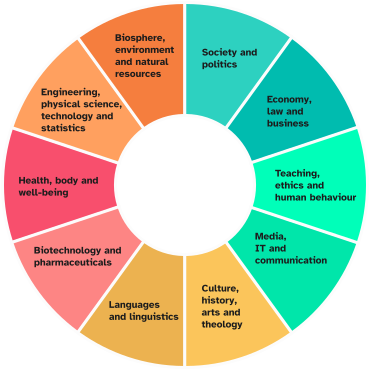
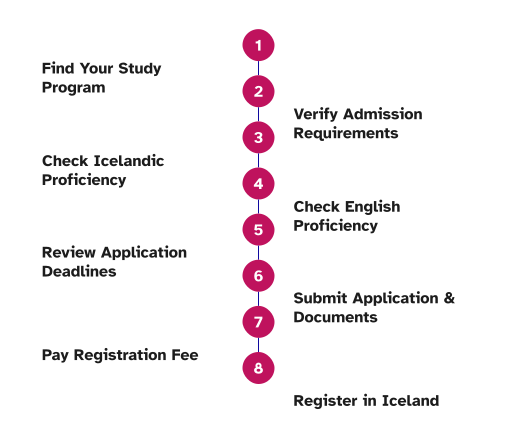
Additional information

The University of Iceland collaborates with over 400 universities worldwide. This provides a unique opportunity to pursue part of your studies at an international university thus gaining added experience and fresh insight into your field of study.

Students generally have the opportunity to join an exchange programme, internship, or summer courses. However, exchanges are always subject to faculty approval.

Students have the opportunity to have courses evaluated as part of their studies at the University of Iceland, so their stay does not have to affect the duration of their studies.

After completing the diploma, students may apply to the Directorate of Education for a teaching license.

This programme could open up careers in:

  • Teaching in upper secondary schools
  • Specialist positions within the education system

This list is not exhaustive.

  • The student organisation for student teachers at the University of Iceland is called Kennó
  • Kennó organises events such as socials for new students, annual galas and workplace tours
  • Get an insight into the lives of student teachers and qualified teachers through the Come and Teach project and the Icelandic Education Award

More about the UI student's social life

Students' comments
Portrait photo of Móses Helgi Halldórsson
Switching to teaching at fifty was the best decision. The programme suited me perfectly, with supportive, excellent teachers. I completed my teaching certification in a year and now enjoy teaching immensely. Highly recommend for those considering a career change.
Portrait photo of Þuríður Ragnheiður Sigurjónsdóttir
Teaching at a vocational school in East Iceland, I pursued a teaching certification to secure my career and explore future opportunities. Distance learning during these changing times is engaging and enhances both my skills and the school's capabilities.
Helpful content
Aurora Cooperation

Study wheel

What interests you?

Aurora Cooperation

How to apply

Follow the path

Contact us

If you still have questions, feel free to contact us.

School of Education
9:00 am - 3:00 pm
General Service and social media

The Service Desk is a point of access for all services. You can drop in at the University Centre or use the WebChat at the bottom right of this page.

Follow the School of Education on Instagram,   Youtube
and Facebook

University of Iceland, Saga (Building)

Share

Did this help?

Why wasn't this information helpful

Limit to 250 characters.