
""
Language skills
required
Programme length
One year.
Study mode
Face-to-face learning Distance learning
Application status
International students:
Students with Icelandic or Nordic citizenship:
Overview

  • Do you want to learn to speak and read basic Icelandic? 
  • Do you want to be able to communicate in Icelandic in your day-to-day life? 
  • Do you want to make it easier for you to actively engage in Icelandic society? 

The Practical Diploma in Icelandic as a second language is a 60 ECTS programme for students who have little prior knowledge of Icelandic. 

Icelandic proficiency requirements

Applicants must demonstrate through an entrance examination that they have reached level A1 within the Common European Framework when they start the programme. See, for example:

Information about the entrance exam can be found here.

Application deadline

The deadline for applications is:

  • 1 February for international students
  • 20 May for students who are residents of Iceland.

Applications must be sent through the Application Portal. Applications sent via email cannot be accepted. 

Classes

A full-time programme consists of two mornings or two afternoons per week, on Mondays/Tuesdays and Wednesdays/Thursdays. Students will have the chance to choose a group in late August, before the start of class. Also, there will be a group in the afternoon, four days per week, from 16:40 to 18:10 if enough participation is achieved. Online learning is available, and students attend either four mornings per week, from 8:20 to 9:50, or four afternoons per week, from 16:40 to 18:10, Monday to Thursday, provided that sufficient participation is achieved. Students choose their group in August, before the start of classes.

It is mandatory for all students of the Practical Diploma, including online students, to take midterm and final exams onsite at the University of Iceland, at UnA, UW, or other universities or official institutions that can supervise university exams.

Beginning of classes

Classes start in mid-August. Enrolled students can check our handbook related to the practical diploma after logging in with their university account.

Note: The last day for students to be allowed to start their studies after the beginning of the semester is 27 August 2026.

Foreign equivalent to the Icelandic matriculation examination (stúdentspróf) or equivalent qualification. Detailed information on admission requirements can be found in the Regulation on admission requirements for undergraduate study at the University of Iceland, no. 331/2022. Further information by country can be found here. Students whose native language is not English must also demonstrate English proficiency: TOEFL (79), IELTS (6,5) or PTE Academic (58). Other ways to meet the English requirements can be found here.

Students must have reached level A1 within the Common European Framework when they start the programme.

Applicants must take an admission test to proof this level of proficiency.

NOTE: At the University Council meeting on 4 December 2025, it was approved that in the academic year 2026–2027, the number of new students from outside the EEA, excluding Switzerland, Greenland and the Faroe Islands, will be limited to a maximum of 50.

Applicants must have passed a foreign equivalent of the Icelandic matriculation exam. Applicants whose first language is not English must also demonstrate proficiency in English, see Article 17 of Regulation no. 331/2022 on admission requirements for undergraduate study at the University of Iceland.

All applicants who meet the admission requirements must pass a written entrance exam to demonstrate level A1 Icelandic skills. Applicants resident in Iceland will take the written exam on site in Iceland but applicants living abroad will take the exam online. Applicants who pass the online written exam (minimum grade 6.0 out of 10) must also pass an oral exam via a video conferencing platform, designed to test A1 skills and confirm the examinee’s identity. The minimum grade for the oral exam is 6.0 out of 10.

If more than 50 students, to whom the restrictions apply, achieve the minimum grade on the oral exam, the applicants with the 50 best grades on the oral exam will be accepted to the programme.

To qualify for a diploma in Icelandic for Practical Purposes, students must complete the following: All students must finish the following six courses: Vocabulary and Grammar I, Speech and Expression I, Pronouncing and Listening I in the autumn semester; Vocabulary and Grammar II, Speech and Expression II and Pronunciation and Listening Comprehension II in the spring semester. On top of that, students must finish two of the following three courses: Self-Study in Icelandic I in autumn, Self-Study in Icelandic II in spring, Icelandic Culture in autumn or spring. To graduate from the Faculty of Icelandic and Comparative Cultural Studies, a student must achieve an average grade of 6.0 as stated in article 114 in Regulation for the University of Iceland no. 569-2009.

Programme structure

Check below to see how the programme is structured.

This programme does not offer specialisations.

First year | Fall
Self Study in Icelandic (ÍSE001G)
Restricted elective course, conditions apply
10 ECTS, credits
Course Description

This course focuses on grammar, listening comprehension and reading comprehension/vocabulary. The course is based on principles of autonomous learning where the overall aim is to train fluency and accuracy through self-directed work under the supervision of an instructor. Students will go through the web-based beginners course Icelandic Online I Plus and choose additionally one of the following sub-sections to work on: grammar, listening or reading/vocabulary. Students attend classes where they get the opportunity to ask questions and practice what they have learned.

Language of instruction: Icelandic
Face-to-face learning
Distance learning
Prerequisites
First year | Fall
Icelandic Culture (ÍSE014G)
Restricted elective course, conditions apply
10 ECTS, credits
Course Description

The aim of this course is to provide an overview of the development of Icelandic culture from early to modern times, with emphasis on contemporary culture and art. Focus is placed on the rapid development of the country from a rural to an urban society during the past decades and the way in which the development has influenced Icelandic music, visual arts, films, theatre, and literature.  Students will e.g. read a varied selection of literary texts. Icelandic Culture is open to all foreign students at the University of Iceland. The course is taught in English.

Language of instruction: English
Face-to-face learning
Distance learning
First year | Fall
Vocabulary and Grammar I (ÍSE002G)
A mandatory (required) course for the programme
10 ECTS, credits
Course Description

This course is aimed at beginners in Icelandic. The main emphasis is on practical efficiency in the spoken and written language. Practical vocabulary, basic grammar and syntax are introduced and practiced through reading, writing and oral communication. The grammatical topics covered on the course include gender, number, common verb phrases and the conjugation of verbs in the present tense.

Language of instruction: Icelandic
Face-to-face learning
Distance learning
Prerequisites
First year | Fall
Speech and Expression I (ÍSE030G)
A mandatory (required) course for the programme
5 ECTS, credits
Course Description

This course is for beginners in Icelandic. Strategies for managing interaction are introduced and practiced, i.e. opening and closing a conversation, making introductions, asking for service or assistance. Simple daily-life phrases are introduced. Students work on assignments as they conduct their daily lives in the so-called Icelandic Village, as well as out in wider society. Students work both individually and in small groups in the classroom setting and out in society through conversations and short presentations.

Language of instruction: Icelandic
Face-to-face learning
Distance learning
Prerequisites
First year | Fall
Pronunciation and Listening I (ÍSE032G)
A mandatory (required) course for the programme
5 ECTS, credits
Course Description

Basic features of the phonetic system of Icelandic are introduced and explained. The pronunciation of vowels and consonants is systematically trained and practiced, as are basic rules of intonation and stress. Students work on various listening, comprehension and pronunciation assignments, inside and outside the classroom.

Language of instruction: Icelandic
Face-to-face learning
Distance learning
Prerequisites
First year | Spring 1
Self Study in Icelandic II (ÍSE009G)
Restricted elective course, conditions apply
10 ECTS, credits
Course Description

This course is a continuation of the course ÍSE001G, Self Study in Icelandic I, based on principles of autonomous learning. The overall aim is to practice fluency and accuracy through self-directed work under the supervision of an instructor. Students will go through the web-based course Icelandic Online 2 Plus and choose additionally one of the following sub-sections to work on: grammar, listening or reading/vocabulary. Students attend classes where they get the opportunity to ask questions and practice what they have learned.

Language of instruction: Icelandic
Face-to-face learning
Distance learning
Prerequisites
First year | Spring 1
Icelandic Culture (ÍSE014G)
Restricted elective course, conditions apply
10 ECTS, credits
Course Description

The aim of this course is to provide an overview of the development of Icelandic culture from early to modern times, with emphasis on contemporary culture and art. Focus is placed on the rapid development of the country from a rural to an urban society during the past decades and the way in which the development has influenced Icelandic music, visual arts, films, theatre, and literature.  Students will e.g. read a varied selection of literary texts. Icelandic Culture is open to all foreign students at the University of Iceland. The course is taught in English.

Language of instruction: English
Face-to-face learning
Distance learning
First year | Spring 1
Vocabulary and Grammar II (ÍSE007G)
A mandatory (required) course for the programme
10 ECTS, credits
Course Description

This course is a continuation of the course ÍSE002G Vocabulary and Grammar I.

The main aim of this course is to expand students' vocabulary through reading and writing. Students read texts/stories on daily-life topics and use them to practice language use, vocabulary and grammar. Basic Icelandic grammar will be introduced and trained at home/in class. Areas of grammar to be covered include conjugation of verbs in the present and past tense, grammatical gender and the declension of nominals.

Language of instruction: Icelandic
Face-to-face learning
Distance learning
Prerequisites
First year | Spring 1
Speech and Expression II (ÍSE031G)
A mandatory (required) course for the programme
5 ECTS, credits
Course Description

This course is a continuation of the course ÍSE030G Speech and Expression I. Students read short texts at home concerning daily-life issues and discuss them in small groups in class. Students are also expected to give presentations about some of these topics in front of the class. Furthermore, lessons are intended to prepare students for communication outside the classroom.

Language of instruction: Icelandic
Face-to-face learning
Distance learning
Prerequisites
First year | Spring 1
Pronunciation and Listening II (ÍSE033G)
A mandatory (required) course for the programme
5 ECTS, credits
Course Description

This course is a continuation of the course ÍSE032G Pronunciation and Listening Comprehension I. Various pronunciation rules are explained, trained and practiced, especially those pertaining to consonant clusters and vowel-consonant sequences. Common elisions and changes of sounds in continuous speech are dealt with. Students work on listening, comprehension, and pronunciation assignments inside and outside the classroom.

Language of instruction: Icelandic
Face-to-face learning
Distance learning
Prerequisites
First year
  • Fall
  • ÍSE001G
    Self Study in Icelandic
    Restricted elective course
    10
    Restricted elective course, conditions apply
    10 ECTS, credits
    Course Description

    This course focuses on grammar, listening comprehension and reading comprehension/vocabulary. The course is based on principles of autonomous learning where the overall aim is to train fluency and accuracy through self-directed work under the supervision of an instructor. Students will go through the web-based beginners course Icelandic Online I Plus and choose additionally one of the following sub-sections to work on: grammar, listening or reading/vocabulary. Students attend classes where they get the opportunity to ask questions and practice what they have learned.

    Face-to-face learning
    Distance learning
    Prerequisites
  • ÍSE014G
    Icelandic Culture
    Restricted elective course
    10
    Restricted elective course, conditions apply
    10 ECTS, credits
    Course Description

    The aim of this course is to provide an overview of the development of Icelandic culture from early to modern times, with emphasis on contemporary culture and art. Focus is placed on the rapid development of the country from a rural to an urban society during the past decades and the way in which the development has influenced Icelandic music, visual arts, films, theatre, and literature.  Students will e.g. read a varied selection of literary texts. Icelandic Culture is open to all foreign students at the University of Iceland. The course is taught in English.

    Face-to-face learning
    Distance learning
    Prerequisites
  • ÍSE002G
    Vocabulary and Grammar I
    Mandatory (required) course
    10
    A mandatory (required) course for the programme
    10 ECTS, credits
    Course Description

    This course is aimed at beginners in Icelandic. The main emphasis is on practical efficiency in the spoken and written language. Practical vocabulary, basic grammar and syntax are introduced and practiced through reading, writing and oral communication. The grammatical topics covered on the course include gender, number, common verb phrases and the conjugation of verbs in the present tense.

    Face-to-face learning
    Distance learning
    Prerequisites
  • ÍSE030G
    Speech and Expression I
    Mandatory (required) course
    5
    A mandatory (required) course for the programme
    5 ECTS, credits
    Course Description

    This course is for beginners in Icelandic. Strategies for managing interaction are introduced and practiced, i.e. opening and closing a conversation, making introductions, asking for service or assistance. Simple daily-life phrases are introduced. Students work on assignments as they conduct their daily lives in the so-called Icelandic Village, as well as out in wider society. Students work both individually and in small groups in the classroom setting and out in society through conversations and short presentations.

    Face-to-face learning
    Distance learning
    Prerequisites
  • ÍSE032G
    Pronunciation and Listening I
    Mandatory (required) course
    5
    A mandatory (required) course for the programme
    5 ECTS, credits
    Course Description

    Basic features of the phonetic system of Icelandic are introduced and explained. The pronunciation of vowels and consonants is systematically trained and practiced, as are basic rules of intonation and stress. Students work on various listening, comprehension and pronunciation assignments, inside and outside the classroom.

    Face-to-face learning
    Distance learning
    Prerequisites
  • Spring 2
  • ÍSE009G
    Self Study in Icelandic II
    Restricted elective course
    10
    Restricted elective course, conditions apply
    10 ECTS, credits
    Course Description

    This course is a continuation of the course ÍSE001G, Self Study in Icelandic I, based on principles of autonomous learning. The overall aim is to practice fluency and accuracy through self-directed work under the supervision of an instructor. Students will go through the web-based course Icelandic Online 2 Plus and choose additionally one of the following sub-sections to work on: grammar, listening or reading/vocabulary. Students attend classes where they get the opportunity to ask questions and practice what they have learned.

    Face-to-face learning
    Distance learning
    Prerequisites
  • ÍSE014G
    Icelandic Culture
    Restricted elective course
    10
    Restricted elective course, conditions apply
    10 ECTS, credits
    Course Description

    The aim of this course is to provide an overview of the development of Icelandic culture from early to modern times, with emphasis on contemporary culture and art. Focus is placed on the rapid development of the country from a rural to an urban society during the past decades and the way in which the development has influenced Icelandic music, visual arts, films, theatre, and literature.  Students will e.g. read a varied selection of literary texts. Icelandic Culture is open to all foreign students at the University of Iceland. The course is taught in English.

    Face-to-face learning
    Distance learning
    Prerequisites
  • ÍSE007G
    Vocabulary and Grammar II
    Mandatory (required) course
    10
    A mandatory (required) course for the programme
    10 ECTS, credits
    Course Description

    This course is a continuation of the course ÍSE002G Vocabulary and Grammar I.

    The main aim of this course is to expand students' vocabulary through reading and writing. Students read texts/stories on daily-life topics and use them to practice language use, vocabulary and grammar. Basic Icelandic grammar will be introduced and trained at home/in class. Areas of grammar to be covered include conjugation of verbs in the present and past tense, grammatical gender and the declension of nominals.

    Face-to-face learning
    Distance learning
    Prerequisites
  • ÍSE031G
    Speech and Expression II
    Mandatory (required) course
    5
    A mandatory (required) course for the programme
    5 ECTS, credits
    Course Description

    This course is a continuation of the course ÍSE030G Speech and Expression I. Students read short texts at home concerning daily-life issues and discuss them in small groups in class. Students are also expected to give presentations about some of these topics in front of the class. Furthermore, lessons are intended to prepare students for communication outside the classroom.

    Face-to-face learning
    Distance learning
    Prerequisites
  • ÍSE033G
    Pronunciation and Listening II
    Mandatory (required) course
    5
    A mandatory (required) course for the programme
    5 ECTS, credits
    Course Description

    This course is a continuation of the course ÍSE032G Pronunciation and Listening Comprehension I. Various pronunciation rules are explained, trained and practiced, especially those pertaining to consonant clusters and vowel-consonant sequences. Common elisions and changes of sounds in continuous speech are dealt with. Students work on listening, comprehension, and pronunciation assignments inside and outside the classroom.

    Face-to-face learning
    Distance learning
    Prerequisites

The timetable shown below is for the current academic year and is FOR REFERENCE ONLY.

Changes may occur for the autumn semester in August and September and for the spring semester in December and January. You will find your final timetable in Ugla when the studies start.

Note! This timetable is not suitable for planning your work schedule if you are a part-time employee.


Additional information

The University of Iceland collaborates with over 400 universities worldwide. This provides a unique opportunity to pursue part of your studies at an international university thus gaining added experience and fresh insight into your field of study.

Students generally have the opportunity to join an exchange programme, internship, or summer courses. However, exchanges are always subject to faculty approval.

Students have the opportunity to have courses evaluated as part of their studies at the University of Iceland, so their stay does not have to affect the duration of their studies.

A better knowledge of Icelandic will enable you to:

  • work on the Icelandic labour market 
  • work in tourism 
  • work in imports and exports 
  • continue studying Icelandic 

This list is not exhaustive 

  • Huldumál is the organisation for students of Icelandic as a second language
  • The organisation promotes an active social calendar and advocates for members

More about the UI student's social life.

Students' comments
""
I find the study programme both challenging and exciting. All courses are taught in Icelandic from the beginning, which can be difficult for people who have recently arrived in Iceland and do not have much knowledge of Icelandic. You have to prepare very well and preferably study every day, if you want to succeed, but it pays off soon.
Helpful content
Aurora Cooperation

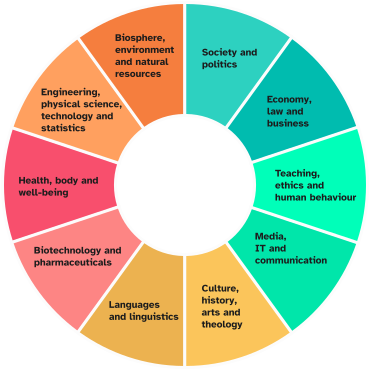
Study wheel

What interests you?

Aurora Cooperation

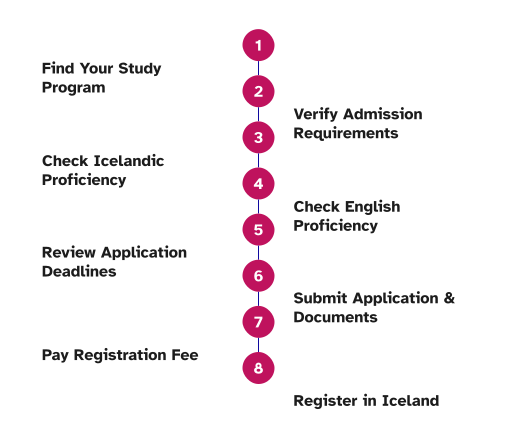
How to apply

Follow the path

Contact us

If you still have questions, feel free to contact us.

School of Humanities
Weekdays: 10-12 am and 1-3 pm
General Service and Social Media

The Service Desk is a point of access for all services. You can drop in at the University Centre or use the WebChat at the bottom right of this page.

Follow the School of Humanities on Instagram,   Youtube
and Facebook

""

Share

Did this help?

Why wasn't this information helpful

Limit to 250 characters.