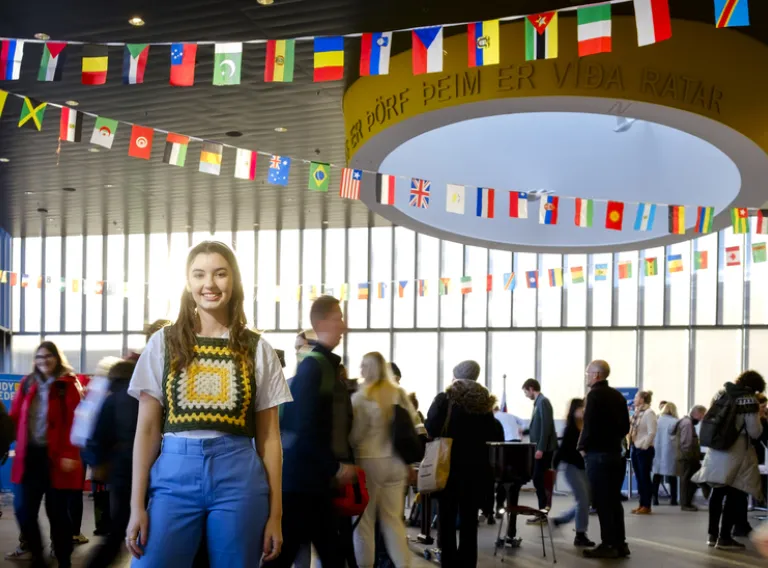
Language skills
Programme length
One year - 60 ECTS
Study mode
Face-to-face learning
Distance learning
Application status
International students:
Students with Icelandic or Nordic citizenship:
- Do you want to learn more about French society?
- Do you want to start with a one-year diploma before deciding your next steps?
- Are you interested in French culture and language?
- Do you want to improve your French?
- Do you want a diverse selection of courses that suit your interests?
French is an important language in international affairs. Along with English and German, it is a procedural language (langue de travail) of the European Union and one of the six official languages of the United Nations.
Applicants should already have studied French at upper secondary school and attained a basic level of proficiency. This programme builds on that knowledge and explores French grammar, pronunciation and texts in greater depth.
Programme structure
The programme is 60 ECTS and is organised as one year of full-time study.
It is made up of:
- Mandatory courses, 48 ECTS
- Elective courses, 12 ECTS
Organisation of teaching
The programme is taught in French.
As of the autumn semester 2024, all mandatory courses will be offered through distance learning.
Objectives
The programme is designed to ensure that students:
- are able to express themselves in French on various topics, both orally and in writing
- acquire proficiency in the French language and insight into the cultures and societies of French-speaking countries
- are able to use their knowledge and understanding in an academic or professional context
Other
- Credits from this programme may be transferred to the 180 ECTS BA programme in French studies.
Icelandic matriculation examination (stúdentspróf) or equivalent qualification.
Students are required to have language proficiency in French at the A2 level according to the Common European Framework of Reference for Languages.
To complete the diploma in French the student must complete all the compulsory courses specified in the programme structure:
- FRA101G French Grammar I
- FRA104G Pronunciation
- FRA106G French society I
- FRA113G Translation I
- FRA201G French society II
- FRA203G History of France
- FRA205G French Grammar II
- FRA214G French Literature and Culture
The other 12 credits are FRA electives from the BA in French Studies, free of choice.
Programme structure
Check below to see how the programme is structured.
This programme does not offer specialisations.
- Year unspecified
- Fall
- French Grammar I
- Pronunciation
- French Society I
- Translation I
- Directed Study in French: Translation II
- Special Reading Project
- Special Pronunciation Project
- French society III
- Not taught this semesterThe Short Story in French Literature
- Languages and Cultures I: Academic Methods and Techniques
- Spring 1
- French society II
- History of France
- French Grammar II
- French Literature and Culture
- Special Reading Project
- Special Pronunciation Project
- Spoken Language Skills Course in France
- Languages and Theatre
Year unspecified | Fall
French Grammar I (FRA101G)
A mandatory (required) course for the programme
6 ECTS, credits
Course Description
The students get the opportunity to develop their knowledge in french grammar and they learn to talk about it (with the appropriate terms). Emphasis on verbs and personal pronouns.
Students are asked to be autonome in their studies and to prepare the courses.
Language of instruction: French
Face-to-face learning
Distance learning
Year unspecified | Fall
Pronunciation (FRA104G)
A mandatory (required) course for the programme
6 ECTS, credits
Course Description
Conversation practice in discussion. There will be one academic lecture per week (1x 40 min.) to teach students the basic concepts and methods of General Phonetics, and one and a half training session per week in a language-lab.
Language of instruction: French
Face-to-face learning
Distance learning
Year unspecified | Fall
French Society I (FRA106G)
A mandatory (required) course for the programme
6 ECTS, credits
Course Description
n this course, students will practice both writing and speaking French. Various topics will be covered related to the different provinces and regions of French society and French-speaking countries.
Media and social media, films, and more will be used.
The material will be discussed, and students will have the opportunity to practice their presentation skills.
Students will be trained in writing short and concise texts on various topics in French. They will practice summarizing material, retelling, paraphrasing, presenting written arguments for their case, and structuring a text clearly. They will also get used to using dictionaries and other aids.
Language of instruction: French
Face-to-face learning
Distance learning
Prerequisites
Year unspecified | Fall
Translation I (FRA113G)
A mandatory (required) course for the programme
6 ECTS, credits
Course Description
In this course students will be trained in reading, analysing and translating French texts (easy to average difficulty) from French into Icelandic. Students will translate different kinds of texts (news, blogs, articles, literary texts) and discuss their characteristics, grammar, syntax, etc. Students will also be trained in the use of dictionaries and others important tools.
Language of instruction: French
Face-to-face learning
Distance learning
Year unspecified | Fall
Directed Study in French: Translation II (FRA022G)
Free elective course within the programme
6 ECTS, credits
Course Description
In this directed study in French students can further develop their skills in translating from French to Icelandic. Texts are chosen in collaboration with the teacher.
Language of instruction: French
Distance learning
Self-study
Year unspecified | Fall
Special Reading Project (FRA110G)
Free elective course within the programme
1 ECTS, credits
Course Description
A reading project in French literature. Students must contact the supervisor.
Language of instruction: French
Year unspecified | Fall
Special Pronunciation Project (FRA111G)
Free elective course within the programme
1 ECTS, credits
Course Description
A pronunciation practice.
Language of instruction: French
Face-to-face learning
Year unspecified | Fall
French society III (FRA319G)
Free elective course within the programme
6 ECTS, credits
Course Description
The course will focus on specific topics related to French society, culture, and history, from the colonial era to the present day. Literary works, films, and academic articles related to the material will be used.
Students will be trained in summarizing material, presenting arguments for their case, and explaining the course material in short essays and presentations.
Language of instruction: French
Face-to-face learning
Distance learning
Prerequisites
Not taught this semester
Year unspecified | Fall
The Short Story in French Literature (FRA434G)
Free elective course within the programme
6 ECTS, credits
Course Description
Short story writing in France reached its peak in the 19th century when the master of storytelling, Guy de Maupassant, was active and short stories regularly appeared on the front pages of newspapers and magazines. The writing of short stories has a long history in French literature, although the definition of this literary genre has varied over time. As a narrative of a “recent event”, the short story emerged in France during the Renaissance with The Heptaméron by Marguerite de Navarre, while the historical short story made its mark in the 17th century with Madame de Lafayette and others. In the 18th century, the short narrative was then used in various ways by Voltaire, Sade, Germaine de Staël, and others, and the diversity increased even further when 19th-century writers and poets tried their hand at the short form, including Balzac, Baudelaire, George Sand, and Mérimée…
In this course, the development of the short story will be briefly presented, and some of its predecessors read and introduced. The main emphasis will be on texts from the 17th to the 19th centuries, examining their content and narrative form. Finally, we will consider the short story in the contemporary French literary world.
The texts will be read in Icelandic or English translations. The course will be taught in Icelandic, but students who read French have access to reading material in French and an optional extra class every week where the week's material is reviewed in French.
Among the authors who will be read and discussed are Marguerite de Navarre, Charles Sorel, Madame de Lafayette, Sade, Germaine de Staël, Baudelaire, Balzac, George Sand, Mérimée, and Maupassant.
Language of instruction: French
Face-to-face learning
Distance learning
Prerequisites
Year unspecified | Fall
Languages and Cultures I: Academic Methods and Techniques (MOM101G)
Free elective course within the programme
5 ECTS, credits
Course Description
Please keep in mind that THIS COURSE IS TAUGHT IN ICELANDIC.
MOM101G is intended for students of foreign languages OTHER than English. BA-students in English and those who do not speak Icelandic should register in MOM102G.
Language of instruction: Icelandic
Face-to-face learning
Prerequisites
Year unspecified | Spring 1
French society II (FRA201G)
A mandatory (required) course for the programme
6 ECTS, credits
Course Description
his course will cover the French language today, focusing on different registers. It will also discuss the main changes that have occurred in French in recent decades, particularly regarding feminine forms of nouns and gender-neutral language. To this end, newspaper articles and academic articles on the development and status of the French language will be used.
Exercises will focus on various aspects related to register and style, word choice, grammar, sentence structure, and text structure.
Students will be trained in arguing their case, summarizing, and explaining the course material in written exercises, lectures, and discussion groups.
Language of instruction: French
Face-to-face learning
Distance learning
Prerequisites
Year unspecified | Spring 1
History of France (FRA203G)
A mandatory (required) course for the programme
6 ECTS, credits
Course Description
French history from the origins to the twentieth century.
Language of instruction: French
Face-to-face learning
Distance learning
Year unspecified | Spring 1
French Grammar II (FRA205G)
A mandatory (required) course for the programme
6 ECTS, credits
Course Description
New elements studied: interrogation, determinants, relative pronouns, negative sentences and subjunctive.
Students should finish French grammar and written expression I before enrolling in this course.
This course emphasizes on how to use grammatical concepts in their assignments.
Students must be well prepared before each lesson and are autonom in their learning process.
Language of instruction: French
Face-to-face learning
Distance learning
Year unspecified | Spring 1
French Literature and Culture (FRA214G)
A mandatory (required) course for the programme
6 ECTS, credits
Course Description
An introductory course in the BA program in French Studies.
Short stories, poems, excerpts from novels and plays from different periods will be read and studied. Students will become familiar with the principal literary texts, the terminology and methods of text analysis and interpretation.
Language of instruction: French
Face-to-face learning
Distance learning
Year unspecified | Spring 1
Special Reading Project (FRA110G)
Free elective course within the programme
1 ECTS, credits
Course Description
A reading project in French literature. Students must contact the supervisor.
Language of instruction: French
Year unspecified | Spring 1
Special Pronunciation Project (FRA111G)
Free elective course within the programme
1 ECTS, credits
Course Description
A pronunciation practice.
Language of instruction: French
Face-to-face learning
Year unspecified | Spring 1
Spoken Language Skills Course in France (FRA438G)
Free elective course within the programme
6 ECTS, credits
Course Description
A two-week intensive course in French language skills at the Université de Rennes. Students will engage in conversation related to history, culture and contemporary issues in French society. The course takes place in weeks 7 and 8 during the spring semester. Max. 18 participants.
Evaluation:
Participation: 50%
Presentation: 25%
Written assignment: 25%
Language of instruction: French
Face-to-face learning
Course taught second half of the semester
Year unspecified | Spring 1
Languages and Theatre (MOM401G)
Free elective course within the programme
6 ECTS, credits
Course Description
Optional course for students of the Faculty of Languages and Cultures, in their 2nd or 3rd year of the BA-programme. The students read and study a well-known play that has been translated into several languages. The students will read the text in the target language. The students choose scenes from the play for the production.
Teachers from the target languages will assist the students with pronunciation.
Maximum number of students in this course is 15.
Language of instruction: Icelandic
Face-to-face learning
Prerequisites
Year unspecified
- Fall
- FRA101GFrench Grammar IMandatory (required) course6A mandatory (required) course for the programme6 ECTS, creditsCourse Description
The students get the opportunity to develop their knowledge in french grammar and they learn to talk about it (with the appropriate terms). Emphasis on verbs and personal pronouns.
Students are asked to be autonome in their studies and to prepare the courses.
Face-to-face learningDistance learningPrerequisitesFRA104GPronunciationMandatory (required) course6A mandatory (required) course for the programme6 ECTS, creditsCourse DescriptionConversation practice in discussion. There will be one academic lecture per week (1x 40 min.) to teach students the basic concepts and methods of General Phonetics, and one and a half training session per week in a language-lab.
Face-to-face learningDistance learningPrerequisitesFRA106GFrench Society IMandatory (required) course6A mandatory (required) course for the programme6 ECTS, creditsCourse Descriptionn this course, students will practice both writing and speaking French. Various topics will be covered related to the different provinces and regions of French society and French-speaking countries.
Media and social media, films, and more will be used.
The material will be discussed, and students will have the opportunity to practice their presentation skills.
Students will be trained in writing short and concise texts on various topics in French. They will practice summarizing material, retelling, paraphrasing, presenting written arguments for their case, and structuring a text clearly. They will also get used to using dictionaries and other aids.
Face-to-face learningDistance learningPrerequisitesFRA113GTranslation IMandatory (required) course6A mandatory (required) course for the programme6 ECTS, creditsCourse DescriptionIn this course students will be trained in reading, analysing and translating French texts (easy to average difficulty) from French into Icelandic. Students will translate different kinds of texts (news, blogs, articles, literary texts) and discuss their characteristics, grammar, syntax, etc. Students will also be trained in the use of dictionaries and others important tools.
Face-to-face learningDistance learningPrerequisitesFRA022GDirected Study in French: Translation IIElective course6Free elective course within the programme6 ECTS, creditsCourse DescriptionIn this directed study in French students can further develop their skills in translating from French to Icelandic. Texts are chosen in collaboration with the teacher.
Distance learningSelf-studyPrerequisitesFRA110GSpecial Reading ProjectElective course1Free elective course within the programme1 ECTS, creditsCourse DescriptionA reading project in French literature. Students must contact the supervisor.
PrerequisitesFRA111GSpecial Pronunciation ProjectElective course1Free elective course within the programme1 ECTS, creditsCourse DescriptionA pronunciation practice.
Face-to-face learningPrerequisitesCourse DescriptionThe course will focus on specific topics related to French society, culture, and history, from the colonial era to the present day. Literary works, films, and academic articles related to the material will be used.
Students will be trained in summarizing material, presenting arguments for their case, and explaining the course material in short essays and presentations.
Face-to-face learningDistance learningPrerequisitesNot taught this semesterFRA434GThe Short Story in French LiteratureElective course6Free elective course within the programme6 ECTS, creditsCourse DescriptionShort story writing in France reached its peak in the 19th century when the master of storytelling, Guy de Maupassant, was active and short stories regularly appeared on the front pages of newspapers and magazines. The writing of short stories has a long history in French literature, although the definition of this literary genre has varied over time. As a narrative of a “recent event”, the short story emerged in France during the Renaissance with The Heptaméron by Marguerite de Navarre, while the historical short story made its mark in the 17th century with Madame de Lafayette and others. In the 18th century, the short narrative was then used in various ways by Voltaire, Sade, Germaine de Staël, and others, and the diversity increased even further when 19th-century writers and poets tried their hand at the short form, including Balzac, Baudelaire, George Sand, and Mérimée…
In this course, the development of the short story will be briefly presented, and some of its predecessors read and introduced. The main emphasis will be on texts from the 17th to the 19th centuries, examining their content and narrative form. Finally, we will consider the short story in the contemporary French literary world.
The texts will be read in Icelandic or English translations. The course will be taught in Icelandic, but students who read French have access to reading material in French and an optional extra class every week where the week's material is reviewed in French.
Among the authors who will be read and discussed are Marguerite de Navarre, Charles Sorel, Madame de Lafayette, Sade, Germaine de Staël, Baudelaire, Balzac, George Sand, Mérimée, and Maupassant.
Face-to-face learningDistance learningPrerequisitesMOM101GLanguages and Cultures I: Academic Methods and TechniquesElective course5Free elective course within the programme5 ECTS, creditsCourse DescriptionPlease keep in mind that THIS COURSE IS TAUGHT IN ICELANDIC.
MOM101G is intended for students of foreign languages OTHER than English. BA-students in English and those who do not speak Icelandic should register in MOM102G.
Face-to-face learningPrerequisites- Spring 2
FRA201GFrench society IIMandatory (required) course6A mandatory (required) course for the programme6 ECTS, creditsCourse Descriptionhis course will cover the French language today, focusing on different registers. It will also discuss the main changes that have occurred in French in recent decades, particularly regarding feminine forms of nouns and gender-neutral language. To this end, newspaper articles and academic articles on the development and status of the French language will be used.
Exercises will focus on various aspects related to register and style, word choice, grammar, sentence structure, and text structure.
Students will be trained in arguing their case, summarizing, and explaining the course material in written exercises, lectures, and discussion groups.
Face-to-face learningDistance learningPrerequisitesFRA203GHistory of FranceMandatory (required) course6A mandatory (required) course for the programme6 ECTS, creditsCourse DescriptionFrench history from the origins to the twentieth century.
Face-to-face learningDistance learningPrerequisitesFRA205GFrench Grammar IIMandatory (required) course6A mandatory (required) course for the programme6 ECTS, creditsCourse DescriptionNew elements studied: interrogation, determinants, relative pronouns, negative sentences and subjunctive.
Students should finish French grammar and written expression I before enrolling in this course.
This course emphasizes on how to use grammatical concepts in their assignments.
Students must be well prepared before each lesson and are autonom in their learning process.
Face-to-face learningDistance learningPrerequisitesFRA214GFrench Literature and CultureMandatory (required) course6A mandatory (required) course for the programme6 ECTS, creditsCourse DescriptionAn introductory course in the BA program in French Studies.
Short stories, poems, excerpts from novels and plays from different periods will be read and studied. Students will become familiar with the principal literary texts, the terminology and methods of text analysis and interpretation.
Face-to-face learningDistance learningPrerequisitesFRA110GSpecial Reading ProjectElective course1Free elective course within the programme1 ECTS, creditsCourse DescriptionA reading project in French literature. Students must contact the supervisor.
PrerequisitesFRA111GSpecial Pronunciation ProjectElective course1Free elective course within the programme1 ECTS, creditsCourse DescriptionA pronunciation practice.
Face-to-face learningPrerequisitesFRA438GSpoken Language Skills Course in FranceElective course6Free elective course within the programme6 ECTS, creditsCourse DescriptionA two-week intensive course in French language skills at the Université de Rennes. Students will engage in conversation related to history, culture and contemporary issues in French society. The course takes place in weeks 7 and 8 during the spring semester. Max. 18 participants.
Evaluation:
Participation: 50%
Presentation: 25%
Written assignment: 25%Face-to-face learningPrerequisitesCourse taught second half of the semesterMOM401GLanguages and TheatreElective course6Free elective course within the programme6 ECTS, creditsCourse DescriptionOptional course for students of the Faculty of Languages and Cultures, in their 2nd or 3rd year of the BA-programme. The students read and study a well-known play that has been translated into several languages. The students will read the text in the target language. The students choose scenes from the play for the production.
Teachers from the target languages will assist the students with pronunciation.
Maximum number of students in this course is 15.
Face-to-face learningPrerequisitesAdditional information The University of Iceland collaborates with over 400 universities worldwide. This provides a unique opportunity to pursue part of your studies at an international university thus gaining added experience and fresh insight into your field of study.
Students generally have the opportunity to join an exchange programme, internship, or summer courses. However, exchanges are always subject to faculty approval.
Students have the opportunity to have courses evaluated as part of their studies at the University of Iceland, so their stay does not have to affect the duration of their studies.
PLEASE NOTE. In order to be eligible for exchange studies or other study periods abroad, students must be enrolled in a programme of at least 90 ECTS credits.
A qualification in French can be an asset in many different ways. Language skills can open doors in the cultural and intellectual sectors in other countries. In our modern society, which is increasingly connected and globalised, language skills and inter-cultural understanding are extremely valuable.
French-speaking countries and territories, other than France, include Belgium, Switzerland, Luxembourg, Québec in Canada, Martinique, Guadeloupe, French Guyana, Mauritius, Senegal, Cameroon, Réunion, French Polynesia and New Caledonia.
French can also be the key to future careers in a wide range of professions.
An education in this area can open up opportunities in:
- Academia
- Tourism
- Media
- Politics
- Teaching
- Translation and interpreting
- Business
- Administration
This list is not exhaustive.
- Linguae is the organisation for language students at the University of Iceland
- Linguae organises social events for students at the Faculty of Languages and Cultures
- Members currently include students of Italian, French, German, Spanish, Danish, Chinese and Russian
- Linguae runs a Facebook group and a Facebook page
Students' comments  The programme is very diverse and not only gives you increased skills in this beautiful and widespread language, but you also get a good insight into the history, culture, and society of France. I have read short stories, worked on translations, read and analyzed French plays, watched films and documentaries, trained pronunciation, and received training in creative writing. There is also a strong emphasis on conversations in class to improve expression skills, both in everyday life and within the academy. What stands out are the teachers who do their best to provide students with professional and personal advice, and help them develop their way of learning. We must not forget that it is possible to go on an exchange program in the 2nd year of study to a number of cities and towns in France, Belgium, and elsewhere!
 Enrolling in French Studies at the University of Iceland is one of the best decisions in my life! The programme is organized really well by teachers and staff, enabling students to do their best at all times. I went to study to gain more knowledge of French, but there is so much more to it. I learned how to tackle tasks using organized, scientific work methods, expanded my network, and opened the door to new opportunities!
 The French programme is so special in my mind because on the one hand there are elments that anyone interested in French would be drawn to, such as translation, grammar or history, and on the other hand, you also get encouragement to get acquainted with topics that you had not bothered with before. While it is certainly a challenge that all the study is done in French, it does not take long to get used to it, and you are starting to think about French in the car on the way home without realizing it. I chose French for a BA degree because I have a passion for languages and literature and now that I am finishing my second year I see that all aspects of the study are intertwined and support what I am most interested in, and give me a deeper understanding of the subject.
Helpful content 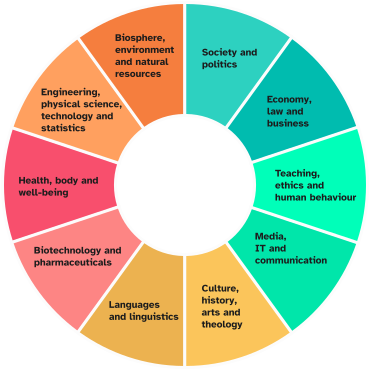
Study wheel
What interests you?
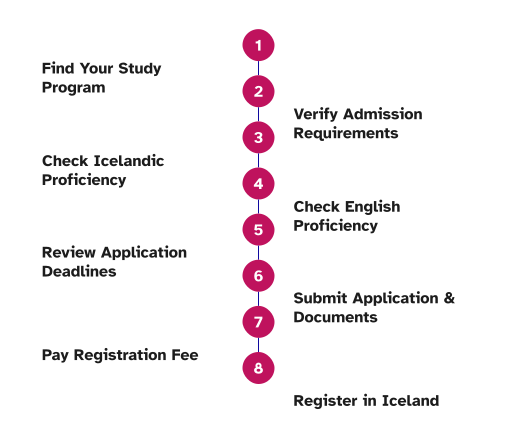
How to apply
Follow the path
Contact us If you still have questions, feel free to contact us.
School of HumanitiesWeekdays: 10-12 am and 1-3 pmGeneral Service and Social MediaThe Service Desk is a point of access for all services. You can drop in at the University Centre or use the WebChat at the bottom right of this page.
Follow the School of Humanities on Instagram, Youtube
and Facebook
Share