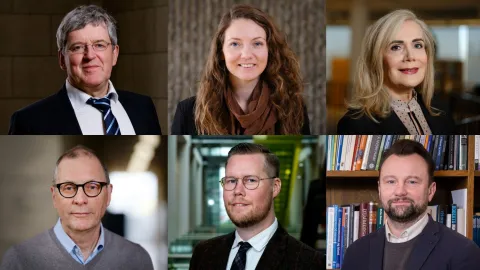
Ólafur Pétur Pálsson, professor at the Faculty of Industrial Engineering, Mechanical Engineering and Computer Science in the School of Engineering and Natural Sciences, Hrefna Dögg Gunnarsdóttir, associate professor at the Faculty of Law in the School of Social Sciences, and Ragný Þóra Guðjohnsen, associate professor in the Faculty of Education and Diversity in the School of Education, have been elected as representatives of the university community from among the university’s academic staff to serve on the University Council for the next two years. The election took place at the University Forum on 29 April.
Ólafur Pétur’s alternate is Eiríkur Steingrímsson, professor in the Faculty of Medicine in the School of Health Sciences; Hrefna Dögg’s alternate is Arngrímur Vídalín, associate professor in the Faculty of Subject Teacher Education in the School of Education; and Ragný Þóra’s alternate is Þórir Jónsson Hraundal, assistant professor in the Faculty of Languages and Cultures in the School of Humanities.
A call for nominations and suggestions for representatives to the University Council was recently advertised. All candidates met the eligibility requirements set out in the University of Iceland’s rules on candidacy. The election was conducted electronically at the University Forum, following the candidates' presentations.
Voting rights were held by the Rector, deans of schools, heads of faculties, representatives elected by the Schools, representatives of staff unions and administration, as well as representatives of affiliated and partner institutions. Student representatives did not have voting rights in this election, as they elect their two representatives to the University Council in a separate election. A total of 55 forum members were eligible to vote, and 46 cast their votes, resulting in a turnout of 83.6%.
The representatives will take their seats on the University Council from 1 July and will serve until the end of June 2028.
Students have already elected their two representatives to the next University Council, and the Minister of Culture, Innovation and Higher Education will appoint two additional members. These eight members will convene at the beginning of the upcoming autumn semester to select three external representatives, after which the new 11-member University Council will be fully constituted.