
Guðjón Ólafsson, one of the founders of Gleipnir Bioforge

Over 80% of pathogenic proteins in the human body are currently considered undruggable with conventional medicines. Many of these disease-causing proteins are the drivers behind serious and incurable diseases such as cancer and neurodegeneration. A new generation of medicines, known as induced proximity therapeutics, offers hope for a cure.

Induced proximity therapeutics have revolutionised how proteins, previously thought impossible to target, are treated. Instead of trying to inhibit their activity, induced proximity therapeutics, such as molecular glues, force these disease-causing proteins into close proximity with effector proteins and thus can leverage the cells’ “inner recycling system” to break them down. That way, the cell itself takes care of breaking down the pathogenic proteins.

“The problem is that the development of these induced proximity therapeutics is very expensive, slow, and has, up until now, largely been based on coincidences. It costs around 1-3 billion US dollars to bring a new drug to market. That affects both the healthcare system and patients, and around a third of that process and cost goes into the drug discovery process itself and preclinical studies,” says Guðjón Ólafsson, chief scientific officer and co-founder of Gleipnir Bioforge, and associate professor at the Faculty of Medicine.

This is where Gleipnir Bioforge and the screening platform SKÍRNIR come into the picture. Gleipnir has developed a revolutionary technology that speeds up and lowers the cost of developing induced proximity therapeutics. “In less time and with significantly lower costs, SKÍRNIR can systematically screen for induced proximity of any protein against many thousands of different proteins in living cells,” Guðjón explains.

Received the University of Iceland Science and Innovation Prize 2025

Guðjón received the University of Iceland Science and Innovation Prize last year, along with Eiríkur Steingrímsson, professor at UI’s Biomedical Center, for a project on which Gleipnir Bioforge is based. The project, one of 36 submitted proposals, won the Technology and Progress category and was also the overall winner of the prize.

The selection committee thought the project, then known as “ProDiGY – Proximity-driven Discovery of Molecular Glue Targets using Synthetic Human-Yeast Protein Interactions” offered clear societal benefits and a high degree of innovation. It also involved exciting technological advances and effectively combined diverse research methods.

Using yeast to develop medicines for humans

The start of the project can be traced to Guðjón’s doctoral research with Dr Peter Thorpe  at the Francis Crick Institute in London. “While there, I did fundamental research on yeast, which is a fantastic cellular model to understand how eukaryotic cells work. I used yeast cells to examine how chromosome segregation is regulated during cell division, a process that can cause cancer when it goes wrong in people,” Guðjón says.

After 17 years of study and research in London and New York, Guðjón moved back home to Iceland with his family when he received a postdoctoral grant from the Icelandic Research Fund. “That grant enabled me to further develop a method to do research on cancer-causing proteins that play a key role in melanoma in Eiríkur’s laboratory at UI’s Biomedical Center.”

Things really started moving when Guðjón’s idea of using this screening platform to accelerate the development of induced proximity therapeutics won the UI Science and Innovation Prize last year. “After that, the project attracted well-deserved attention, and we have received immense support from the University of Iceland, TTO Iceland, and the emerging innovation community here in Iceland. We participated in the innovation and business accelerators with Snjallræði and KLAK health at the end of 2025, which gave us invaluable experience to launch the project quickly,” says Guðjón, who is very pleased with all the support now available to entrepreneurs in Iceland.
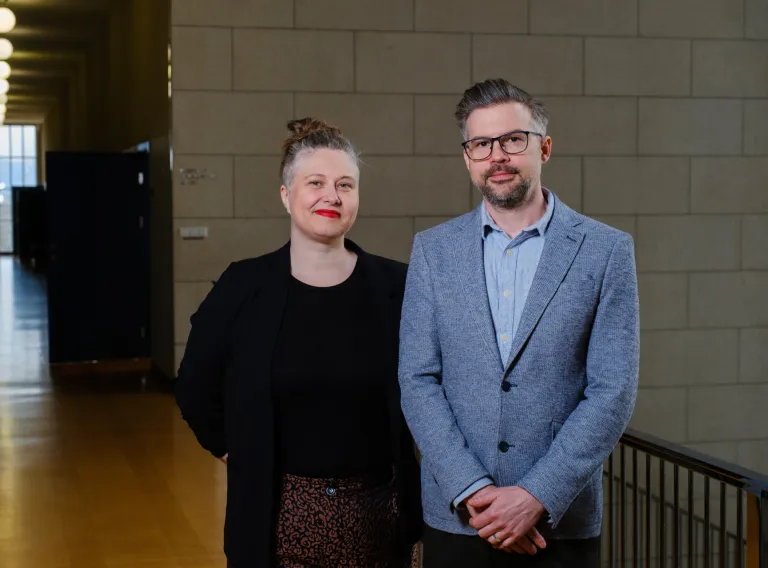

Guðjón Ólafsson and Henný Adolfsdóttir, founders of Gleipnir Bioforge.

A faster process that reduces uncertainty

The screening platform SKÍRNIR uses yeast cells as a “living test tube”. “This enables us to research thousands of biological interactions simultaneously to identify the best drug targets or protein pairs, and then we confirm the results in human cells,” Guðjón says.

Not only is the process both fast and economical, but it also decreases uncertainty. “We’re mapping the biology before pharmaceutical companies start their chemical development, speeding up the path to market for these new and potentially groundbreaking medicines,” he explains.

With this so-called “biological-function-first” approach, it is possible to identify precisely which protein pairs are best suited to target specific pathogenic proteins before beginning the conventional, and expensive, drug search. Thus, the risk and cost of developing induced proximity therapeutics can be significantly reduced.

“In fact, SKÍRNIR can be used to screen for virtually any protein from any organism, for example, proteins from drug-resistant bacteria and viruses. Therefore, Gleipnir Bioforge is a so-called species and disease agnostic company,” Guðjón adds.

Highly experienced colleagues

Guðjón is supported by highly experienced colleagues. “My co-founder and Gleipnir Bioforge’s chief executive officer is Henny Adolfsdóttir, who has years of experience in international business and contract negotiations. Marketing and sales are run by Birna Björnsdóttir, who brings invaluable experience after having worked at Pfizer, Teva and Sidekick.”

At the company’s laboratory, based at UI, Dr. Hieu Tran is the research director. Hieu has a PhD in biochemistry from the Graz University of Technology in Austria and previously worked as a biotechnologist at Alvotech. With him is Mikael Norðquist, who’ll complete his master’s in biochemistry and molecular biology in the School of Engineering and Natural Sciences in June 2027. Mikael applies bioinformatics and molecular biology in his research. He is the leader and one of the founders of the first Icelandic team in iGEM, an international competition in synthetic biology.

Incurable diseases will become a thing of the past

Asked what impact he believes the work of Gleipnir Bioforge could have on society, Guðjón says he is particularly excited about the company’s collaboration with the academic community.

“SKÍRNIR is operated using specialised screening equipment that Gleipnir Bioforge acquired through private investment. This equipment is the only one of its kind in Iceland, but it is accessible to researchers at the University of Iceland, and we are very open to collaborating with other start-ups and biotechnology companies. The equipment is already being used, for example, in a doctoral project at UI investigating a disease-related protein linked to serious syndromes, leukaemia and autoimmunity,” he says.

Above all, however, Gleipnir’s breakthrough technology is expected to have a major impact on the development of the next generation of medicines by providing the pharmaceutical industry with a more efficient and faster method for developing induced proximity therapeutics. Over time, this could accelerate the arrival of treatments for diseases that have so far been considered untreatable.

“Our vision at Gleipnir Bioforge is simply that incurable diseases will become a thing of the past. Induced proximity therapeutics and molecular glues will transform the landscape of drug treatment, making treatments more effective, safer and better for patients, and we are proud to offer the pharmaceutical industry a faster and more targeted way to develop these important treatments.”

Guðjón Ólafsson, one of the founders of Gleipnir Bioforge
"Our vision at Gleipnir Bioforge is simply that incurable diseases will become a thing of the past. Induced proximity therapeutics and molecular glues will transform the landscape of drug treatment." IMAGE/Kristinn Ingvarsson

Share

Tags
Did this help?

Why wasn't this information helpful

Limit to 250 characters.