In a new article in the journal Science, Magnús Tumi Guðmundsson, professor of geophysics at the Institute of Earth Sciences at the University of Iceland, and Christopher J. Bean, professor at the Dublin Institute for Advanced Studies, say that despite significant advances in recent decades in monitoring volcanoes, scientists are far from being able to forecast exactly when eruptions will start, their duration or magnitude.
The article belongs to the class of perspectives articles in Science, titled "Forecasting volcanic eruptions across scales", written at the request of the editor of Science, one of the most prestigious science journals worldwide. In the article, Magnús Tumi and Bean discuss one of earth sciences largest challenges: if, and then how, it’s possible to forecast volcanic eruptions, not only whether an eruption is imminent, but also their magnitude, evolution and impact.
The authors argue that volcanoes are among the most complex natural phenomena on Earth, and even though it is often possible to see that an eruption is likely, predicting its size can be very difficult. They point out that eruptions range from small effusive eruptions to massive, catastrophic eruptions that impact the climate and communities worldwide. Luckily, those kinds of eruptions are rare but can have a significant impact when they do occur.
Magnús Tumi is well-known in Iceland and has been among the country’s leading geophysicists and volcanologists for decades. He has repeatedly been called upon by the government and media to assess the status and development of volcanic eruptions in Iceland.
Iceland plays a key role
When it comes to volcanic activity and eruption forecasts, Iceland is prominent in the article. Iceland is effectively a living laboratory in geophysics, seismology and volcanology where volcanic activity, plate-boundaries and glaciers meet, making them impossible to ignore. Icelanders literally live on the boundary between two tectonic plates, and thus, volcanic eruptions have shaped both the land and the Icelandic nation for centuries.
The authors point out that volcanoes can give very different warnings. Some show clear signs of impending eruption for weeks or months, such as earthquakes, ground deformation and changes in geothermal heat. The warning signs for the eruption in Eyjafjallajökull in 2010, e.g., were relatively clear when compared to signs from many other volcanoes — and are often mentioned as an example of how closely monitored volcanoes can give scientists warnings about impending eruptions before they start.
The article also notes that other volcanoes can erupt at a very short notice. Hekla is specifically mentioned as an example of volcanoes where short-term precursors have sometimes lasted less than an hour before eruption. This makes eruption forecasting particularly difficult and underscores the importance of continuous monitoring.
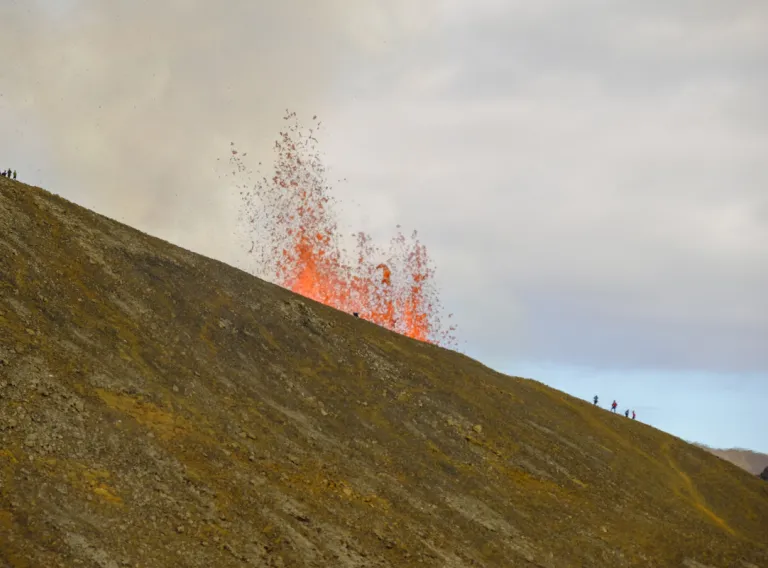
The article also discusses recent events on the Reykjanes Peninsula in 2023, when a large magmatic intrusion (a dyke) formed in a few hours without an eruption. Later, comparable magmatic intrusions led to eruptions. This shows that large-scale major unrest related to magma movement in the Earth’s crust does not always automatically lead to an eruption.