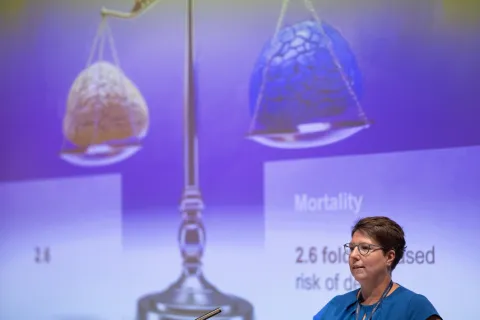
A symposium was held in Reykjavík in mid-September, organised by the University of Iceland (UI), the National University Hospital of Iceland (Landspítali), and the University of Innsbruck. Its purpose was to create a platform for interdisciplinary dialogue on medication safety, research, and clinical innovation to promote better quality and increased patient safety in relation to delirium.
In recent years, the University of Iceland, in collaboration with Landspítali, has engaged in robust research cooperation with the University of Innsbruck in Austria, particularly with Professor Anita Weidmann. The research group, led by Freyja Jónsdóttir, Associate Professor at the Faculty of Pharmaceutical Sciences, on behalf of the University of Iceland, has primarily focused on medications that may potentially be a causative factor in developing delirium among various patient groups. The objective is to lay the groundwork for international clinical guidelines.
At-risk groups
Delirium is a syndrome characterised by a disturbance in attention, consciousness, cognitive ability, and sensory perception. Delirium has a sudden onset and a fluctuating course. Delirium is a common, serious, and complex problem associated with poor prognosis for those who contract it. By responding quickly and correctly, delirium can be prevented, and recovery outcomes can be improved. Certain patient groups are at particular risk of developing delirium, such as patients with dementia, the elderly, and patients undergoing surgery.