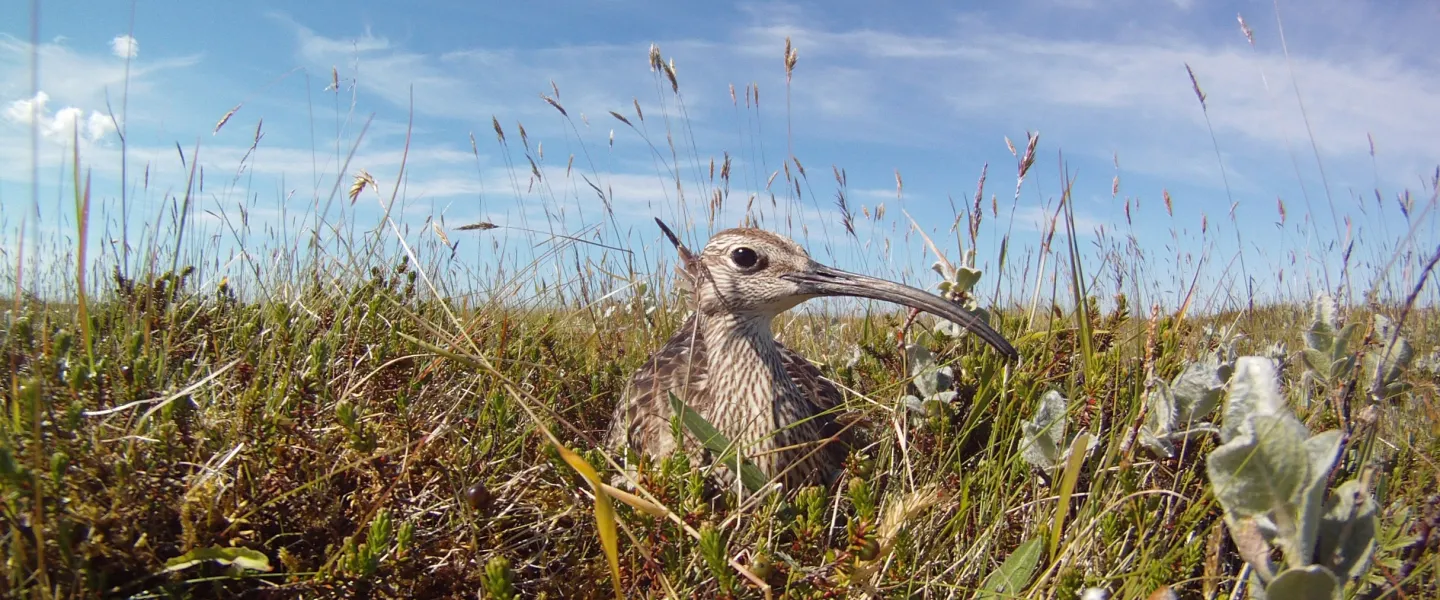
Whimbrel on the nest South Lowlands photo Camilo Carneiro


The Icelandic whimbrel migrates faster than any other whimbrel subspecies between its breeding and wintering grounds and is also the subspecies most threatened by human activities that reduce breeding habitat. These are among the findings of an extensive global study led by Camilo Carneiro, a postdoctoral researcher at the University of Iceland's South Iceland Research Centre, comparing the annual cycle and threats faced by different whimbrel subspecies.

The whimbrel is divided into two species and seven subspecies that live and migrate on all continents except Antarctica. All subspecies are long-distance migrants, breeding mainly in Arctic and boreal regions in North America, Europe, and Asia and wintering in areas closer to the equator.

Scientists have for some time used GPS equipment to track the migration of different bird species between their breeding and wintering grounds. Among those employing this technology are researchers at the University of Iceland's South Iceland Research Centre, who have conducted extensive research on various migratory bird species, including whimbrels. They have dedicated more than a decade studying this species, and as a result, the breeding grounds of the Icelandic whimbrel are among the best monitored of all whimbrel subspecies. Tómas Grétar Gunnarsson, research professor and director of the centre, and José Alves, guest researcher at the centre, have led much of the whimbrel research there and are also among the authors of the new study.

Research conducted at the centre has, for example, revealed that Icelandic whimbrels almost always fly south to their wintering grounds in a single, non-stop flight. On their return journey to Iceland, they either do the reverse or, more commonly, make a stopover of one to two weeks before completing the journey.

“Our research has also shown that the date of departure from the wintering grounds is an important predictor of migration behaviour, with whimbrels departing later being more likely to fly directly to Iceland, as if they are speeding to make up for lost time,” says Camilo, who completed his PhD under the supervision of José and Tómas.
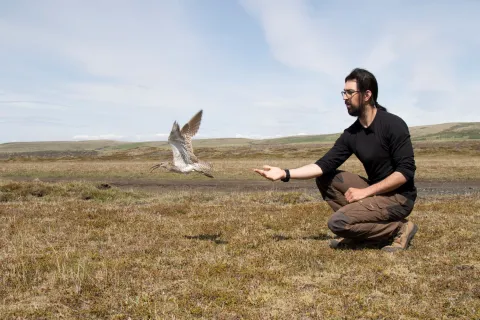
Camilo releasing a whimbrel_Triin Kaasiku
Camilo releasing a whimbrel. PHOTO/Triin Kaasiku

Datasets from all over the world

During his PhD studies, Camilo became increasingly interested in viewing specific annual phases as part of the broader annual cycle.

“I see this as crucial because there are a suite of potential trade-offs and carry-over effects operating cyclically, particularly in organisms with an apparently tight schedule, such as the whimbrel. As I saw more and more papers being published on the migrations of whimbrels along different flyways, I started to think it would be good to put all those findings into a single picture. This idea stayed in the back of my mind for some time,” Camilo says when asked about the origins of the newly published study.

Camilo used the initiative Global Wader, which aims to build a definitive register of shorebird tracking datasets, as a foundation for bringing as much whimbrel tracking data together in one place as possible. “Global Whimbrel, as we called it, started with a few flexible aims that were discussed and refined with people from around the globe as they came on board with us.”

The study is based on tracking datasets contributed by more than 50 researchers from around the world, representing most of the whimbrel tracking data collected to date. The aim was to identify spatial gaps in tracking coverage, compare subspecies across the annual cycle, and estimate the threats facing different subspecies in order to highlight where key research is most needed.

Using more than 2.6 million recorded locations from 251 individual whimbrels, the research group calculated migration distances for different subspecies, as well as estimating migration speed, ground speed, total stopover time, and the number of stopovers. They also scored 12 categories of threats facing whimbrels, which were further divided into more specific threat classes.

A different annual schedule

“Overall, the entire annual cycle of Icelandic birds stands out. They have relatively short migrations, are clearly faster in autumn than in spring, and spend longer at both their breeding and wintering sites than any other subspecies,” says Camilo.
The research showed that whimbrels generally migrate faster in spring, possibly reflecting a greater time pressure to reach their breeding grounds than their wintering sites. However, the Icelandic whimbrel does the opposite and migrates faster in autumn, and it also spends significantly less time at stopover sites compared with the average across subspecies. This could be related to their shorter migration distances, of 6,000 kilometres, which Icelandic whimbrels routinely cover in a non-stop flight.

“They cover this distance in approximately five days and nights. If you imagine that while you go about everything you normally do between Monday and Friday, a whimbrel is flying continuously between Iceland and West Africa, that is very impressive.”

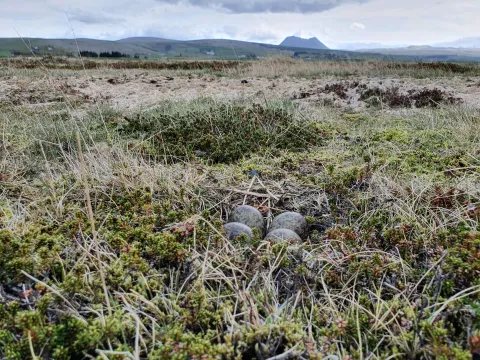
Whimbrel nest with Þríhyrningur on the background. PHOTO/Camilo Carneiro

Expansion of summerhouses, tree plantations and lupin affects breeding habitats

Icelandic whimbrels also differ from other subspecies in the threats they face. “Particularly at their breeding grounds, this is the subspecies with the highest impact scores from human activities that essentially reduce the space available for breeding. For example, there is a clear expansion of summerhouses, which are often built on whimbrel breeding habitat, reducing its availability. Likewise, the increase in tree plantations is evident, and this not only removes suitable breeding habitat but also creates a buffer effect, as whimbrels avoid areas near plantations,” Camilo explains, mentioning also research conducted by Aldís Pálsdóttir and other colleagues at the centre.

The expansion of Nootka lupin in Iceland was also assessed as having a medium impact on Icelandic whimbrel breeding by reducing the availability of suitable habitat.

Looking across all subspecies, the authors identified major gaps in tracking coverage in Africa, the Middle East, the Indian subcontinent, and the breeding grounds of northern and central Russia.

The authors emphasise in the study that current understanding of whimbrel ecology remains fragmented, “with under-sampled regions and subspecies possibly having crucial but still unrecognised conservation needs. At the same time, we highlight consistent pressures that are likely to intensify under ongoing environmental change.”

Asked about which findings he considers most interesting in the research Camilo says he finds fascinating the variation in the timing and duration of each annual phase, breeding, migration, and wintering. “This suggests that different subspecies operate under different constraints that result in contrasting uses of space and time. This naturally complicates the conservation picture because a single recipe for protection is unlikely to work everywhere. The particular circumstances of each subspecies need to be considered if conservation actions are to be effective,” Camilo further notes. .

Asked about the scientific and public value of the research, Camilo points out that it helps identify where future research is most likely to have the greatest impact. “For society as a whole, I believe the greatest value comes from our threat assessment, where we highlight the factors negatively affecting whimbrels throughout the annual cycle, and therefore where we, as a society, need to focus our efforts if we wish to protect them.”

The study, A Global Perspective on the Annual Cycles of Whimbrels, is available online at the Ibis journal website.

Share

Tags
Did this help?

Why wasn't this information helpful

Limit to 250 characters.