- Do you want to learn diverse methods for sharing information?
- Are you interested in culture and heritage?
- Would you like to study two subjects?
- Do you enjoy planning?
- Are you creative and innovative?
- Do you want to work on challenging projects?
This is a 60 ECTS minor that can be taken alongside a 120 ECTS major in another subject to complete a 180 ECTS BA degree.
Museum studies is an interdisciplinary subject, incorporating various areas relevant to the work of museums.
Examples include history, archaeology, art history and theory, ethnology, anthropology, literature and linguistics. Museum studies also includes physical sciences such as natural history and others such as conservation, pedagogy and information technology, as well as subjects relating to management, computer science, marketing, economics, tourism, design and communication.
Museums and galleries are among the most important cultural institutions in any society. There are a huge number of museums in Iceland and abroad, exploring an extremely wide range of topics.
In brief, the four main areas of a museum’s mission are:
- collection
- conservation
- research
- sharing information
Museums may deal with a very broad range of subjects. Some museums focus on exhibitions or education, while others focus on conservation or research. Most museums share certain common attributes, though, and similarities in their nature and mission.
Museums operate in accordance with certain laws, regulations, ethics and conventions. In brief, the four main areas of a museum’s mission are: collection, conservation, research and sharing information.
The admission requirement for the major subject (120 ECTS) has to be fulfilled. After a year of studies students can register for the minor (60 ECTS).
60 ECTS credits have to be completed for the minor. The minor consists of: theories and fundamental approaches 40 ECTS credits and electives 20 ECTS credits.
Programme structure
Check below to see how the programme is structured.
This programme does not offer specialisations.
- Year unspecified
- Fall
- Not taught this semesterMaterial Culture and Society: Objects, homes and bodies
- Museum
- Cultural and Heritage Tourism
- Microhistories about Poverty, Emotion and Disability
- Anthropology of gender
- Critical Thinking
- Not taught this semesterCultural Heritage
- Not taught this semesterIcelandic Art History, Museums and Education
- Artefact Studies
- Not taught this semesterStriking Vikings: Vikings in modern culture, film, and video games
- Research Project in Museum Studies
- Not taught this semesterLiterary tourism and writer's museums
- Spring 1
- Museums and society: Dead circuses?
- Social Issues and Museums: Challenges and Opportunities
- Introduction to Museology and Museography
- Not taught this semesterMuseums and Society: The Circus of Death?
- Material Culture and Society: Objects, homes and bodies
- Museum mergers: Prerequisites, processes and the future
- Culture and Dissent
- Handicraft, manufacturing and mentality in the 18th and 19th century – fashion, textiles and clothes making in Iceland
- The Art Object: Life and Material
- Not taught this semesterCultural Heritage
- Not taught this semesterCultural menace: From porcelain dogs to punks and hoodlums
- Not taught this semesterCultural Heritage
- Art, nature and society
- Research and sources in archives
- Summer
- Field experience at an excavation or work at a museum
Material Culture and Society: Objects, homes and bodies (ÞJÓ205G)
This course is an introduction to the study of the material culture of everyday life. Students will be get a good glimpse of this multidisciplinary field, with examples drawn from the past as well as the present, and with equal emphasis on the material culture of Iceland and that of other countries. The topics of study will range from clothes and fashion to foodways, from the objects in our daily surroundings to trash and hygiene, from crafts and consumer goods to houses, gardens and the home, and from urban landscapes to museums and exhibits. Along the way, students will gain familiarity with various theoretical concepts and approaches emphasizing for example the human body, gender, consumption, place and space.
Museum (SAF501G)
One of the main purposes of Icelandic museums is to preserve the country's cultural and natural heritage for future generations. Furthermore, to encourage increased knowledge of this heritage and understanding of its connections to the outside world. According to Icelandic museum laws, museums are expected to "enhance people's quality of life" by fostering an understanding of the development and status of culture, art, nature, and/or science. Therefore, museums and museum education can impact society, groups, and individuals. Museology plays a key role in this context and is the main subject of this course.
Students will be introduced to theoretical approaches aimed at supporting diverse and impactful educational practices related to archaeology, art, natural sciences, cultural heritage, and other museum subjects. Attention will be given to the different target audiences of museum education, the role of visitors within museums, spatial considerations, text production, multimedia, interactivity, and more.
This is a distance-learning course divided into three modules. Each module includes short lectures by the instructor reflecting on the course material, guest lectures (delivered digitally), and supplementary materials. Over the semester, three in-person and/or Zoom sessions will be held, where students will receive lectures from museum professionals and work on an educational project in collaboration with a museum in Reykjavík. The project will be developed based on students’ academic interests, under the supervision of the instructor and with support from museum staff.
Cultural and Heritage Tourism (FER506M)
The module looks at meanings and definitons of the concept of culture in cultural tourism especially regarding presentation and mediation of cultural heritage in museums as well as in other types of surroundings. Questions concerning political and ethical issues of collections and presentation of artefacts will be discussed and thoughts will be given to different ways in which people read and perceive of history and heritage, their own as well as others. The relations between cultural tourism and creative tourism will also be explored. Questions regarding appropriation of cultural heritage will be explored as well as who have the power to define cultural heritage Emphasis will be put on Icelandic heritage and museums and a visit will be made to at least one museum.
Fieldwork is within the capital area
Microhistories about Poverty, Emotion and Disability (SAG512M)
The course is intended to be, first of all, a very practical overview of the main categories of public sources that are preserved in archives and are accessible in electronic form. All categories have their advantages and disadvantages. The sources were created within some kind of administration and their aim was to gather information about the "population" that is under, preserve it and use the information to strengthen the administration and "create" the facts it needed. to hold to maintain itself. Secondly, the course is an introduction to the development that has taken place in the methodology of solitude in new Icelandic research in history. This is a new perspective on what has been called the unification of history. Thirdly, the course will be an introduction to how the emotions of individuals in the past can be analyzed through public sources and how the ideology of the history of emotions can be used in those analyzes and a new integration of theories about poverty and disability in the past with special emphasis on gender perspectives.
Anthropology of gender (MAN353G)
In this course, the key concepts of gendered culture; sex, gender, and sexual orientation will be contextualized through anthropological research and knowledge. The goal is for students to gain a solid understanding of these concepts, how they are continuously reshaped, and how they shape societies and cultures everywhere. The course will explore how anthropological research in the early 20th century was influenced by dominating gender norms and examine the impact of feminist movements over the past half-century on the emergence and evolution of diverse anthropological studies. Emphasis will be placed on analyzing the characteristics of contemporary feminist and queer research, and students will engage with these topics through selected ethnographies, field texts, and review articles on gendered culture.
Critical Thinking (HSP105G)
The aim of this course is to show students the importance of critical thinking by introducing its main concepts and methods as well as different understandings of the notion. Furthermore, the aim is to train students in critical thinking and argumentation, both in a philosophical and an everyday context. Special emphasis will be placed on analysing arguments. The relationship between critical thinking and ethics will be thoroughly examined.
The teaching involves both lectures and discussion sessions. Assignments will primarily be aimed at practical tasks relevant to everyday experiences.
Cultural Heritage (ÞJÓ506M)
What is cultural heritage and what purpose does it serve? Why does it always seem to be endangered? How does it tie together the past and the present? What's it got to do with the nation and the state? Historical consciousness? Globalization? Capitalism? Politics? The course will seek to answer these questions with reference to new research in folklore, ethnology, anthropology, art history, sociology, museology, history and archaeology and with a view to understanding what is going on in this expanding field of study.
Icelandic Art History, Museums and Education (LVG302G)
Course Outline:
- Introduction to Art History.
- Methods of interpretation
- The development of Icelandic Art History and how it relates to international History of Art.
Course Format: Lectures, seminars and visits to local art museums.
Artefact Studies (FOR303G)
The course gives a general introduction to artefact studies, typology and material analysis, as well as introducing the principal artefact types found in Iceland: pottery, stone vessels and utensils, jewellery and weapons, textiles, glass, clay pipes, etc.
Striking Vikings: Vikings in modern culture, film, and video games (SAF301M)
Vikings are one of the most recognisable group of people from the past. Often seen as crazed berserker, with horned helmets, battle axes raised and ready, beautiful long hair billowing in the wind, they are thought of jumping out of longboats, running up the shore towards an unexpecting populace. This image crosses cultural barriers: Viking re-enactment societies exist in places with no actual Viking history. People proudly declare themselves Vikings as part of their identity and way of life. There is Viking metal, beers, foods, restaurants, and comic books. A further demonstration of the endurance of the Viking myth is the silver screen: The first Viking film came out in 1907 and are produced to this day. This, in turn, influences the use of Vikings in other areas, including the tourism sector, museum exhibitions, music industry, food and drink production and the video game industry.
This course introduces the various uses of Vikings in society, starting with tracing the history of the modern, popular culture Vikings back to Victorian times, all the way to Iceland during, and after the economic crash 2008-2011. Students will be shown the various uses of Vikings in the cultural sector, discussing the good, the bad and the ugly sides of the Viking imagery and its uses in the present and past. Next, they will gain an insight into Vikings in films related to the image of Iceland. This raises the question: in which films do Vikings appear, and how are they portrayed? The aim is to provide a comprehensive overview of the history of Viking representations in Icelandic cinema, exploring how they have been depicted by Icelandic filmmakers as well as by international directors who have chosen to make films about and/or set in Iceland. Finally, Vikings in video games are explored, introducing how Old Norse literature migrates into gaming, and how the image of Vikings has altered and expanded within the gaming sphere.
Learning Outcomes: Students – gain knowledge of the history of vikings as mediated through cultural artifacts and images – get a comprehensive overview of the mediation of the Viking image in the 20th century – are able to analyze and discuss the most prominent mediation practices and traditions in the 20th century – can analyze and situate historically the various mediated representations of vikings in contemporary culture.
Research Project in Museum Studies (SAF001G)
This course involves the student in taking part in a realistic research project in a museum or gallery, the aim being for the student to increase her/ his skills in applying academic approaches to actual museum work. The first part of the study is academic, and concentrates on methodology, each student then giving a report on the reading to the supervisor. The research project itself involves the student in preparing a research plan under the guidance of the supervisor, and then carrying out this project while actually working in a museum. On completion of the project, the student has to present a report on the project, and presentation of her/his findings.
Literary tourism and writer's museums (SAF503M)
In this course we will examine three main areas in relation to literary tourism and writer's museums. First, we will examine how writers have used museums as sites for their storytelling. Second, we will examine the field of literary tourism in Iceland and in particular, the ways in which writer's museums are addressing the lives and times of literary authors like the Nobel Prize winner Halldór Laxness. And third, we will examine the wider social and cultural significance of literary tourism and writer's museums in Iceland. Attention will also be made to museums and exhibitions that represent Icelandic (oral) literary heritage. The course will in particular examine writer's museums like Gljúfrasteinn, Þórbergssetur, Davíðshús, Nonnahús, Reykholt and Skriðuklaustur.
Museums and society: Dead circuses? (SAF201M)
This course delves into the multifaceted relationship between museums and the societies they serve. It aims to explore how museums are not only custodians of cultural heritage but also active participants in shaping cultural narratives and communal identities. By examining historical contexts, theoretical frameworks, and practical case studies, students will gain insight into the influential role that museums play in reflecting and sometimes challenging societal values. The course will cover topics such as museums as agents of social change, the importance of inclusivity and accessibility, and the impact of digital technology on community engagement. Through discussions, case studies, and hands-on projects, students will explore how museums can effectively engage with diverse audiences and contribute to a more equitable society. By the end of the course, students will have developed a nuanced understanding of how museums can evolve in response to the dynamic needs and values of the communities they serve.
Social Issues and Museums: Challenges and Opportunities (SAF202M)
This course critically examines the impact of contemporary social issues on museums and their practices. It seeks to provide students with a comprehensive understanding of how museums are confronted with, and often strive to address, various societal challenges, including diversity, equity, inclusion, social justice, and sustainability. Throughout the course, students will explore social issues within the museum context and analyze real-world examples of museums that actively engage with these topics. Key themes will include the role of museums as advocates for marginalized communities, the importance of community collaboration and co-creation, and strategies for addressing climate change within museum practices. The course is taught from the end of February to the end of March.
Introduction to Museology and Museography (SAF201G)
This course introduces students to the history of museums and to key debates within the fields of museology and museography. The course discusses contemporary practice in museums, like collecting, preservation and cataloguing, research and mediation in the twenty-first century. The course explores museums’ missions and their roles in a variety of museums including art, cultural history, and natural history.
Museums and Society: The Circus of Death? (SAF603M)
The societal role of museums will be discussed from several angles: economic, political, cultural, social and last but not least in an international context. Examples of topics that will be discussed in the course are the role of museums in building the concept of the nation; the legal environment of museums; how museums are run; the status and role of the main museums; museums owned and run by local authorities and other museums; the financing of museums, and the policies of authorities regarding museums. Both national and foreign examples will be taken.
Work format
Teaching will take the form of lectures and discussions.
Material Culture and Society: Objects, homes and bodies (ÞJÓ205G)
This course is an introduction to the study of the material culture of everyday life. Students will be get a good glimpse of this multidisciplinary field, with examples drawn from the past as well as the present, and with equal emphasis on the material culture of Iceland and that of other countries. The topics of study will range from clothes and fashion to foodways, from the objects in our daily surroundings to trash and hygiene, from crafts and consumer goods to houses, gardens and the home, and from urban landscapes to museums and exhibits. Along the way, students will gain familiarity with various theoretical concepts and approaches emphasizing for example the human body, gender, consumption, place and space.
Museum mergers: Prerequisites, processes and the future (SAF302M)
Over the past four decades, cultural institutions such as museums have become targets of changing cultural politics around the world. Museums have been increasingly positioned as a part of economic restructuring and development, social and national image politics, and as a platform for democratic participation. New ideas and new language accompany these changes, including the idea that collaboration and integration of institutions should pave the way for increased social prosperity. Digital technology and economy is often used in this crucible as a force for synergy and increased productivity in the field of innovation.
In the course, these issues will be examined from the aforementioned perspectives. We will examine academic writings and examine real-life examples from the field of museums in Europe and Iceland, which have been in the line of fire of change. Icelandic and international lecturers will contribute to the course. The course is taught via distance learning and assessment is based on assignments completed evenly throughout the semester.
Culture and Dissent (MFR703M)
The course deals with interconnections between political radicalism, culture, tradition and power. We will focus on contemporary representations of dissent in particular, look at the discourse of democracy and cultural difference, reactions to and criticism of protest in the Western political tradition and dissent in more repressive political systems. The role of intellectuals and writers will be explored as well as the function of artistic expression and design in transforming cultural and social environments. We will also discuss media and social media discourse in connection with an attempt to understand the various and sometimes contradictory objectives of public institutions. A few points of conflict will be discussed that to some extent expose fundamental conflicts in liberal democratic societies such as questions about the wisdom and ignorance of publics, reactions to climate change, inequality and extreme poverty. Finally corruption and power will be discussed as well as social and cultural expression, the possibilities and limitations of freedom of speech, the use and abuse of information, disinformation, secrecy, fake and “fake news”.
Handicraft, manufacturing and mentality in the 18th and 19th century – fashion, textiles and clothes making in Iceland (SAG417M)
The objective of the course is to examine the fashion and clothes making of Icelanders in the 18th and 19th century from various angles. Research on handicraft and manufacturing will be examined in light of a variety of sources on handicraft, manufacturing and mentality in Iceland in relation to corresponding phenomena elsewhere in the realm of Denmark-Norway at the time. The reading material will be both scholarly work and primary sources. New research will be combined with primary sources, both from archives and museums. Field trips will be an important part of the course and research and analysis on clothes that are preserved. In recent years access has become better to published primary sources, both printed and online. The students will become capable of reading, finding, using and evaluating archival material from the 18th and 19th century and defining research questions in the field.
The Art Object: Life and Material (LIS808M)
Interdisciplinary reseach on material culture has expanded considerably in the last decades. Although art historians have, in some sense, always studied materiality, material culture, collecting and provenance, art history as a field has had limited part in academic discourse within material culture studies on human relationships to objects. In this course students are afforded a valuable opportunity to consider deeply art objects and their „lives“ within and outside of institutions: their manufacture, use, exchange, exhibition, conservation, classification and definition, as well as the values and ideas attached to them. Each week students are presented with one object of study and receive training in various methods of researching, analyzing and interpreting art, through visual analysis, analysis of the material and make of objects, their categorization within the classification systems of museums and examination of provenance and exhibition history. Alongside this students will be introduced to theories of material culture studies and their intersection with the subjects and theories art history, such as insititutional critique and provenance. The course is run in collaboration with museums in the capital region of Iceland and is suitable for students of art history, visual art, history, archaeology, folkloristics and museum studies.
Cultural Heritage (ÞJÓ447M)
What is cultural heritage and what purpose does it serve? Why does it always seem to be endangered? How does it tie together the past and the present? What's it got to do with the nation and the state? Historical consciousness? Globalization? Capitalism? Politics? The course will seek to answer these questions with reference to new research in folklore, ethnology, anthropology, art history, sociology, museology, history and archaeology and with a view to understanding what is going on in this expanding field of study.
Cultural menace: From porcelain dogs to punks and hoodlums (ÞJÓ445G)
The course will focus on various cases from the nineteenth century onwards of cultural elements that have been considered adversary to culture and civilisation in Iceland. Ideas, behaviour and artefacts that have been seen to be threats to Icelandic culture or a menace to a sound and healthy cultural life (such as jazz, popular fiction, avant-garde art) will be reflected upon, and the nature of the assumed dangers explored. As part of the discussion, the interconnection between social power and culture will be taken into careful consideration and questions about who defines cultural menace, by what means and for what purpose will be asked. Do such threats have aspects in common and in what ways have definitions been influenced by interests, ideals and moral standards that are subject to change? To what extent have ideas about cultural menace played a role in fashioning and defining Icelandic culture?
To what extent has Icelandic culture been formed through normative ideas about cultivated behaviour and civilisation? To what extent has Icelandic culture been shaped through resistance to foreign mass culture that has been seen to present itself in the Icelandic community in the guise of, for example, Danish dress fashion and American soap-operas?
Cultural Heritage (ÞJÓ446G)
What is cultural heritage and what purpose does it serve? Why does it always seem to be endangered? How does it tie together the past and the present? What's it got to do with the nation and the state? Historical consciousness? Globalization? Capitalism? Politics? The course will seek to answer these questions with reference to new research in folklore, ethnology, anthropology, art history, sociology, museology, history and archaeology and with a view to understanding what is going on in this expanding field of study.
Art, nature and society (LVG020G)
Note that students in the elective Visual Arts Education: Art programme have priority if the maximum number of participants is reached.
This course explores the relationship between visual arts, nature, and society with a focus on contemporary art, sustainability, and education for sustainable development. Students engage with ideas and practices of artists who work with nature and community, analyzing their methods within a theoretical framework. Emphasis is placed on experimentation, artistic processes, and the reuse of materials with environmental awareness in mind.
Objectives and content
Students will:
- acquire an understanding of curriculum approaches that integrate art, nature, and society,
- develop personal artistic expression using diverse media and materials,
- contextualize and defend their own artistic work in relation to theoretical and creative aims,
- connect their projects to teaching in compulsory school, with emphasis on key curriculum pillars: sustainability, democracy, equality, and cultural literacy.
Teaching methods include lectures, discussions, field visits, and project-based learning. Independent work, creative processes, and collaboration are emphasized.
Research and sources in archives (SAG206M)
Students learn and are trained in the methods of archival research, finding and evaluating sources in archives. Practical exercises will be assigned.
Field experience at an excavation or work at a museum (FOR413G)
This course is comprised solely of work experience connected to archaeology undertaken by the student. Work can include participation on an archaeological fieldschool, excavation (uppgröftur), survey project (fornleifaskráning), post-excavation analysis (urvinnsla) including finds or conservation work (forvarsla) and work at a museum or heritage agency. If you are in doubt about what might count, contact the chair of the department. The work must entail a minimum of 40 full-working days. At the end of the work, students must ask for a report form to be filled out by their employer/supervisor and this form must then be returned to the chair of department. Please contact the chair of department of archaeology for the form.
Field experience at an excavation or work at a museum (FOR419G)
This course is comprised solely of work experience connected to archaeology undertaken by the student. Work can include participation on an archaeological fieldschool, excavation (uppgröftur), survey project (fornleifaskráning), post-excavation analysis (urvinnsla) including finds or conservation work (forvarsla) and work at a museum or heritage agency. If you are in doubt about what might count, contact the chair of the department. The work must entail a minimum of 20 full-working days. At the end of the work, students must ask for a report form to be filled out by their employer/supervisor and this form must then be returned to the chair of department. Please contact the chair of department of archaeology for the form.
- Fall
- Not taught this semesterÞJÓ205GMaterial Culture and Society: Objects, homes and bodiesMandatory (required) course10A mandatory (required) course for the programme10 ECTS, creditsCourse Description
This course is an introduction to the study of the material culture of everyday life. Students will be get a good glimpse of this multidisciplinary field, with examples drawn from the past as well as the present, and with equal emphasis on the material culture of Iceland and that of other countries. The topics of study will range from clothes and fashion to foodways, from the objects in our daily surroundings to trash and hygiene, from crafts and consumer goods to houses, gardens and the home, and from urban landscapes to museums and exhibits. Along the way, students will gain familiarity with various theoretical concepts and approaches emphasizing for example the human body, gender, consumption, place and space.
Language of instruction: IcelandicSAF501GMuseumMandatory (required) course10A mandatory (required) course for the programme10 ECTS, creditsCourse DescriptionOne of the main purposes of Icelandic museums is to preserve the country's cultural and natural heritage for future generations. Furthermore, to encourage increased knowledge of this heritage and understanding of its connections to the outside world. According to Icelandic museum laws, museums are expected to "enhance people's quality of life" by fostering an understanding of the development and status of culture, art, nature, and/or science. Therefore, museums and museum education can impact society, groups, and individuals. Museology plays a key role in this context and is the main subject of this course.
Students will be introduced to theoretical approaches aimed at supporting diverse and impactful educational practices related to archaeology, art, natural sciences, cultural heritage, and other museum subjects. Attention will be given to the different target audiences of museum education, the role of visitors within museums, spatial considerations, text production, multimedia, interactivity, and more.
This is a distance-learning course divided into three modules. Each module includes short lectures by the instructor reflecting on the course material, guest lectures (delivered digitally), and supplementary materials. Over the semester, three in-person and/or Zoom sessions will be held, where students will receive lectures from museum professionals and work on an educational project in collaboration with a museum in Reykjavík. The project will be developed based on students’ academic interests, under the supervision of the instructor and with support from museum staff.
Distance learningPrerequisitesFER506MCultural and Heritage TourismElective course8Free elective course within the programme8 ECTS, creditsCourse DescriptionThe module looks at meanings and definitons of the concept of culture in cultural tourism especially regarding presentation and mediation of cultural heritage in museums as well as in other types of surroundings. Questions concerning political and ethical issues of collections and presentation of artefacts will be discussed and thoughts will be given to different ways in which people read and perceive of history and heritage, their own as well as others. The relations between cultural tourism and creative tourism will also be explored. Questions regarding appropriation of cultural heritage will be explored as well as who have the power to define cultural heritage Emphasis will be put on Icelandic heritage and museums and a visit will be made to at least one museum.
Fieldwork is within the capital area
Face-to-face learningPrerequisitesSAG512MMicrohistories about Poverty, Emotion and DisabilityElective course10Free elective course within the programme10 ECTS, creditsCourse DescriptionThe course is intended to be, first of all, a very practical overview of the main categories of public sources that are preserved in archives and are accessible in electronic form. All categories have their advantages and disadvantages. The sources were created within some kind of administration and their aim was to gather information about the "population" that is under, preserve it and use the information to strengthen the administration and "create" the facts it needed. to hold to maintain itself. Secondly, the course is an introduction to the development that has taken place in the methodology of solitude in new Icelandic research in history. This is a new perspective on what has been called the unification of history. Thirdly, the course will be an introduction to how the emotions of individuals in the past can be analyzed through public sources and how the ideology of the history of emotions can be used in those analyzes and a new integration of theories about poverty and disability in the past with special emphasis on gender perspectives.
Face-to-face learningPrerequisitesMAN353GAnthropology of genderElective course5Free elective course within the programme5 ECTS, creditsCourse DescriptionIn this course, the key concepts of gendered culture; sex, gender, and sexual orientation will be contextualized through anthropological research and knowledge. The goal is for students to gain a solid understanding of these concepts, how they are continuously reshaped, and how they shape societies and cultures everywhere. The course will explore how anthropological research in the early 20th century was influenced by dominating gender norms and examine the impact of feminist movements over the past half-century on the emergence and evolution of diverse anthropological studies. Emphasis will be placed on analyzing the characteristics of contemporary feminist and queer research, and students will engage with these topics through selected ethnographies, field texts, and review articles on gendered culture.
Face-to-face learningOnline learningPrerequisitesAttendance required in classCourse DescriptionThe aim of this course is to show students the importance of critical thinking by introducing its main concepts and methods as well as different understandings of the notion. Furthermore, the aim is to train students in critical thinking and argumentation, both in a philosophical and an everyday context. Special emphasis will be placed on analysing arguments. The relationship between critical thinking and ethics will be thoroughly examined.
The teaching involves both lectures and discussion sessions. Assignments will primarily be aimed at practical tasks relevant to everyday experiences.
Face-to-face learningPrerequisitesCourse taught first half of the semesterNot taught this semesterÞJÓ506MCultural HeritageElective course10Free elective course within the programme10 ECTS, creditsCourse DescriptionWhat is cultural heritage and what purpose does it serve? Why does it always seem to be endangered? How does it tie together the past and the present? What's it got to do with the nation and the state? Historical consciousness? Globalization? Capitalism? Politics? The course will seek to answer these questions with reference to new research in folklore, ethnology, anthropology, art history, sociology, museology, history and archaeology and with a view to understanding what is going on in this expanding field of study.
Face-to-face learningDistance learningPrerequisitesNot taught this semesterLVG302GIcelandic Art History, Museums and EducationElective course10Free elective course within the programme10 ECTS, creditsCourse DescriptionCourse Outline:
- Introduction to Art History.
- Methods of interpretation
- The development of Icelandic Art History and how it relates to international History of Art.
Course Format: Lectures, seminars and visits to local art museums.
Face-to-face learningPrerequisitesAttendance required in classCourse DescriptionThe course gives a general introduction to artefact studies, typology and material analysis, as well as introducing the principal artefact types found in Iceland: pottery, stone vessels and utensils, jewellery and weapons, textiles, glass, clay pipes, etc.
Face-to-face learningPrerequisitesNot taught this semesterSAF301MStriking Vikings: Vikings in modern culture, film, and video gamesElective course10Free elective course within the programme10 ECTS, creditsCourse DescriptionVikings are one of the most recognisable group of people from the past. Often seen as crazed berserker, with horned helmets, battle axes raised and ready, beautiful long hair billowing in the wind, they are thought of jumping out of longboats, running up the shore towards an unexpecting populace. This image crosses cultural barriers: Viking re-enactment societies exist in places with no actual Viking history. People proudly declare themselves Vikings as part of their identity and way of life. There is Viking metal, beers, foods, restaurants, and comic books. A further demonstration of the endurance of the Viking myth is the silver screen: The first Viking film came out in 1907 and are produced to this day. This, in turn, influences the use of Vikings in other areas, including the tourism sector, museum exhibitions, music industry, food and drink production and the video game industry.
This course introduces the various uses of Vikings in society, starting with tracing the history of the modern, popular culture Vikings back to Victorian times, all the way to Iceland during, and after the economic crash 2008-2011. Students will be shown the various uses of Vikings in the cultural sector, discussing the good, the bad and the ugly sides of the Viking imagery and its uses in the present and past. Next, they will gain an insight into Vikings in films related to the image of Iceland. This raises the question: in which films do Vikings appear, and how are they portrayed? The aim is to provide a comprehensive overview of the history of Viking representations in Icelandic cinema, exploring how they have been depicted by Icelandic filmmakers as well as by international directors who have chosen to make films about and/or set in Iceland. Finally, Vikings in video games are explored, introducing how Old Norse literature migrates into gaming, and how the image of Vikings has altered and expanded within the gaming sphere.
Learning Outcomes: Students – gain knowledge of the history of vikings as mediated through cultural artifacts and images – get a comprehensive overview of the mediation of the Viking image in the 20th century – are able to analyze and discuss the most prominent mediation practices and traditions in the 20th century – can analyze and situate historically the various mediated representations of vikings in contemporary culture.
Face-to-face learningDistance learningPrerequisitesSAF001GResearch Project in Museum StudiesElective course10Free elective course within the programme10 ECTS, creditsCourse DescriptionThis course involves the student in taking part in a realistic research project in a museum or gallery, the aim being for the student to increase her/ his skills in applying academic approaches to actual museum work. The first part of the study is academic, and concentrates on methodology, each student then giving a report on the reading to the supervisor. The research project itself involves the student in preparing a research plan under the guidance of the supervisor, and then carrying out this project while actually working in a museum. On completion of the project, the student has to present a report on the project, and presentation of her/his findings.
Self-studyPrerequisitesNot taught this semesterSAF503MLiterary tourism and writer's museumsElective course5Free elective course within the programme5 ECTS, creditsCourse DescriptionIn this course we will examine three main areas in relation to literary tourism and writer's museums. First, we will examine how writers have used museums as sites for their storytelling. Second, we will examine the field of literary tourism in Iceland and in particular, the ways in which writer's museums are addressing the lives and times of literary authors like the Nobel Prize winner Halldór Laxness. And third, we will examine the wider social and cultural significance of literary tourism and writer's museums in Iceland. Attention will also be made to museums and exhibitions that represent Icelandic (oral) literary heritage. The course will in particular examine writer's museums like Gljúfrasteinn, Þórbergssetur, Davíðshús, Nonnahús, Reykholt and Skriðuklaustur.
Self-studyPrerequisites- Spring 2
SAF201MMuseums and society: Dead circuses?Mandatory (required) course5A mandatory (required) course for the programme5 ECTS, creditsCourse DescriptionThis course delves into the multifaceted relationship between museums and the societies they serve. It aims to explore how museums are not only custodians of cultural heritage but also active participants in shaping cultural narratives and communal identities. By examining historical contexts, theoretical frameworks, and practical case studies, students will gain insight into the influential role that museums play in reflecting and sometimes challenging societal values. The course will cover topics such as museums as agents of social change, the importance of inclusivity and accessibility, and the impact of digital technology on community engagement. Through discussions, case studies, and hands-on projects, students will explore how museums can effectively engage with diverse audiences and contribute to a more equitable society. By the end of the course, students will have developed a nuanced understanding of how museums can evolve in response to the dynamic needs and values of the communities they serve.
Distance learningPrerequisitesCourse taught first half of the semesterSAF202MSocial Issues and Museums: Challenges and OpportunitiesMandatory (required) course5A mandatory (required) course for the programme5 ECTS, creditsCourse DescriptionThis course critically examines the impact of contemporary social issues on museums and their practices. It seeks to provide students with a comprehensive understanding of how museums are confronted with, and often strive to address, various societal challenges, including diversity, equity, inclusion, social justice, and sustainability. Throughout the course, students will explore social issues within the museum context and analyze real-world examples of museums that actively engage with these topics. Key themes will include the role of museums as advocates for marginalized communities, the importance of community collaboration and co-creation, and strategies for addressing climate change within museum practices. The course is taught from the end of February to the end of March.
Distance learningPrerequisitesCourse taught second half of the semesterSAF201GIntroduction to Museology and MuseographyMandatory (required) course10A mandatory (required) course for the programme10 ECTS, creditsCourse DescriptionThis course introduces students to the history of museums and to key debates within the fields of museology and museography. The course discusses contemporary practice in museums, like collecting, preservation and cataloguing, research and mediation in the twenty-first century. The course explores museums’ missions and their roles in a variety of museums including art, cultural history, and natural history.
Face-to-face learningDistance learningPrerequisitesNot taught this semesterSAF603MMuseums and Society: The Circus of Death?Mandatory (required) course10A mandatory (required) course for the programme10 ECTS, creditsCourse DescriptionThe societal role of museums will be discussed from several angles: economic, political, cultural, social and last but not least in an international context. Examples of topics that will be discussed in the course are the role of museums in building the concept of the nation; the legal environment of museums; how museums are run; the status and role of the main museums; museums owned and run by local authorities and other museums; the financing of museums, and the policies of authorities regarding museums. Both national and foreign examples will be taken.
Work format
Teaching will take the form of lectures and discussions.
Face-to-face learningDistance learningPrerequisitesÞJÓ205GMaterial Culture and Society: Objects, homes and bodiesMandatory (required) course10A mandatory (required) course for the programme10 ECTS, creditsCourse DescriptionThis course is an introduction to the study of the material culture of everyday life. Students will be get a good glimpse of this multidisciplinary field, with examples drawn from the past as well as the present, and with equal emphasis on the material culture of Iceland and that of other countries. The topics of study will range from clothes and fashion to foodways, from the objects in our daily surroundings to trash and hygiene, from crafts and consumer goods to houses, gardens and the home, and from urban landscapes to museums and exhibits. Along the way, students will gain familiarity with various theoretical concepts and approaches emphasizing for example the human body, gender, consumption, place and space.
Face-to-face learningDistance learningOnline learningPrerequisitesSAF302MMuseum mergers: Prerequisites, processes and the futureElective course10Free elective course within the programme10 ECTS, creditsCourse DescriptionOver the past four decades, cultural institutions such as museums have become targets of changing cultural politics around the world. Museums have been increasingly positioned as a part of economic restructuring and development, social and national image politics, and as a platform for democratic participation. New ideas and new language accompany these changes, including the idea that collaboration and integration of institutions should pave the way for increased social prosperity. Digital technology and economy is often used in this crucible as a force for synergy and increased productivity in the field of innovation.
In the course, these issues will be examined from the aforementioned perspectives. We will examine academic writings and examine real-life examples from the field of museums in Europe and Iceland, which have been in the line of fire of change. Icelandic and international lecturers will contribute to the course. The course is taught via distance learning and assessment is based on assignments completed evenly throughout the semester.
Distance learningPrerequisitesMFR703MCulture and DissentElective course10Free elective course within the programme10 ECTS, creditsCourse DescriptionThe course deals with interconnections between political radicalism, culture, tradition and power. We will focus on contemporary representations of dissent in particular, look at the discourse of democracy and cultural difference, reactions to and criticism of protest in the Western political tradition and dissent in more repressive political systems. The role of intellectuals and writers will be explored as well as the function of artistic expression and design in transforming cultural and social environments. We will also discuss media and social media discourse in connection with an attempt to understand the various and sometimes contradictory objectives of public institutions. A few points of conflict will be discussed that to some extent expose fundamental conflicts in liberal democratic societies such as questions about the wisdom and ignorance of publics, reactions to climate change, inequality and extreme poverty. Finally corruption and power will be discussed as well as social and cultural expression, the possibilities and limitations of freedom of speech, the use and abuse of information, disinformation, secrecy, fake and “fake news”.
Face-to-face learningPrerequisitesSAG417MHandicraft, manufacturing and mentality in the 18th and 19th century – fashion, textiles and clothes making in IcelandElective course10Free elective course within the programme10 ECTS, creditsCourse DescriptionThe objective of the course is to examine the fashion and clothes making of Icelanders in the 18th and 19th century from various angles. Research on handicraft and manufacturing will be examined in light of a variety of sources on handicraft, manufacturing and mentality in Iceland in relation to corresponding phenomena elsewhere in the realm of Denmark-Norway at the time. The reading material will be both scholarly work and primary sources. New research will be combined with primary sources, both from archives and museums. Field trips will be an important part of the course and research and analysis on clothes that are preserved. In recent years access has become better to published primary sources, both printed and online. The students will become capable of reading, finding, using and evaluating archival material from the 18th and 19th century and defining research questions in the field.
Face-to-face learningPrerequisitesLIS808MThe Art Object: Life and MaterialElective course5Free elective course within the programme5 ECTS, creditsCourse DescriptionInterdisciplinary reseach on material culture has expanded considerably in the last decades. Although art historians have, in some sense, always studied materiality, material culture, collecting and provenance, art history as a field has had limited part in academic discourse within material culture studies on human relationships to objects. In this course students are afforded a valuable opportunity to consider deeply art objects and their „lives“ within and outside of institutions: their manufacture, use, exchange, exhibition, conservation, classification and definition, as well as the values and ideas attached to them. Each week students are presented with one object of study and receive training in various methods of researching, analyzing and interpreting art, through visual analysis, analysis of the material and make of objects, their categorization within the classification systems of museums and examination of provenance and exhibition history. Alongside this students will be introduced to theories of material culture studies and their intersection with the subjects and theories art history, such as insititutional critique and provenance. The course is run in collaboration with museums in the capital region of Iceland and is suitable for students of art history, visual art, history, archaeology, folkloristics and museum studies.
Face-to-face learningPrerequisitesNot taught this semesterÞJÓ447MCultural HeritageElective course10Free elective course within the programme10 ECTS, creditsCourse DescriptionWhat is cultural heritage and what purpose does it serve? Why does it always seem to be endangered? How does it tie together the past and the present? What's it got to do with the nation and the state? Historical consciousness? Globalization? Capitalism? Politics? The course will seek to answer these questions with reference to new research in folklore, ethnology, anthropology, art history, sociology, museology, history and archaeology and with a view to understanding what is going on in this expanding field of study.
Face-to-face learningPrerequisitesNot taught this semesterÞJÓ445GCultural menace: From porcelain dogs to punks and hoodlumsElective course10Free elective course within the programme10 ECTS, creditsCourse DescriptionThe course will focus on various cases from the nineteenth century onwards of cultural elements that have been considered adversary to culture and civilisation in Iceland. Ideas, behaviour and artefacts that have been seen to be threats to Icelandic culture or a menace to a sound and healthy cultural life (such as jazz, popular fiction, avant-garde art) will be reflected upon, and the nature of the assumed dangers explored. As part of the discussion, the interconnection between social power and culture will be taken into careful consideration and questions about who defines cultural menace, by what means and for what purpose will be asked. Do such threats have aspects in common and in what ways have definitions been influenced by interests, ideals and moral standards that are subject to change? To what extent have ideas about cultural menace played a role in fashioning and defining Icelandic culture?
To what extent has Icelandic culture been formed through normative ideas about cultivated behaviour and civilisation? To what extent has Icelandic culture been shaped through resistance to foreign mass culture that has been seen to present itself in the Icelandic community in the guise of, for example, Danish dress fashion and American soap-operas?
Face-to-face learningPrerequisitesNot taught this semesterÞJÓ446GCultural HeritageElective course10Free elective course within the programme10 ECTS, creditsCourse DescriptionWhat is cultural heritage and what purpose does it serve? Why does it always seem to be endangered? How does it tie together the past and the present? What's it got to do with the nation and the state? Historical consciousness? Globalization? Capitalism? Politics? The course will seek to answer these questions with reference to new research in folklore, ethnology, anthropology, art history, sociology, museology, history and archaeology and with a view to understanding what is going on in this expanding field of study.
Face-to-face learningPrerequisitesLVG020GArt, nature and societyElective course5Free elective course within the programme5 ECTS, creditsCourse DescriptionNote that students in the elective Visual Arts Education: Art programme have priority if the maximum number of participants is reached.
This course explores the relationship between visual arts, nature, and society with a focus on contemporary art, sustainability, and education for sustainable development. Students engage with ideas and practices of artists who work with nature and community, analyzing their methods within a theoretical framework. Emphasis is placed on experimentation, artistic processes, and the reuse of materials with environmental awareness in mind.
Objectives and content
Students will:
- acquire an understanding of curriculum approaches that integrate art, nature, and society,
- develop personal artistic expression using diverse media and materials,
- contextualize and defend their own artistic work in relation to theoretical and creative aims,
- connect their projects to teaching in compulsory school, with emphasis on key curriculum pillars: sustainability, democracy, equality, and cultural literacy.
Teaching methods include lectures, discussions, field visits, and project-based learning. Independent work, creative processes, and collaboration are emphasized.
Face-to-face learningPrerequisitesAttendance required in classSAG206MResearch and sources in archivesElective course10Free elective course within the programme10 ECTS, creditsCourse DescriptionStudents learn and are trained in the methods of archival research, finding and evaluating sources in archives. Practical exercises will be assigned.
Distance learningPrerequisites- Summer
FOR413GField experience at an excavation or work at a museumElective course10Free elective course within the programme10 ECTS, creditsCourse DescriptionThis course is comprised solely of work experience connected to archaeology undertaken by the student. Work can include participation on an archaeological fieldschool, excavation (uppgröftur), survey project (fornleifaskráning), post-excavation analysis (urvinnsla) including finds or conservation work (forvarsla) and work at a museum or heritage agency. If you are in doubt about what might count, contact the chair of the department. The work must entail a minimum of 40 full-working days. At the end of the work, students must ask for a report form to be filled out by their employer/supervisor and this form must then be returned to the chair of department. Please contact the chair of department of archaeology for the form.
PrerequisitesFOR419GField experience at an excavation or work at a museumElective course5Free elective course within the programme5 ECTS, creditsCourse DescriptionThis course is comprised solely of work experience connected to archaeology undertaken by the student. Work can include participation on an archaeological fieldschool, excavation (uppgröftur), survey project (fornleifaskráning), post-excavation analysis (urvinnsla) including finds or conservation work (forvarsla) and work at a museum or heritage agency. If you are in doubt about what might count, contact the chair of the department. The work must entail a minimum of 20 full-working days. At the end of the work, students must ask for a report form to be filled out by their employer/supervisor and this form must then be returned to the chair of department. Please contact the chair of department of archaeology for the form.
PrerequisitesAdditional information The University of Iceland collaborates with over 400 universities worldwide. This provides a unique opportunity to pursue part of your studies at an international university thus gaining added experience and fresh insight into your field of study.
Students generally have the opportunity to join an exchange programme, internship, or summer courses. However, exchanges are always subject to faculty approval.
Students have the opportunity to have courses evaluated as part of their studies at the University of Iceland, so their stay does not have to affect the duration of their studies.
Graduates may work in management positions in any area of the public and private sector that is relevant to collections, conservation, research, teaching, and sharing cultural heritage.
Also project management in education or the cultural sector and cultural tourism.
An education in this area can open up opportunities in:
- Museum work
- Research
- Teaching
- Leadership
- Exhibition design
- Cultural tourism
- Web communication
This list is not exhaustive.
There is no specific student organisation for this programme, but students meet frequently in the Student Cellar.
Students' comments
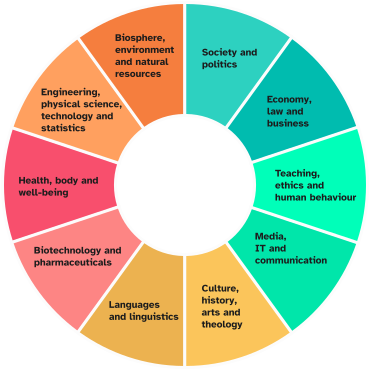
Students appreciate the University of Iceland for its strong academic reputation, modern campus facilities, close-knit community, and affordable tuition.Helpful content Study wheel
What interests you?
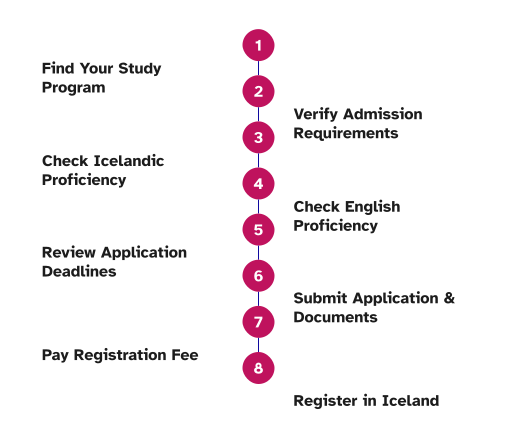
How to apply
Follow the path
Contact us If you still have questions, feel free to contact us.
School of Social SciencesWeekdays 9 am - 3 pmStudent and Teaching ServiceThe School office offers support to students and lecturers, providing guidance, counselling, and assistance with various matters.
You are welcome to drop by at the office in Gimli or you can book an online meeting in Teams with the staff.
Share