""
Language skills
required, minimum level of B2
Programme length
1 years.
Study mode
Face-to-face learning
Application status
International students:
Students with Icelandic or Nordic citizenship:
Overview

  • Do you want to learn Arabic?
  • Would you like to learn more about the Middle East?
  • Do you want to study Middle Eastern history and literature?
  • Do you want to understand the history of Islam from the medieval period to the modern day?

This is a 60 ECTS minor, meaning that you will also need to complete a 120 ECTS major in another subject to graduate with a BA degree.

The programme aims to promote interest in and understanding of the Middle East and its culture in a broad sense, as well as to provide students with a basic level of Arabic, which is the main language of the region.

The programme explores the Middle East from ancient times with special emphasis on the ascent of Islam in the seventh century, the emergence of the Islamic Caliphate in the Middle Ages, and the development into the modern era.

Students will be presented with a thorough overview of the history and culture of the Middle East, its literature, scholarship and arts, with the goal of shedding light on the modern day.

Main topics:

  • The history of the Middle East
  • Literature
  • Islamic societies

Matriculation examination

Students take all the compulsory courses in the programme, 60 ECTS in total. 

Programme structure

Check below to see how the programme is structured.

This programme does not offer specialisations.

Year unspecified | Fall
History of the Middle East I (MAF101G)
A mandatory (required) course for the programme
10 ECTS, credits
Course Description

This course surveys the history of the Middle East from ancient times to the medieval period. Topics include the emergence of Egypt and Sumerians and other peoples of the so-called 'cradle of civilization'. Special emphasis will be on the emergence of Islam in the seventh century, and ascent of the Islamic empire in the following centuries. Among the subjects discussed are the prophet Muhammad and his successors, the creation of the Quran, the Caliphates of the Ummayyads and the Abassids and the 'golden age' of Islam. Teaching language is Icelandic but reading materials are mostly in English.

Language of instruction: Icelandic
Face-to-face learning
Year unspecified | Fall
Arabic I (MAF102G)
A mandatory (required) course for the programme
10 ECTS, credits
Course Description

The first two or three weeks of the course are focused on the study of the Arabic alphabet and its sounds. After this, the focus shifts onto key grammar points, simple sentences and vocabulary, along with the practice of listening and oral skills. Attendance and homework are of great importance in this course. The course is taught in English.

This course is a prerequisite for MAF204G Arabic II.

Language of instruction: Icelandic
Face-to-face learning
Not taught this semester
Year unspecified | Fall
Arabic II (MAF204G)
A mandatory (required) course for the programme
10 ECTS, credits
Course Description

This course continues to develop aspects of the Arabic language introduced in Arabic I. Students are expected to have a firm command of the Arabic alphabet and pronunciation and emphasis will be put on reading, writing, listening, and oral expression. Further attention will be given to grammatical structures and the use of dictionaries. Attendance and homework are of great importance in this course. The course is taught in English.

A prerequisite for this course is MAF102G: Arabic I.

Language of instruction: Icelandic
Face-to-face learning
Year unspecified | Fall
Contemporary Turkish Culture and History (MAF302G)
A mandatory (required) course for the programme
10 ECTS, credits
Course Description

This course offers a survey of Turkish contemporary issues from a socio-cultural perspective. Through the use of cultural productions, such as movies, literature or music, and backed by sociological standpoint, the course explores the complexity of the Turkish social ecosystem, starting from the 50’ until nowadays. Contemporary issues, conflicts, debates, contradictions that shake Turkish society and politics will be examined closely, with attention to their historical background, and with special emphasis on social and cultural movements, ethnical and religious minorities. The class will be taught in English.

Language of instruction: English
Year unspecified | Spring 1
History of the Middle East II (MAF203G)
A mandatory (required) course for the programme
10 ECTS, credits
Course Description

This course is a continuation of the course History of the Middle East I, which is however not a prerequisite for this course. It is possible to take both courses or either one. Here we will address the development of the Middle East since 1300, especially its relationship with the West. Among subjects discussed will be the rise of the Ottomans and the Safavids, European colonialism and its effects on Middle Eastern culture and politics, the rise of nationalism and the emergence of modern states, and several conflicts that have shaped and continue shaping the region until this day. Teaching language is Icelandic but reading materials are mostly in English.

Language of instruction: Icelandic
Year unspecified | Spring 1
Arabic III (MAF301G)
A mandatory (required) course for the programme
10 ECTS, credits
Course Description

This course builds on the foundation acquired in Arabic II. We will continue to increase vocabulary while focusing on all four skills: speaking, listening, reading and writing, as well as analyzing more complex grammatical issues.

Attendance and homework are of great importance in this course.

The course is a precursor to MAF401G Arabic IV

Language of instruction: English
Face-to-face learning
Year unspecified | Spring 1
Arabic IV (MAF401G)
A mandatory (required) course for the programme
10 ECTS, credits
Course Description

This course builds on the foundation acquired in Arabic III. We will continue to increase vocabulary while focusing on all four skills: speaking, listening, reading and writing, as well as analyzing more complex grammatical issues.

Attendance and homework are of great importance in this course.

A prerequisite for this course is MAF301G Arabic III.

Language of instruction: English
Face-to-face learning
Year unspecified
  • Fall
  • MAF101G
    History of the Middle East I
    Mandatory (required) course
    10
    A mandatory (required) course for the programme
    10 ECTS, credits
    Course Description

    This course surveys the history of the Middle East from ancient times to the medieval period. Topics include the emergence of Egypt and Sumerians and other peoples of the so-called 'cradle of civilization'. Special emphasis will be on the emergence of Islam in the seventh century, and ascent of the Islamic empire in the following centuries. Among the subjects discussed are the prophet Muhammad and his successors, the creation of the Quran, the Caliphates of the Ummayyads and the Abassids and the 'golden age' of Islam. Teaching language is Icelandic but reading materials are mostly in English.

    Face-to-face learning
    Prerequisites
  • MAF102G
    Arabic I
    Mandatory (required) course
    10
    A mandatory (required) course for the programme
    10 ECTS, credits
    Course Description

    The first two or three weeks of the course are focused on the study of the Arabic alphabet and its sounds. After this, the focus shifts onto key grammar points, simple sentences and vocabulary, along with the practice of listening and oral skills. Attendance and homework are of great importance in this course. The course is taught in English.

    This course is a prerequisite for MAF204G Arabic II.

    Face-to-face learning
    Prerequisites
  • Not taught this semester
    MAF204G
    Arabic II
    Mandatory (required) course
    10
    A mandatory (required) course for the programme
    10 ECTS, credits
    Course Description

    This course continues to develop aspects of the Arabic language introduced in Arabic I. Students are expected to have a firm command of the Arabic alphabet and pronunciation and emphasis will be put on reading, writing, listening, and oral expression. Further attention will be given to grammatical structures and the use of dictionaries. Attendance and homework are of great importance in this course. The course is taught in English.

    A prerequisite for this course is MAF102G: Arabic I.

    Face-to-face learning
    Prerequisites
  • MAF302G
    Contemporary Turkish Culture and History
    Mandatory (required) course
    10
    A mandatory (required) course for the programme
    10 ECTS, credits
    Course Description

    This course offers a survey of Turkish contemporary issues from a socio-cultural perspective. Through the use of cultural productions, such as movies, literature or music, and backed by sociological standpoint, the course explores the complexity of the Turkish social ecosystem, starting from the 50’ until nowadays. Contemporary issues, conflicts, debates, contradictions that shake Turkish society and politics will be examined closely, with attention to their historical background, and with special emphasis on social and cultural movements, ethnical and religious minorities. The class will be taught in English.

    Prerequisites
  • Spring 2
  • MAF203G
    History of the Middle East II
    Mandatory (required) course
    10
    A mandatory (required) course for the programme
    10 ECTS, credits
    Course Description

    This course is a continuation of the course History of the Middle East I, which is however not a prerequisite for this course. It is possible to take both courses or either one. Here we will address the development of the Middle East since 1300, especially its relationship with the West. Among subjects discussed will be the rise of the Ottomans and the Safavids, European colonialism and its effects on Middle Eastern culture and politics, the rise of nationalism and the emergence of modern states, and several conflicts that have shaped and continue shaping the region until this day. Teaching language is Icelandic but reading materials are mostly in English.

    Prerequisites
  • MAF301G
    Arabic III
    Mandatory (required) course
    10
    A mandatory (required) course for the programme
    10 ECTS, credits
    Course Description

    This course builds on the foundation acquired in Arabic II. We will continue to increase vocabulary while focusing on all four skills: speaking, listening, reading and writing, as well as analyzing more complex grammatical issues.

    Attendance and homework are of great importance in this course.

    The course is a precursor to MAF401G Arabic IV

    Face-to-face learning
    Prerequisites
  • MAF401G
    Arabic IV
    Mandatory (required) course
    10
    A mandatory (required) course for the programme
    10 ECTS, credits
    Course Description

    This course builds on the foundation acquired in Arabic III. We will continue to increase vocabulary while focusing on all four skills: speaking, listening, reading and writing, as well as analyzing more complex grammatical issues.

    Attendance and homework are of great importance in this course.

    A prerequisite for this course is MAF301G Arabic III.

    Face-to-face learning
    Prerequisites

The timetable shown below is for the current academic year and is FOR REFERENCE ONLY.

Changes may occur for the autumn semester in August and September and for the spring semester in December and January. You will find your final timetable in Ugla when the studies start.

Note! This timetable is not suitable for planning your work schedule if you are a part-time employee.


Additional information

The University of Iceland collaborates with over 400 universities worldwide. This provides a unique opportunity to pursue part of your studies at an international university thus gaining added experience and fresh insight into your field of study.

Students generally have the opportunity to join an exchange programme, internship, or summer courses. However, exchanges are always subject to faculty approval.

Students have the opportunity to have courses evaluated as part of their studies at the University of Iceland, so their stay does not have to affect the duration of their studies.

Multicultural societies rely on people who have an understanding of other cultures.

An education in this area can open up opportunities in:

  • Services for refugees and asylum seekers
  • International organisations
  • Social services
  • Journalism
  • Academia
  • Research
  • Consulting

This list is not exhaustive.

  • Linguae is the organisation for language students at the University of Iceland 
  • Linguae organises social events for students at the Faculty of Languages and Cultures 
  • Members currently include students of Italian, French, German, Spanish, Danish, Chinese and Russian 
  • Linguae runs a Facebook group and a Facebook page

More about the UI student's social life.

Students' comments
""
Students appreciate the University of Iceland for its strong academic reputation, modern campus facilities, close-knit community, and affordable tuition.
Helpful content
Aurora Cooperation

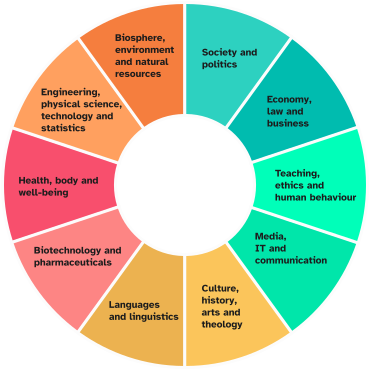
Study wheel

What interests you?

Aurora Cooperation

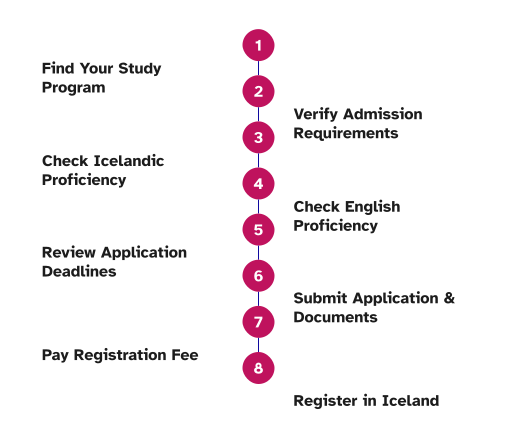
How to apply

Follow the path

Contact us

If you still have questions, feel free to contact us.

School of Humanities
Weekdays: 10-12 am and 1-3 pm
General Service and Social Media

The Service Desk is a point of access for all services. You can drop in at the University Centre or use the WebChat at the bottom right of this page.

Follow the School of Humanities on Instagram,   Youtube
and Facebook

""

Share

Did this help?

Why wasn't this information helpful

Limit to 250 characters.