
""
Language skills
required
Programme length
One year.
Study mode
Face-to-face learning
Application status
International students:
Students with Icelandic or Nordic citizenship:
Overview

  • Are you interested in historical linguistics?
  • Would you like to strengthen your understanding of foreign languages?
  • Do you want to be able to read important primary sources about philosophy, history, theology or the history of science dating from the classical period to the 19th century?
  • Do you want to be able to read medieval or ancient texts?
  • Do you want to learn more about Latin and Greek?
  • Do you enjoy literature, philosophy or art history?
  • Are you interested in postgraduate studies in this field?

Students taking the diploma in classical languages study both Ancient Greek and Latin and are based at the Department of Classical and Romance Languages.

In order to understand the material, knowledge of the two classical languages is essential. Classical studies therefore begin with the study of Latin and/or Ancient Greek.

60 ECTS is defined as one year of full-time study, meaning that full-time students can complete the programme in one year. Part-time students may completed the diploma in classical languages in two years. If the programme is not completed in two years, a student may apply to the Department for an extension. The Department may grant an extension with certain conditions.

Students who wish to continue studying Ancient Greek or Latin at the University of Iceland are able to do so and may have credits transferred from the diploma programme to the BA programme.

Course topics include:

  • Latin
  • Classical studies
  • Ancient Greek

Please note that this is a 60 ECTS diploma and students must complete at least 180 ECTS to graduate with a BA degree.

Other

This subject can be taken as a

See more on Majors and minors under Helpful content below.

Icelandic matriculation examination (stúdentspróf) or equivalent qualification. Further information can be found in article 15, regulation on admission requirements for undergraduate study no. 331/2022.

To complete the diploma in Classical Languages the student must complete all the compulsory courses specified in the programme structure:

- KLM101G Latin I: Beginner's Course
- KLM102G Ancient Greek: Beginner's Course
- KLM201G Latin II: A Selection of Latin Texts
- KLM202G Ancient Greek II

Other courses shall be selected in consultation with the supervisor.

Programme structure

Check below to see how the programme is structured.

This programme does not offer specialisations.

Year unspecified | Fall
Latin I: Beginner's Course (KLM101G)
A mandatory (required) course for the programme
10 ECTS, credits
Course Description

This course is a beginner’s course in Latin. No prior knowledge of Latin is assumed at the outset. It introduces the basics of Latin grammar and syntax. Chosen passages will be read in Latin, translated and thoroughly analysed. Teaching consists of 24 lectures on particular aspects of the Latin language and assigned readings.

This course is taught in Icelandic but students can get permission of the instructor to complete assignments and exams in English.

Language of instruction: Icelandic
Face-to-face learning
Year unspecified | Fall
Ancient Greek I: Beginner's Course (KLM102G)
A mandatory (required) course for the programme
10 ECTS, credits
Course Description

This course is a beginner’s course in Ancient Greek. It introduces the basics of grammar and syntax of the Attic dialect. No prior knowledge of Greek is assumed at the outset. Reading knowledge of Ancient Greek will be prioritized and chosen passages will be read in Greek, translated and thoroughly analysed. Teaching consists of both lectures on particular aspects of the Greek language and assigned readings. It is essential that students read the assigned materials before each lecture.

This course is taught in Icelandic but students can get permission of the instructor to complete assignments and exams in English.

Language of instruction: Icelandic
Face-to-face learning
Year unspecified | Fall
The World of Ancient Greece: History and Society (KLM115G)
Free elective course within the programme
10 ECTS, credits
Course Description

This course is an introduction to the history of Ancient Greek civilization, with an emphasis on Ancient Greek culture and world view, from earliest times to the Roman period.

Language of instruction: Icelandic
Year unspecified | Fall
The Ancient Novel (KLM304G)
Free elective course within the programme
10 ECTS, credits
Course Description

This course is an introduction to the novel in classical antiquity. Prose fiction appeared  in the 1st century and developed further into late antiquity. There are various relations to older genres of literature, such as Greek and Roman comedies and satires. In this course the student will be introduced to the major authors of the ancient novel and their works and we will discuss their relations to other Greek and Latin literature.

Knowledge of Latin is not required, but students Classics may choose to work on a supervised independent study project (5 ECTS, or 10 ECTS) focusing on the original text in connection to the course. The supervised independent study projects which are available to students with reading knowledge of Latin or Greek are intended to strengthen their proficiency in Latin and train them in the reading of original texts.

Language of instruction: Icelandic
Face-to-face learning
Year unspecified | Fall
Propertius (KLM301G)
Free elective course within the programme
5 ECTS, credits
Course Description

In this course we will read selections from the works of the Roman poet Sextus Propertius.

A specific text is assigned for each class meeting. Students are expected to have read the text and prepared in advance. During class meetings the text will be read, translated and analyzed grammatically and materially as needed.

Language of instruction: Icelandic
Not taught this semester
Year unspecified | Fall
Intruduction to Classical Studies (KLM103G)
Free elective course within the programme
10 ECTS, credits
Course Description

The course is an introduction to Classical Studies. It will deal with the history of the discipline as well as its subject matter and methods: Students will be introduced to classical philology and the various branches of Classical Studies, such as the history, literature, and philosophy of classical antiquity. The course will, moreover, address issues concerning the use of sources, methodology, and conventions in Classics. Students will be introduced to major resources. Knowledge of the classical languages is not required.

Language of instruction: Icelandic
Face-to-face learning
Year unspecified | Spring 1
Latin II: A Selection of Latin Texts (KLM201G)
A mandatory (required) course for the programme
10 ECTS, credits
Course Description

The course is a continuation of LAT101G Latin I. Students will read a selection of Latin texts by various authors.

This course is taught in Icelandic but students can get permission of the instructor to complete assignments and exams in English.

Language of instruction: Icelandic
Face-to-face learning
Year unspecified | Spring 1
Ancient Greek II (KLM202G)
A mandatory (required) course for the programme
10 ECTS, credits
Course Description

The course is a continuation of KLM102G Ancient Greek I. The first part of the course resumes coverage of grammar and syntax of Ancient Greek (Attic) where Ancient Greek I left off. During the second half of the course, students will read a selection of Ancient Greek texts by different authors from various periods.

Students can get permission of the instructor to complete assignments and exams in English.

Language of instruction: Icelandic
Face-to-face learning
Year unspecified | Spring 1
Cicero: On the Nature of the Gods (KLM406G)
Free elective course within the programme
5 ECTS, credits
Course Description

M. Tullius Cicero is no doubt of of the most important as well as one of the most influential Latin prose authors. In this course we will read from his De natura deorum (On the Nature of the Gods), which contains discussions concerning philosophical theories about the nature of divinity. Passages will be read from the 2nd book of De natura deorum which contains a discussion concerning the Stoic theory of divinity. Passages will be read in the original language, translated and analysed grammatically as well as materially.

Language of instruction: Icelandic
Face-to-face learning
Year unspecified | Spring 1
Medieval Latin (KLM203G)
Free elective course within the programme
5 ECTS, credits
Course Description

In this course we will read selections from medieval literature broadly conceived (from the end og the 4th century to the end of the 15th century): poetry and historiography, philosophy and theology. Texts will be analysed grammatically and discussed materially as needed.

The course will be taught in Icelandic, but students whose native language is not Icelandic may complete assignments and exams in English.

Language of instruction: Icelandic
Face-to-face learning
Year unspecified | Spring 1
Greek and Roman Historians and Historiography (KLM204G)
Free elective course within the programme
10 ECTS, credits
Course Description

This course introduces Ancient Greek and Roman historiography, tracing its beginning and development, and discusses its scope, aims and methods. Among authors who will be discussed are Herodotus, Thucydides, Xenophon, Polybius, Cato, Sallust, Livy, Plutarch, Suetonius, Tacitus, Ammianus Marcellinus and others. Readings will include excerpts from ancient texts in translation.

Language of instruction: Icelandic
Face-to-face learning
Year unspecified
  • Fall
  • KLM101G
    Latin I: Beginner's Course
    Mandatory (required) course
    10
    A mandatory (required) course for the programme
    10 ECTS, credits
    Course Description

    This course is a beginner’s course in Latin. No prior knowledge of Latin is assumed at the outset. It introduces the basics of Latin grammar and syntax. Chosen passages will be read in Latin, translated and thoroughly analysed. Teaching consists of 24 lectures on particular aspects of the Latin language and assigned readings.

    This course is taught in Icelandic but students can get permission of the instructor to complete assignments and exams in English.

    Face-to-face learning
    Prerequisites
  • KLM102G
    Ancient Greek I: Beginner's Course
    Mandatory (required) course
    10
    A mandatory (required) course for the programme
    10 ECTS, credits
    Course Description

    This course is a beginner’s course in Ancient Greek. It introduces the basics of grammar and syntax of the Attic dialect. No prior knowledge of Greek is assumed at the outset. Reading knowledge of Ancient Greek will be prioritized and chosen passages will be read in Greek, translated and thoroughly analysed. Teaching consists of both lectures on particular aspects of the Greek language and assigned readings. It is essential that students read the assigned materials before each lecture.

    This course is taught in Icelandic but students can get permission of the instructor to complete assignments and exams in English.

    Face-to-face learning
    Prerequisites
  • KLM115G
    The World of Ancient Greece: History and Society
    Elective course
    10
    Free elective course within the programme
    10 ECTS, credits
    Course Description

    This course is an introduction to the history of Ancient Greek civilization, with an emphasis on Ancient Greek culture and world view, from earliest times to the Roman period.

    Prerequisites
  • KLM304G
    The Ancient Novel
    Elective course
    10
    Free elective course within the programme
    10 ECTS, credits
    Course Description

    This course is an introduction to the novel in classical antiquity. Prose fiction appeared  in the 1st century and developed further into late antiquity. There are various relations to older genres of literature, such as Greek and Roman comedies and satires. In this course the student will be introduced to the major authors of the ancient novel and their works and we will discuss their relations to other Greek and Latin literature.

    Knowledge of Latin is not required, but students Classics may choose to work on a supervised independent study project (5 ECTS, or 10 ECTS) focusing on the original text in connection to the course. The supervised independent study projects which are available to students with reading knowledge of Latin or Greek are intended to strengthen their proficiency in Latin and train them in the reading of original texts.

    Face-to-face learning
    Prerequisites
  • KLM301G
    Propertius
    Elective course
    5
    Free elective course within the programme
    5 ECTS, credits
    Course Description

    In this course we will read selections from the works of the Roman poet Sextus Propertius.

    A specific text is assigned for each class meeting. Students are expected to have read the text and prepared in advance. During class meetings the text will be read, translated and analyzed grammatically and materially as needed.

    Prerequisites
  • Not taught this semester
    KLM103G
    Intruduction to Classical Studies
    Elective course
    10
    Free elective course within the programme
    10 ECTS, credits
    Course Description

    The course is an introduction to Classical Studies. It will deal with the history of the discipline as well as its subject matter and methods: Students will be introduced to classical philology and the various branches of Classical Studies, such as the history, literature, and philosophy of classical antiquity. The course will, moreover, address issues concerning the use of sources, methodology, and conventions in Classics. Students will be introduced to major resources. Knowledge of the classical languages is not required.

    Face-to-face learning
    Prerequisites
  • Spring 2
  • KLM201G
    Latin II: A Selection of Latin Texts
    Mandatory (required) course
    10
    A mandatory (required) course for the programme
    10 ECTS, credits
    Course Description

    The course is a continuation of LAT101G Latin I. Students will read a selection of Latin texts by various authors.

    This course is taught in Icelandic but students can get permission of the instructor to complete assignments and exams in English.

    Face-to-face learning
    Prerequisites
  • KLM202G
    Ancient Greek II
    Mandatory (required) course
    10
    A mandatory (required) course for the programme
    10 ECTS, credits
    Course Description

    The course is a continuation of KLM102G Ancient Greek I. The first part of the course resumes coverage of grammar and syntax of Ancient Greek (Attic) where Ancient Greek I left off. During the second half of the course, students will read a selection of Ancient Greek texts by different authors from various periods.

    Students can get permission of the instructor to complete assignments and exams in English.

    Face-to-face learning
    Prerequisites
  • KLM406G
    Cicero: On the Nature of the Gods
    Elective course
    5
    Free elective course within the programme
    5 ECTS, credits
    Course Description

    M. Tullius Cicero is no doubt of of the most important as well as one of the most influential Latin prose authors. In this course we will read from his De natura deorum (On the Nature of the Gods), which contains discussions concerning philosophical theories about the nature of divinity. Passages will be read from the 2nd book of De natura deorum which contains a discussion concerning the Stoic theory of divinity. Passages will be read in the original language, translated and analysed grammatically as well as materially.

    Face-to-face learning
    Prerequisites
  • KLM203G
    Medieval Latin
    Elective course
    5
    Free elective course within the programme
    5 ECTS, credits
    Course Description

    In this course we will read selections from medieval literature broadly conceived (from the end og the 4th century to the end of the 15th century): poetry and historiography, philosophy and theology. Texts will be analysed grammatically and discussed materially as needed.

    The course will be taught in Icelandic, but students whose native language is not Icelandic may complete assignments and exams in English.

    Face-to-face learning
    Prerequisites
  • KLM204G
    Greek and Roman Historians and Historiography
    Elective course
    10
    Free elective course within the programme
    10 ECTS, credits
    Course Description

    This course introduces Ancient Greek and Roman historiography, tracing its beginning and development, and discusses its scope, aims and methods. Among authors who will be discussed are Herodotus, Thucydides, Xenophon, Polybius, Cato, Sallust, Livy, Plutarch, Suetonius, Tacitus, Ammianus Marcellinus and others. Readings will include excerpts from ancient texts in translation.

    Face-to-face learning
    Prerequisites

The timetable shown below is for the current academic year and is FOR REFERENCE ONLY.

Changes may occur for the autumn semester in August and September and for the spring semester in December and January. You will find your final timetable in Ugla when the studies start.

Note! This timetable is not suitable for planning your work schedule if you are a part-time employee.



Additional information

The University of Iceland collaborates with over 400 universities worldwide. This provides a unique opportunity to pursue part of your studies at an international university thus gaining added experience and fresh insight into your field of study.

Students generally have the opportunity to join an exchange programme, internship, or summer courses. However, exchanges are always subject to faculty approval.

Students have the opportunity to have courses evaluated as part of their studies at the University of Iceland, so their stay does not have to affect the duration of their studies.

An education in Greek, Latin and classical studies (or classics) can lead to a wide range of career opportunities.

The study of classics or classical languages provides students with training in a unique blend of skills in different academic fields: languages and linguistics, history and literature.

Due to the diversity of the subject, students learn to think both analytically and holistically. They also gain language skills and an understanding of the nature of different sources, how to approach sources critically and close read a variety of texts.

An education in this area can open up opportunities in:

  • Research
  • Teaching
  • Journalism
  • Writing
  • Publishing
  • Tourism
  • Politics

This list is not exhaustive.

More about the UI student's social life

Students' comments
Sólveig Hrönn Hilmarsdóttir
One of the things that attracted me to studying the classical languages, Latin and Greek, is how varied the studies are. In my studies in Iceland, and as an exchange student at Glasgow University I have taken courses on all aspects concerning antiquity, Latin, Greek, linguistics, literature, history, philosophy, and art. The degree thus provides a good foundation in a broad field, and in many ways, I think classical languages is the most interdisciplinary programme offered at the University of Iceland. The teachers are very enthusiastic about their field and always ready to assist students and talk to them.
Kristrún Ósk Óskarsdóttir
Since I can remember, I have had a great interest in Ancient Greece and Rome. In my studies of classical languages, Latin and Greek, I have gained a deeper understanding of the language and culture of these civilizations. The programme is diverse, covering the languages and the rich cultural heritage of the Ancient Greeks and Romans. The teachers are highly knowledgeable in their field and always ready to assist students. I believe that anyone interested in classical antiquity and its influences on the present should be able to find something suitable among the many courses available.
Portrait photo of Hörður Brynjar Halldórsson
I chose classical languages to read original philosophical texts. My interest in ancient cultures and languages grew, as did my fascination with Icelandic. The programme is both challenging and enjoyable, with supportive teachers. I highly recommend it.
Helpful content
Aurora Cooperation

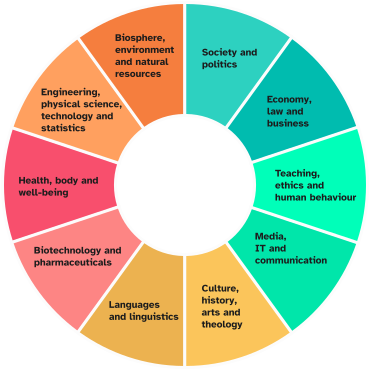
Study wheel

What interests you?

Aurora Cooperation

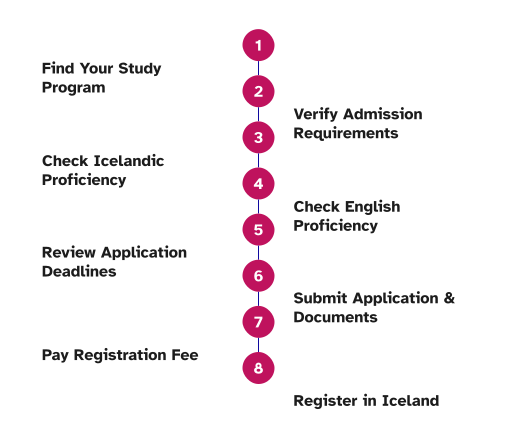
How to apply

Follow the path

Contact us

If you still have questions, feel free to contact us.

School of Humanities
Weekdays: 10-12 am and 1-3 pm
General Service and Social Media

The Service Desk is a point of access for all services. You can drop in at the University Centre or use the WebChat at the bottom right of this page.

Follow the School of Humanities on Instagram,   Youtube
and Facebook

""

Share

Did this help?

Why wasn't this information helpful

Limit to 250 characters.