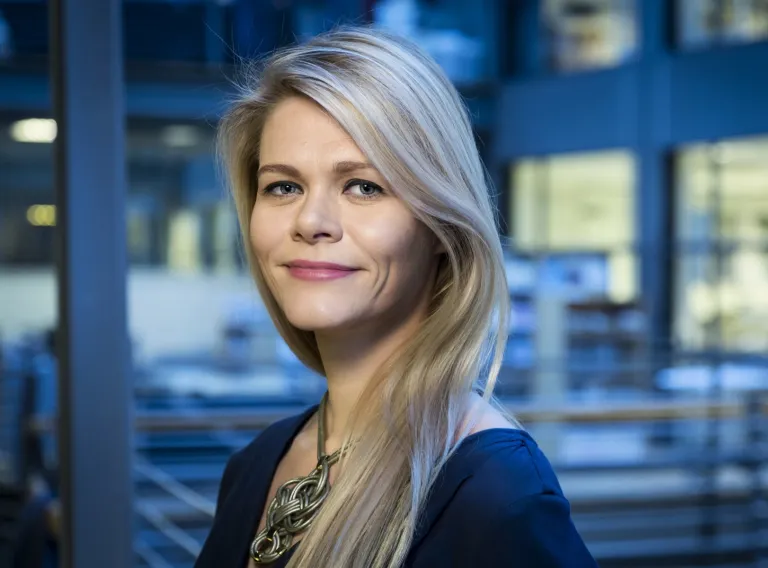
Edda Björk Þórðardóttir, postdoctoral researcher in public health sciences
When the importance of a healthy lifestyle is discussed, good diet and sufficient sleep are usually mentioned. The subject of sleep has not only provided inspiration to many Icelandic poets through the ages, but is also one of the things that ordinary people discuss over their first cup of coffee in the morning. For thousands of years, people have scrutinised dreams and tried to connect them to daily life, sometimes using psychology and often using very unscientific methods, interpreting dreams as predictions of the future. In the Icelandic Sagas, for example, dreams are an important plot device, foreshadowing the story to create tension and connect the supernatural with day-to-day reality.
Edda Björk Þórðardóttir, postdoctoral researcher in public health sciences, talks more about sleep than most people, since her research focuses on the phenomenon, as well as the dreams that generally accompany sleep. "Sleep is a fascinating thing," says Edda Björk of the incredible phenomenon that is essential for us all, but which not everyone can necessarily take for granted. "What happens when we sleep is still in large part a mystery. If we completely denied ourselves sleep, we would become extremely confused and experience memory loss and hallucination. Experiments on animals have also shown that lack of sleep can eventually lead to organ failure."
The SAGA cohort study on women's trauma forms the foundation of the research
"Most of us who have experienced sleep loss due to stress or a wakeful infant know how lack of sleep can have a negative impact on our mental and physical health. It is important to map the scale of the problem and its symptoms in order to develop effective treatments," says Edda Björk, who has worked at the Directorate of Health and as an editor of the online journal Heilsan okkar. In these positions, she has explored trauma and its wide-ranging impact on people, not least on sleep. Edda Björk is now working as a postdoctoral researcher at the University of Iceland Faculty of Medicine.
"Sometimes sleep can be elusive," says Edda Björk, "sleep problems are widely recognised and can sometimes be linked to difficult experiences."
In her research, she uses the SAGA cohort database, with a special emphasis on the links between trauma and sleep problems in participants. The SAGA cohort is a large and wide-ranging study by the University of Iceland Faculty of Medicine, in which all women in Iceland were invited to participate. Over 30 thousand women signed up for the study, which has created a huge database – a gold mine for Edda Björk and other scientists. The goal of collecting this data is to improve public health in Iceland, not least among women who have suffered trauma in their lives.