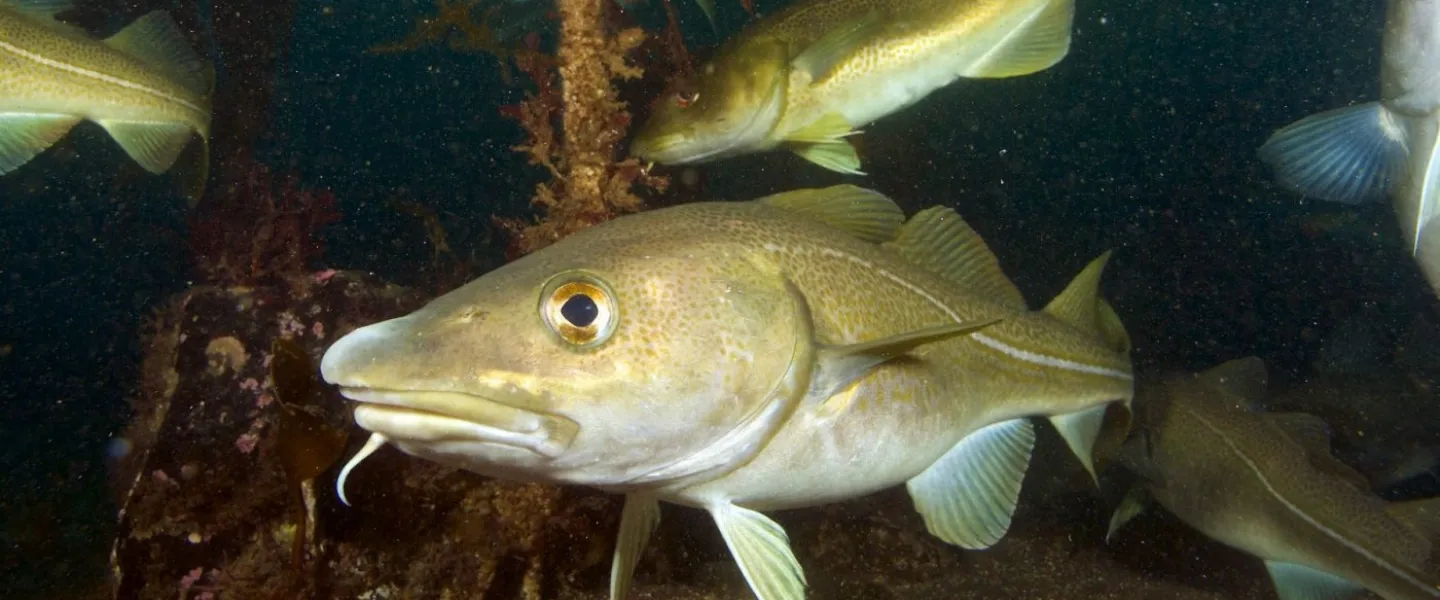
Scientists from the University of Iceland shed new light on the evolution of cod fish and their dispersion in the oceans by sequencing the genomes of various types of cod fish from the Atlantic, the Arctic, and the Pacific oceans. A scientific article discussing the conclusions of the study was published in the prestigious journal Science Advances yesterday. The scientists point out that alongside global warming and the melting of the Arctic ice further hybridisation between cod species in these areas will take place with unforeseeable consequences for biodiversity.
The headline of the article in Science Advances is: “Codweb: whole-genome sequencing uncovers extensive reticulations fuelling adaptation among Atlantic, Arctic, and Pacific gadids”, and its authors are Einar Árnason, professor emeritus in evolutionary biology and population genetics at the Faculty of Life and Environmental Sciences at the University of Iceland and Katrín Halldórsdóttir, specialist at the Life and Environmental Institute at the University. The study is part of a larger research project, “Population genomics of highly fecund codfish ” which received a three-year excellence grant from the Icelandic Research Fund last year.
Einar and Katrín have for a number of years devoted themselves to research on the genetic evolution of the cod and focused on natural selection in this most important commercial fish for Icelanders. Competition is fierce between individuals within the same species and between different species and it leads to natural selection explaining the diversity of organisms and their adaptation.
The Atlantic cod hybridised with Arctic species and created the Alaskan Pollack
The goal of the study discussed in Science Advances was to explore the origins and kinship of the cod to its sister species, like pollack, in the Arctic Ocean and the Pacific, i.e. how the cod as an organism can adapt to new habitats in the Pacific and formed new species and which part hybridisation plays in this process. Einar and Katrín’s study involved sequencing the whole genomes of various types of cod in the Atlantic, Arctic and Pacific and analyse hybridisation between them.
The sequencing showed that the evolutionary connections of cod fish is better described as a connecting web than a traditional evolutionary tree, according to the authors. In the article the evolutionary connection of discrete species is traced further, e.g. how the Atlantic cod hybridised with species in the Arctic resulting in the walleyed pollack, or the Alaskan pollack as shown in the video below. “The characteristic of cod fish to be able to adapt to new habitats with great success and to become dominant in the ecosystem is probably a result of genes they have received through hybridisation, resulting in genetic diversity that allows for adaptation to new ecological niches. Such adaptation is probably the reason why these fish have become the most important fishing stocks in the world,“ says Einar.
Evolution, institution, hybridisation, and annexation of genes among cod fish