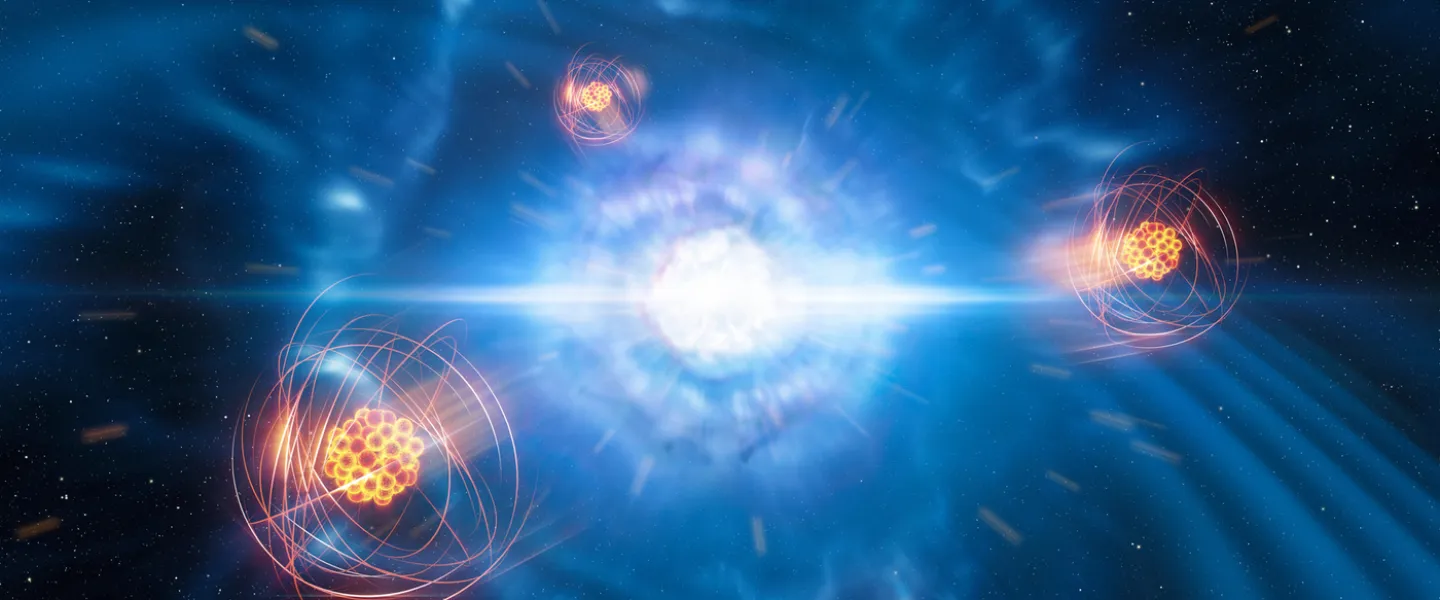
The first unequivocal evidence of where the heaviest elements were forged has now been found by a large group of European-based astronomers. For the first time, an element heavier than iron has been clearly detected in the collision of two neutron stars, resolving one of the fundamental questions about the history of the universe. Among the scientists in the research group is Kasper Elm Heintz who completed his doctorate in astrophysics from the University of Iceland last week. These ground-breaking results are published in the latest issue of Nature - International Journal of Science.
Scientists have known since the 1950s that hydrogen and helium were formed during the Big Bang, and that heavier elements up to iron are created by nuclear fusion in stars, and when stars explode as supernovae. But iron is only no. 26 out of about 90 naturally occurring elements in the periodic table. Where the other elements heavier than iron came from has long been a mystery.
To answer this mystery, it is necessary to pin point exactly how and where these elements came to be. The only way elements heavier than iron can be formed is by a process called neutron capture, where neutrons penetrate an atomic nucleus - for example, an iron atom - which absorbs the neutrons, creating a new, heavier atomic nucleus and thus a new element. Neutron capture can be either fast or slow, in the so-called r-process (rapid) or s-process (slow). Elements formed almost exclusively by the r-process are typically very heavy and near the end of the periodic table: gold, platinum, uranium. It is this rapid process whose location has never been established. In recent years, the scientific consensus has evolved toward the idea that much of the r-process happens when two neutron stars collide - but the definitive evidence has thus far been missing.
Detected a collision of two neutron stars in 2017
This has now been proven thanks to the team of scientists led by Darach Watson at the Niels Bohr at the University of Copenhagen. The discovery was made by studying the light from a neutron star collision. A neutron star is an extremely compact star, that we now know consists mainly of neutrons. It is typically only about 20 km in diameter, but can weigh one and a half to two times more than the Sun.
European Southern Observatory video on the research (Author: ESO/L. Calçada)