Freysteinn Sigmundsson, research scientist at the University of Iceland's Institute of Earth Sciences
An international group of research scientists led by Freysteinn Sigmundsson, research scientist at the University of Iceland's Institute of Earth Sciences, has presented a new method for evaluating when molten magma in volcano roots becomes unstable and forces its way towards the surface of the Earth. In an article in the prestigious and widely read science journal Nature Communications, the method is used to better understand precursors, onset and evolution of a large-volume eruption in Iceland in 2014-2015.
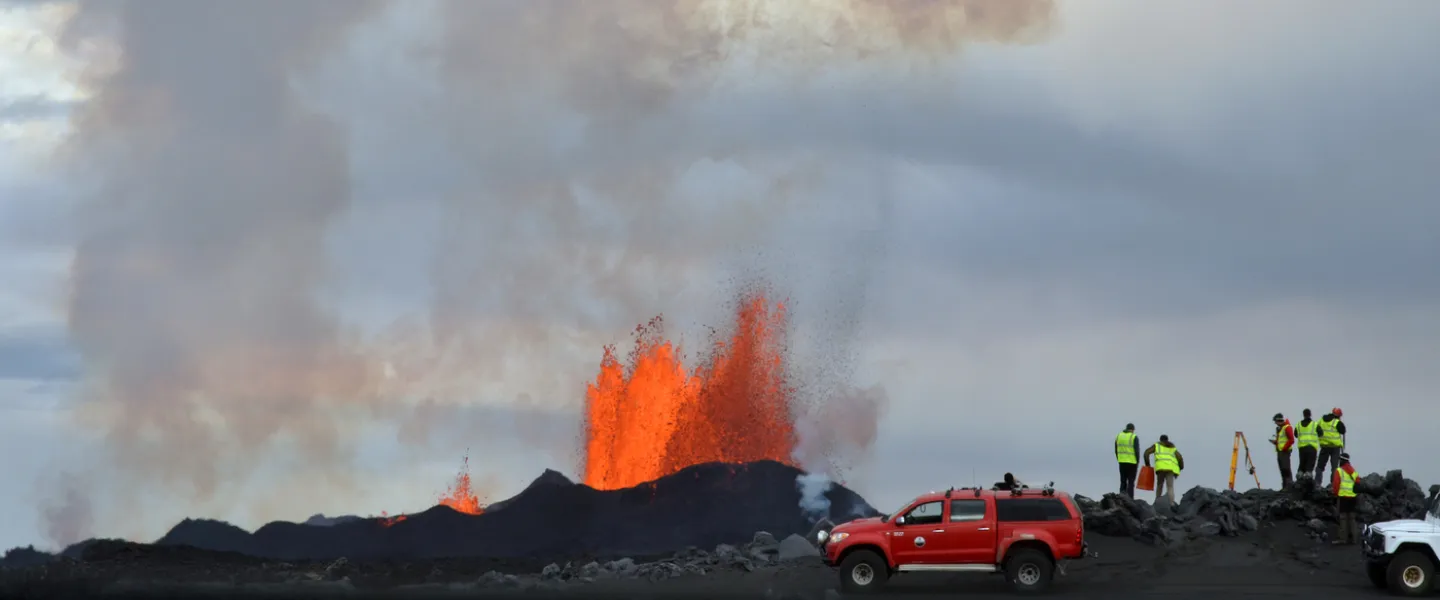
Just over five years have passed since the end of the 2014-2015 Holuhraun eruption in the Bardarbunga volcanic system; an eruption that produced the largest lava field in Iceland for more than 200 years. The data gathered in the time leading up to the eruption and during it has proven a valuable source for new discoveries in earth sciences in recent years, and now for improved understanding of magma movements in volcano roots.
In the study published in Nature Communications the group of scientists shed light on what conditions need to be in place in a volcano for an eruption to start, and furthermore how eruptions develop and lead to caldera formation, i.e. when a large part of a volcano subsides at the same time as a large amount of magma reaches the surface, as was the case in the 2014-2015 activity.
"Previous methods to understand magma movements in the surface have certain limitations and are based on assumptions that are not always applicable. It is also noteworthy that some large-volume eruptions have small or minor precursors in terms of increased earthquake activity and magma movements. Small eruptions can on the other hand have large precursors. This is not what is expected from commonly used models that volcanologists have used to interpret monitoring data from volcanoes," Freysteinn points out.