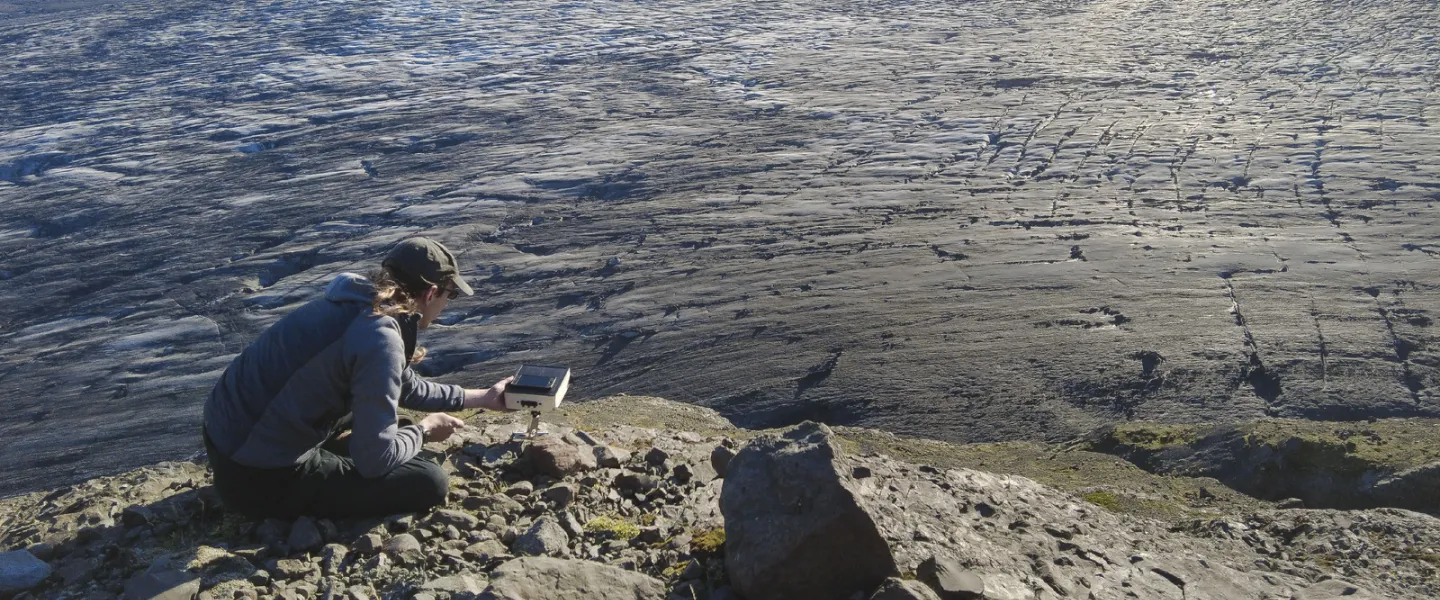
Kieran Baxter working on the Ice-Watch project

Dramatic footage captured by expert at the University of Iceland's Reserach Centre in Höfn and the University of Dundee has shown how climate change is melting Iceland’s glaciers. The footage has received media attention worldwide.

The footage, taken over a period of less than six weeks, shows the significant retreat of the Breiðamerkurjökull glacier, within Vatnajökull National Park in the south-east of the country. Experts highlight that the rapid rate of summer melt is now significantly exceeding recovery during the winter months.

The time-lapse was captured by Dr Kieran Baxter, a lecturer in Communication Design at the University’s Duncan of Jordanstone College of Art & Design and a leading expert in the visual communication of glacial retreat across Europe. Kieran is, furthermore a postdoc at the University of Iceland’s Research Centre in Hornafjörður. Working with partners at the University of Iceland’s Research Centre in Hornafjörður, the footage shows the startling rate at which centuries-old ice is melting, highlighting the impact that climate change is having on some of the planet’s most fragile and beautiful landscapes.

One of their projects is the short film After Ice, premiered earlier this year. The information used in the film and the research is visual, photographs, film footage and drone images, obtained with specialised technology, i.e. cameras of various kinds revealing the dramatic changes in several Icelandic glaciers in the Vatnajökull area in the past few decades. The film has been shown in numerous film festivals all over the world and been nominated for awards.
The film above features the very dramatic changes to glaciers over the past decades. The film underlines the effects of climate change this extreme tourist attraction that the glaicers are. The film has attracted great attention and has been on the largest media outlets in the world, such as BBCNBC and Sky News

Kieran Baxter

Paths chosen today have a huge influence on the climate impact in the future

World leaders are currently gathering in Glasgow Scotland at the COP26 conference where they discuss the effects of and reactions to climate changes. “Footage like this should act as a wake-up call that we cannot ignore the signs any longer,” says Dr Baxter. "Climate change is already having dire consequences around the world and we have to take responsibility for that. The paths we choose now, including the decisions made at COP26, will have a huge influence on the climate impacts that we will have to deal with in the future. The volume of ice melt that we are seeing in Iceland is just one of the indicators that show us the scale of those impacts.” 

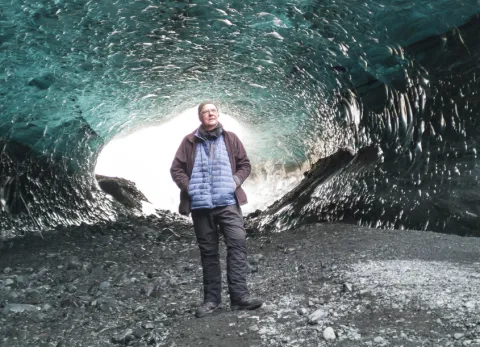
Dr. Þorvarður Árnason in an ice cave
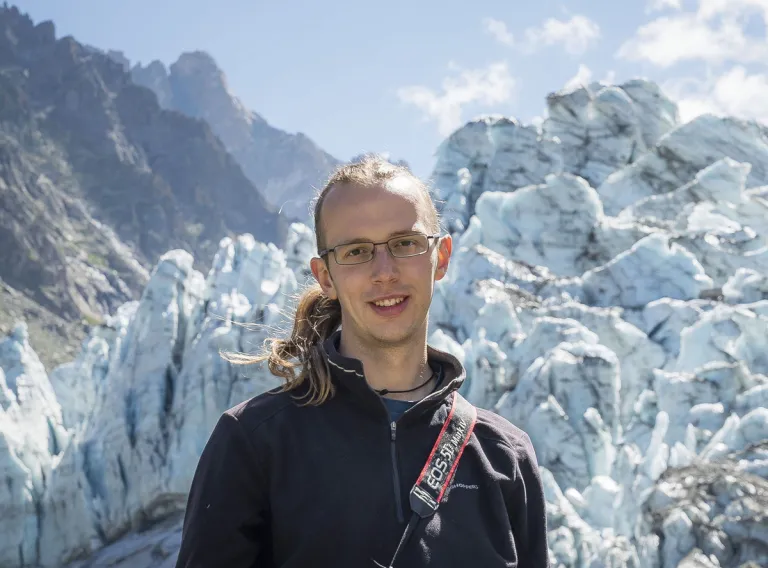
The scholar Þorvarður Árnason from the University of Iceland Research Centre in Hornafjörður

Dr Þorvarður Árnason, who leads the collaborative project at the University of Iceland, said “Where our previous co-production, After Ice, involved re-creating the recent past of glacier melt in Iceland, the new project looks into the future – or rather a range of potential futures that depend on action to reduce greenhouse gas emissions today. “This project involves a close cooperation between artists and scientists in Scotland and Iceland. We have found this interdisciplinary work to be vital to successful climate change communication.”

Iceland’s glaciers are coming under increasing attack from climbing temperatures. Since 1989, Vatnajökull ice cap, one of the largest in Europe, has lost 150–200 km³ of ice and its area has been reduced by more than 400 km² according to the Icelandic Meteorological Office. Many glacier termini have retreated by more than a kilometre in this time.

Snævarr Guðmundsson, glaciologist at the South East Iceland Nature Research Centre, said "While this footage represents only a fraction of the 16km wide glacier terminus, it demonstrates how rapidly Breiðamerkurjökull is now melting. 
“When a glacier is in balance the winter accumulation would equal the summer melt, but we do not see that here. The ablation has accelerated beyond recovery and in recent decades a retreat of up to 250m per year has been recorded."

Previously, Dr Baxter has published dramatic aerial photographs showing the disappearance of some of Iceland’s largest glaciers, working in conjunction the University of Iceland and the National Land Survey of Iceland. His passion for studying glaciers has also seen him document how a century of global warming has caused vast levels of ice loss around Mont Blanc.

Most recently, Dr Baxter has worked on a project to visualise the future of Breiðamerkurjökull, Iceland’s third-largest glacier, and how it will respond to different scenarios of greenhouse gas emissions over the coming century. Helga Árnadóttir, specialist at Vatnajökull National Park, added, “It is important to communicate the research that is happening in the national park and to improve access to the results through visualisations like this one. This project is of great value for the park rangers, park visitors and tour operators in the area and will increase the quality of information about melting glaciers and climate change.”

This ongoing time-lapse project to record Iceland’s glacier melt can be followed at climatevis.com/ice-watch.

Tags

Share

Did this help?

Why wasn't this information helpful

Limit to 250 characters.