Grant recipients and their representatives with the Rector of UI and the Fund's board. IMAGE/Kristinn Ingvarsson

Seven grants have been awarded from the Eggert Fund at UI to support a range of research in the earth and life sciences. The grants, amounting to a total sum of ISK 7 million, were presented at a formal event in the UI Ceremonial Hall.


Adam Ray Smith, research lecturer in biology at the UI Institute of Life and Environmental Sciences, received funding to study the relationship between embryos and their environment, with the aim of better understanding developmental processes. In particular, he will focus on how reduced oxygen levels affect cell migration and behaviour, which is relevant both for natural development and our understanding of tumour biology. The study uses fish, including Atlantic salmon and zebrafish, to address a range of questions about fundamental aspects of developmental biology and how that knowledge can be applied in areas such as ecology, aquaculture and even human health. The grant will support the development of new tools that enable researchers to precisely control low-oxygen environments for the fish. Embryos developed under different environmental conditions will be used to analyse the genetic and cellular factors that determine adaptations, or potential lack of adaptation, to changes in their environment.
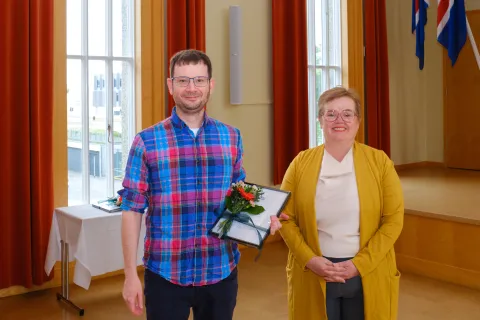
Adam accepting the grant from Silja Bára R. Ómarsdóttir, Rector of UI.
Adam accepting the grant from Silja Bára R. Ómarsdóttir, Rector of UI. IMAGE/Kristinn Ingvarsson

Adam Ray Smith completed a doctorate from the University of Maryland in 2011. He worked as a postdoctoral researcher at Indiana University 2011-2016 and an assistant professor at the same university 2016-2021. Since 2024, he has been a research lecturer at the UI Institute of Life and Environmental Sciences. Adam’s research has focused on the evolution of biological diversity, particularly in fish, using approaches from evolutionary genetics, developmental biology and physiology. He has explored topics such as the evolution of cichlid vision and communication in electric fish through electronic signalling.

François Singh, lecturer at the UI Faculty of Medicine, received funding for a study aimed at identifying new pharmacological compounds that affect mitochondrial degradation and biogenesis in cells and analysing the molecular pathways behind these processes. Mitochondria have a remarkable ability to adapt to both physiological and pathogenic conditions. Since they are involved in numerous cellular processes, disruptions to their functioning can have widespread effects and cause various disease symptoms. Recent research has demonstrated that regulation of mitochondrial balance is complex and that cells can use different pathways to compensate for defects in the way they break down. This underlines the importance of maintaining healthy mitochondrial balance for proper cellular function. In this study, various compounds will be screened to learn more about the processes involved in mitochondrial degradation and biogenesis. The knowledge generated by the research will be used to promote improved mitochondrial health, either by stimulating the biogenesis of healthy mitochondria or increasing the degradation of defective mitochondria.

Guðjón Ólafsson receiving the grant from Silja Bára R. Ómarsdóttir, Rector of UI, on behalf of François.
Guðjón Ólafsson accepting the grant from Silja Bára R. Ómarsdóttir, Rector of UI, on behalf of François who was unable to attend. IMAGE/Kristinn Ingvarsson

François Singh’s laboratory investigates how mitochondrial balance is regulated under normal conditions and in relation to disease. He acquired his expertise in mitochondrial stress responses during his doctoral studies at the University of Strasbourg in France, in collaboration with the University of Basel in Switzerland. As a postdoctoral researcher at the University of Dundee in the United Kingdom, François further studied the physiological role of pathogenic mutations associated with Parkinson’s disease, with a focus on mitochondrial clearance and general self-regulation of cells. François was hired as a lecturer at the University of Iceland in 2023.

Guðjón Ólafsson, lecturer at the UI Faculty of Medicine, received a grant to support research into centromeres in chromosomes and how they relate to cancer development. When a cell divides, it must share its chromosomes equally between the daughter cells. Centromeres, specialised regions of each chromosome, control this process. When it goes wrong, cells end up with an incorrect number of chromosomes, which is one of the main symptoms of cancer. It has recently been discovered that cells produce RNA from centromeres, and that accurate chromosome segregation depends on having the correct amount of this RNA. However, little is known about how this production is regulated. Guðjón Ólafsson’s laboratory is searching for binding sites of cancer-related transcription factors, known as MYC and MITF, in centromeres. His recent results suggest that these sites are common in human centromeres. The grant will be used to investigate whether these factors actually do regulate transcription from centromeres, both in a yeast cell model and human cells. The results will shed light on the relationship between cellular stress, centromeric transcription and chromosomal instability, and may reveal new biomarkers or therapeutic targets for cancer treatment.

Guðjón Ólafsson accepting the grant from Silja Bára R. Ómarsdóttir, the Rector of UI.
Guðjón Ólafsson accepting the grant from Silja Bára R. Ómarsdóttir, the Rector of UI. IMAGE/Kristinn Ingvarsson

Guðjón Ólafsson completed a doctorate from University College London and the Francis Crick Institute in 2018 and then worked as a researcher at the Queen Mary University of London and New York University before returning to Iceland, initially as a postdoctoral researcher in Eiríkur Steingrímsson’s laboratory and later as a lecturer. Guðjón is also the co-founder and chief scientific officer of Gleipnir BioForge, a biotech startup at UI working to develop a screening platform to inactivate disease-related proteins through induced proximity. He received the UI Science and Innovation Prize for this idea in 2025.

Iwona Galeczka, research lecturer at the UI Institute of Earth Sciences, received a grant for research on chemical weathering of bedrock due to climate change. Rising atmospheric temperatures and higher levels of carbon dioxide are altering the planet’s geochemical and biochemical cycles. One of the main consequences of this in Iceland is increased release of metals and nutrients into groundwater, rivers, and coastal areas. This can be traced to chemical weathering of the country’s bedrock. Among the elements released are iron and phosphorous. These changes may affect water quality, ecosystems and the carbon cycle itself. Iwona’s project investigates how temperate and CO2 levels control the release and mobility of metals and nutrients during rock weathering. Element release rates will be quantified through experiments under conditions representing past, present and possible future climate change scenarios. By directly measuring the release of metals and nutrients, the study will increase our understanding of weathering and its environmental impact, as well as the carbon cycle.

Iwona accepting the grant from Silja Bára R. Ómarsdóttir, Rector of UI.
Iwona accepting the grant from Silja Bára R. Ómarsdóttir, Rector of UI. IMAGE/Kristinn Ingvarsson

Iwona works as an environmental geochemist at the Institute of Earth Sciences. Her area of expertise is related to the behaviour of carbon dioxide in geothermal systems and Iceland’s bedrock. After completing her doctorate from UI in 2013, Iwona worked as a postdoctoral researcher at the Institute of Earth Sciences, and subsequently at Iceland GeoSurvey, GNS Science in New Zealand and Carbfix in areas such as geothermal exploration and utilisation, geochemical monitoring and carbon capture. She has also contributed to training undergraduate and postgraduate students at UI, Reykjavík University and the GRÓ Geothermal Training Programme.

Silja Bára R. Ómarsdóttir, Rector of UI, delivers and address at the ceremony.

Kristinn Ragnar Óskarsson, lecturer at the Faculty of Life and Environmental Sciences, received a grant for research on the protein FOXA1, a transcription factor that regulates how and when DNA is transcribed into RNA. Numerous mutations in FOXA1 are known to be associated with cancer, particularly certain breast and prostate cancers. These mutations have been linked to disease progression and treatment response. FOXA1 is largely an intrinsically disordered protein, which makes it difficult to study its structure and interactions using conventional methods. The study uses a specialised technique called smFRET (single-molecule Förster Resonance Energy Transfer), which allows scientists to measure distances, track movements within individual protein molecules and investigate how FOXA1 interacts with other biomolecules. The ultimate goal is to define how cancer-associated mutations affect FOXA1, thereby improving our understanding of the protein’s role in cancer progression. This could contribute to the development of more targeted and effective treatments.

Kristinn accepting the grant from Silja Bára R. Ómarsdóttir, Rector of UI.
Kristinn accepting the grant from Silja Bára R. Ómarsdóttir, Rector of UI. IMAGE/Kristinn Ingvarsson

Kristinn Ragnar Óskarsson completed a doctorate in biochemistry from UI in 2020. He worked as a postdoctoral researcher at the Science Institute 2020-2024 and as an adjunct lecturer at the Faculty of Life and Environmental Sciences 2024-2025, before taking a permanent position as a lecturer at the Faculty. Kristinn’s research has primarily focused on the function and biological roles of intrinsically disordered regions in proteins.

Simon William Matthews, research lecturer at the UI Institute of Earth Sciences, received funding to conduct petrological analyses of magma evolution using new techniques. The crystals in magma provide important information about how it developed as it travelled from the mantle to the Earth’s surface. The amount, shape and chemical composition of the crystals provide clues about the magma’s cooling history, crystallisation rate and fluid dynamic state. Older research methods in this field are extremely time-consuming and have therefore been used only to a limited extent. Recent advances in machine vision algorithms, along with new instruments and facilities for rapid analysis of thin sections, have greatly increased the efficiency of such research. The grant from the Eggert Fund will enable Simon and his colleagues to take advantage of these new techniques. They will now be able to create images showing elemental distribution using an electron microscope and a new laser-based chemical analysis instrument currently being installed at the Institute of Earth Sciences. The combination of new technology and increased automation of analytical methods will open new horizons in the field, both in terms of research and responses to volcanic eruptions.

Simon accepting the grant from Silja Bára R. Ómarsdóttir, Rector of UI.
Kristinn accepting the grant from Silja Bára R. Ómarsdóttir, Rector of UI. IMAGE/Kristinn Ingvarsson

Simon completed a doctorate in geochemistry from the University of Cambridge in 2019. He worked as a postdoctoral researcher at Johns Hopkins University in the US, the University of Cambridge and UI, before taking a position as a research lecturer at the UI Institute of Earth Sciences in autumn 2023. Simon’s research combines computational methods with petrological and geochemical observations to understand the behaviour of magma and fluids within the Earth.

Theresa Bonatotzky, postdoctoral researcher in physical geography at the Faculty of Life and Environmental Sciences, received funding to study soil formation on Surtsey. The island of Surtsey was formed in a submarine eruption between 1963 and 1967, and offers a unique opportunity to research soil formation on new land free from human interference. Despite decades of research into the colonisation of plants and animals and the development of ecosystems on the island , soil formation has been relatively little studied. This is especially true for the weathering of rock and volcanic ash and the formation of clay minerals and oxides that control the physical and chemical properties of soils and, therefore, the way they function in ecosystems. This study is focused on the relationship between weathering, the formation of clay minerals, and the physical properties of soil on Surtsey. The aim is compare soil samples from Surtsey with similar samples from older islands – Heimaey and Eldey – to discover how soil formation progresses on new land in subarctic conditions and how biogeographical factors and time contribute to the establishment and development of terrestrial ecosystems.

Theresa accepting the grant from Silja Bára R. Ómarsdóttir, Rector of UI.
Kristinn accepting the grant from Silja Bára R. Ómarsdóttir, Rector of UI. IMAGE/Kristinn Ingvarsson

Theresa Bonatotzky completed a diploma in land and water management from BOKU University in Vienna in 2011. In June 2021, she completed a joint doctorate from UI and BOKU University. Her doctoral thesis examined the weathering process of volcanic ash and the impact on soil formation south of Vatnajökull. Theresa’s research is focused on soil properties and different kinds of vegetation.

About the Eggert Fund

The Eggert Fund was established at UI in 1995 after Eggert Vilhjálmur Briem (b. 18 August 1895, d. 14 May 1996) bequeathed his estate to the University. The purpose of the Fund is to support research and equipment purchasing in the field of earth and life sciences.

Eggert was born in Goðdalir in Skagafjörður. As a young man, he travelled to Germany to study mechanics, before moving to the US for the duration of the First World War. After his time in the US, Eggert spent several years working in Iceland before returning to America in 1928. There he qualified as an air mechanic and later as a commercial pilot in 1930. For many years, he worked in factories in America and made money from inventions, e.g. related to sewing machines. Eggert was also fascinated by the physical sciences and was well read on the subject.

In 1958, Eggert met Professor Þorbjörn Sigurðsson, who had recently established the UI Physics Institute. Eggert became a particular benefactor of that institute and later the UI Science Institute, which took over the role of the Physics Institute in 1966. He moved home to Iceland in 1970 and would spend long hours in the Science Institute library, reading and chatting to the staff about theoretical topics. He also took part in trips organised by the Science Institute, including glacier expeditions. Eggert presented the Physics Institute and the Science Institute with various pieces of equipment and also donated funds to support development of new fields of research and many new scientific projects at the University of Iceland.

For further information, please contact Helga Brá Árnadóttir, project manager for the UI Scholarship Funds, on 899-8719 or helgab@hi.is

For further information about funds and grants at the University of Iceland please visit the funds and grants website

Grant recipients and their representatives with the Rector of UI and the Fund's board. IMAGE/Kristinn Ingvarsson

Share

Tags
Did this help?

Why wasn't this information helpful

Limit to 250 characters.