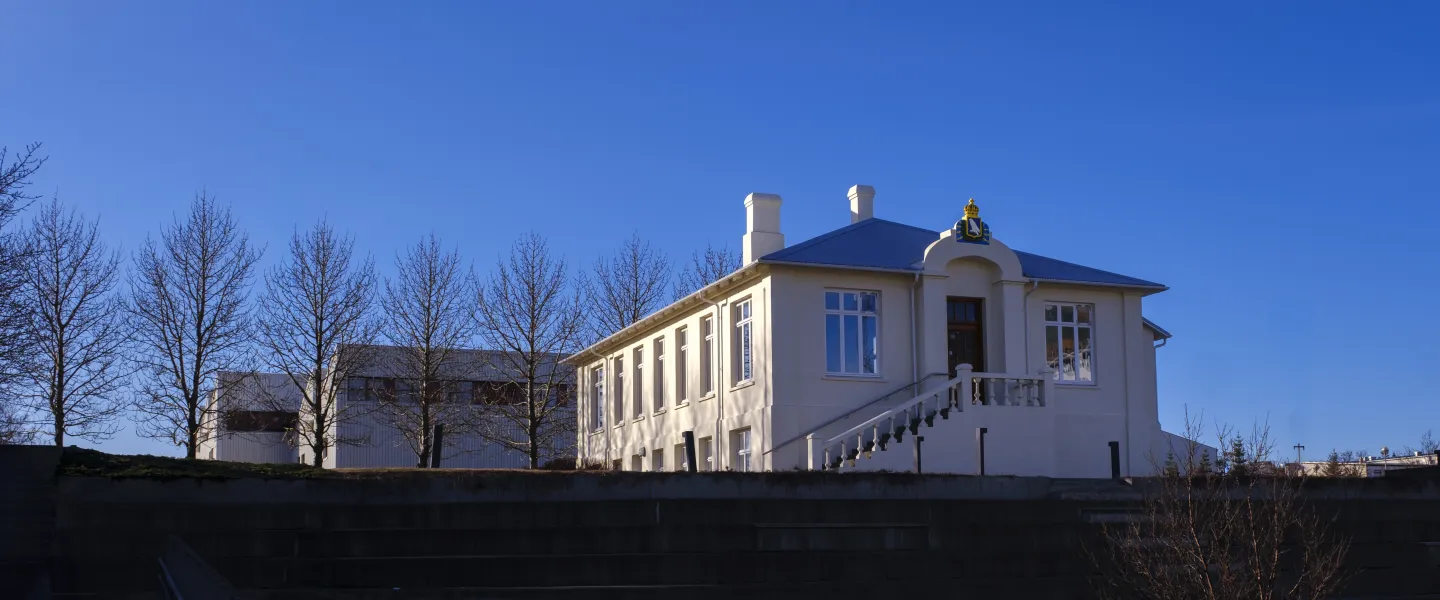
Loftskeytastöðin við Suðurgötu
The exhibition Winter Blue will be opened on the lower floor of Telegram Station (Loftskeytastöðin) at Suðurgata on Thursday, February 12. The exhibition contains multimedia work by scientists and artists working together to shed light on the recession of glaciers in Iceland.
Winter Blue is a collaboration between Þorvarður Árnason, director of the University of Iceland´s Research Centre in Hornafjörður and associate research professor in interdisciplinary environmental studies, and artists Þóranna D. Björnsdóttir, associate professor at the Iceland University of the Arts, and Konstantine Vlasis, a doctoral student at New York University, who conducts audio research on the glaciers of Hornafjörður, as well as visual designer Kieran Baxter, who also works at the Hornafjörður Research Centre at and has e.g. developed time-lapse methods that reveal the immense retreat of glaciers on the southeast coast of Iceland.
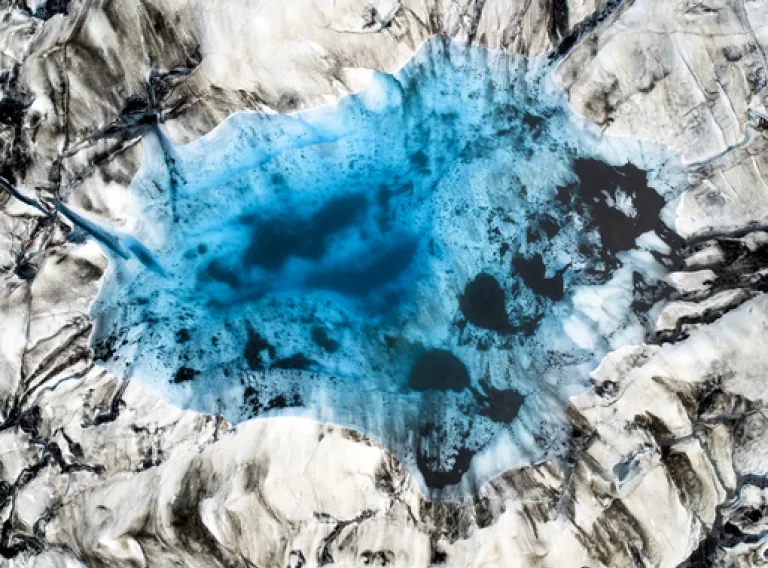
The exhibition’s name refers to the characteristic color which outlet glaciers exhibit during winter, glacier blue. Þorvarður has in his research focused on the development of visual research methods where he utilizes photographic and filmic methods to document and illustrate the impact of climate change on the glaciers of Hornafjörður, whose margins move further and further inland due to melting. The research is on the boundary of science and art and with Winter Blue the exhibitors wish to highlight the need to enhance the dialogue between these two fields concerning joint initiatives and resistance to climate change and its impact on the environment.
Þorvarður has been involved in four art exhibitions where glacier blue is in the foreground: Blueness in Hornafjörður, Glacier Blue in Hjalteyri, Arctic Blue in Helsinki and Ripples: Shifting realities in the Arctic in Reykjavík. Þóranna was the curator of the first two exhibitions and also curates the installation of Winter Blue in Loftskeytastöðin. Þorvarður has for some time now been aiming to share his glacier work with other staff and students at the University of Iceland and it is particularly fitting to doso in the University´s cultural centre, Loftskeytastöðin.
More about the artwork at the exhibition
Kieran Baxter holds a PhD in landscape heritage visualisation from the University of Dundee, Scotland. His research explores how the application of aerial photography and digital technologies can better serve outreach and communication in the sciences. This line of enquiry has led his visual practice from the cultural heritage of Scotland to the glacial landscapes of Iceland and the Alps. By better understanding how visualisation technologies operate in the context of visual culture and art practice, his research aims to improve the outreach tools available to scientists and environmental specialists.
Title of work: Breiðamerkursandur - a 3D reproduction of the Danish General Staff maps.
The project aims to produce a digital 3D reconstruction of Breiðamerkurjökull as it appeared near the end of the Little Ice Age, using maps created by the Danish Military Council. These maps are based on surveys conducted shortly after the glacier’s advance ceased (1903–1904, following an advance ending around 1890) and therefore depict the glacier at or near its maximum extent, making them a crucial resource for research into the region’s glacial history. The 3D model builds on techniques developed by Kieran Baxter for the documentary After Ice (2021) and enables close examination of the glacier and its surrounding landscape, enhancing understanding of local environmental conditions and the landscape evolution that followed the onset of glacial retreat. The model can also serve as a platform for visualizing changes in the extent of Breiðamerkurjökull over time, linked to scientific data describing the glacier’s condition at specific periods. The project is being conducted in collaboration with Snævarr Guðmundsson, a glaciologist and Director of the Southeast Iceland Nature Centre.
Konstantine Vlasis is an environmental composer and audio researcher. His work explores the ways that sound and listening mediate experiences of changing landscapes, and how music can be a form of climate communication and environmental storytelling.
Title of work: Air Flow (2025)
Audio-visual installation, photos contributed by Þorvarður Árnason
The work amplifies the diverse sounds of glacial air using the resonant frequencies of the installation space. The photomontage reacts to these frequencies, shifting between images as the sounds of air attune and vibrate the physical environment. In this way, the work not only reframes glaciers as masses of air that flow, but perpetuates their continued flow through real-time acoustic resonance.
Þorvarður Árnason studied filmmaking in Montréal, Canada, and has been engaged in filmmaking and photography for nearly fifty years alongside other activities. He has been the director of the University of Iceland's Research Centre in Hornafjörður since 2006 and also holds the position of associate research professor in interdisciplinary environmental studies. Climate change has been a growing part of Þorvarður's work in recent years, especially the collection and dissemination of information about the downwasting of glaciers in Hornafjörður. For these purposes, Þorvarður has primarily used visual methods based on his knowledge of landscape photography and filmmaking, at the same time attempting to connect the data that is collected with these methods to scholarly knowledge and theory, e.g. in the field of environmental aesthetics. This research approach has furthermore opened up possibilities for Þorvarður to collaborate in an interactive manner with artists from various disciplines, as the exhibition Vetrarblámi bears clear witness to.
Title of work: Vetrarblámi (Winter Blue)
The subject of the exhibition is glaciers, and its name is derived from the unique blue color characteristic of outlet glaciers during wintertime. Based on photographs and videos of the outlet glaciers of Hornafjörður, SoutheastIceland, which environmental scholar and landscape photographer/filmmaker Þorvarður Árnason has created/collected for the last two decades, mainly then during the winter.
Þóranna Dögg Björnsdóttir is a sound & visual artist based in Reykjavík Iceland. Interweaving image and sound; her work is often built upon the interplay of film and live music performances and takes on the form of sculpture, performance and soundwork.
Title of work: Brotabrot (e. fragment of fragments), sound- and moving image.
Images contributed by Þorvarður Árnason - sound for composition captured at Fláajökull glacier.
A glacier escapes its own weight, unleashing the past, sifting and breaking….here and now.
The exhibition Winter Blue will be open in Loftskeytastöðin to March 7th 2026. Loftskeytastöðin is open Thursdays to Saturdays, from 1 pm to 5 pm. The exhitbion is open to everyon and admission is free for students and staff at the University of Iceland.
Share
Buses 14, 1, 6, 3 and 12 stop at the University of Iceland in Vatnsmýri. Buses 11 and 15 also stop nearby. Let's travel in an ecological way!