
Aðalbygging
Ceremonial Hall
In recent years, leading scholars worldwide have focused on one key question: How can knowledge offer real value to society and industry?
Studies suggest that the relationship between universities and industry is not simply a one-way transfer of ideas from academia into society, but rather a dynamic interaction in which research, collaboration, and shared knowledge actively shape innovation. Collaboration is a crucial factor, both through informal connections and through organised partnerships in complex and wide-ranging research projects.
The University of Iceland will bring this development into sharp focus at an international event in the Main Building’s Ceremonial Hall on Tuesday, May 26, from 9:00 to 11:30 a.m. Three of Europe’s leading scholars in this field will give presentations and discuss the key prerequisites for societal development and innovation. The central theme at the event is how universities and industry work together for their mutual advantage — and how government policy can support such collaboration. A special emphasis will be placed on interdisciplinary cooperation and the challenges involved in utilising and combining knowledge from different actors.
The event is open to all and will streamed live.
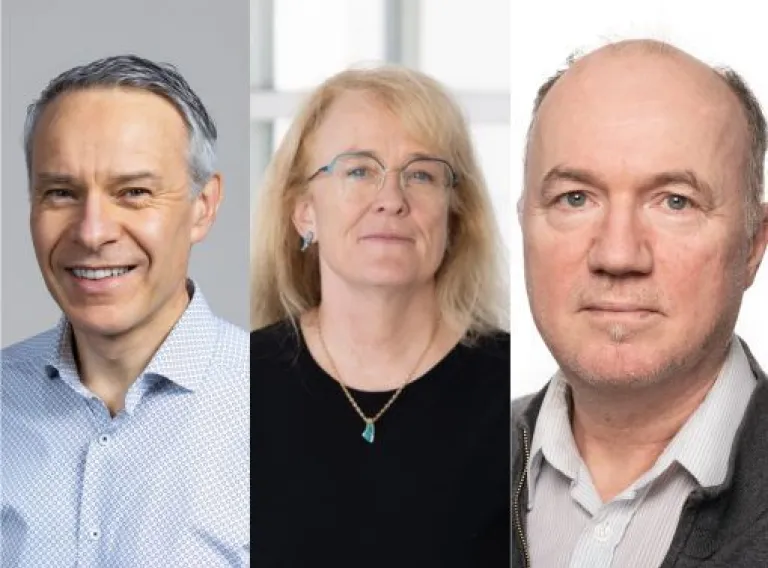
The speakers at the event are:
Markus Perkmann, professor at Imperial College Business School, one of Europe’s most influential scholars in university-industry collaboration. His research demonstrates that this collaboration isn’t just about turning research into marketable products, but rather about strengthening the research itself. Scholars participate in collaboration, consultation, and mutual projects, and that participation isn’t an exception to their academic work but an integral part of it.
Maureen McKelvey, professor at the University of Gothenburg, who has studied how value creation emerges in ecosystems where universities, companies and governments work together. She demonstrates that value is created where these relationships are not only active but reciprocal and built on longöterm collaboration.
Magnus Guldbrandsen, professor at the University of Oslo, who has studied how these relationships have evolved over time. His research demonstrates that they’re characterised by cooperation and built-in tension, between practical application and research independence. That tension is not a weakness, but rather a prerequisite for success.
Rögnvaldur Sæmundsson, Pro-Rector for Science and Interdisciplinarity and professor of industrial engineering at UI, will serve as moderator.
The event will include a panel discussion in which participants will discuss these pressing issues and answer questions from the audience.
In addition to the speakers and moderator, taking part in the panel are: Ágúst Ingþórsson, director of the Icelandic Centre for Research; Linda Heimisdóttir, CEO of Miðeind; Margrét Helga Ögmundsdóttir, professor at the University of Iceland, CEO, and co-founder of Ternaria Biosciences; and Sigríður Valgeirsdóttir, head of the Office for Innovation, Research and Digital Affairs at the Ministry of Culture, Innovation and Higher Education.
From its very beginning, the University of Iceland has placed strong emphasis on its connections with society and has built its work on robust research and innovation. The University’s impact is not based on a simple transfer of knowledge into industry, but rather on active relationships in which research, collaboration, and the mutual exchange of knowledge drive innovation, which in turn creates a positive, long-term impact.
The event is organised in cooperation with the Ministry of Culture, Innovation and Higher Education.
Admission is free.
Share
Buses 14, 1, 6, 3 and 12 stop at the University of Iceland in Vatnsmýri. Buses 11 and 15 also stop nearby. Let's travel in an ecological way!