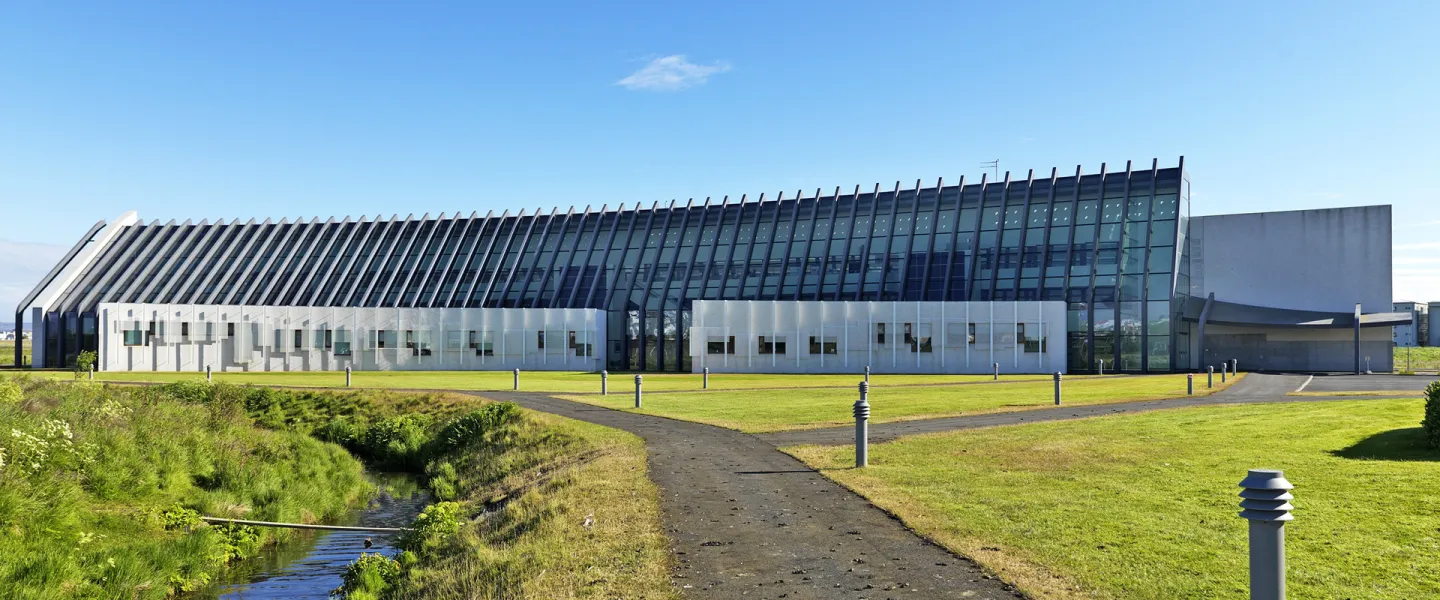
Aðalbygging
The Aula
Doctoral candidate:
Méline Payet--Clerc
Title of thesis:
New insights on the dynamics of Plinian basaltic eruptions: Field reconstruction and physical modeling of the Veiðivötn 1477 CE basaltic eruptive plume
Opponents:
Lucia Gurioli, Professor, Université Clermont Auvergne Mark Woodhouse, Senior research fellow at the University of Bristol Sylvie Vergniolle, Professor at University of Paris Cité Sonia Calvari, Research director at the National Institute of geophysics and Volcanology (Italy) Andrea Di Muro, Physician, University of Claude Bernard Lyon 1
Advisor:
Dr. Ármann Höskuldsson, research professor at the Institute of Earth Sciences, University of Iceland
Other members of the doctoral committee:
Dr. Þorvaldur Þórðarson, Professor at the Faculty of Earth Sciences, University of Iceland
Dr. Guillaume Carazzo, Physician at the Institut de Physique du Globe de Paris, Université Paris Cité.
Joint degree:
This is a Joint degree with the University of Paris Cité. The defense took place on the 23rd of June 2026 in Paris, France.
Abstract:
The 1477 CE eruption of the Veiðivötn fissure swarm (V1477) occurred along a discontinuous ~70 km fissure between the Torfajökull and Bárðarbunga systems (Iceland). Basaltic tephras erupted along a 20 km segment of the fissure and spread over more than half of Iceland (> 50,000 km2), with ash identified in Scandinavia. The event produced an estimated 10.8 ± 0.5 km3 (4.3 km3 DRE) of material and generated a plume that rose to 30.7 ± 3 km. Paris Plume Model simulations yield an eruption rate of 2.6 ± 1.3 ×10⁸ kg/s, consistent with Plinian to ultra-Plinian activity (VEI 5-6). Sustaining such plume height would require volatile contents above 2 wt.%, substantially exceeding typical Veiðivötn basalt values (<1 wt.%). Although shallow lake water was thought to have enhanced explosivity through magma-water (fuel-coolant) interactions, vesicularity data (71-84%) indicate predominantly magmatic fragmentation. Surface water may have been constrained to (i) secondary quenching of the pyroclasts, reflected in abundant fine ash in the proximal deposit, and (ii) steam enrichment of the plume, boosting the plume height. The deposit comprises of 32 tephra-fall units with a homogeneous glass (SiO2 = 49.99 ± 1.35 wt.%) and microlite-poor groundmasses. Three eruptive stages are identified: Stage I, low vesicularity and unimodal grain-size distributions; Stage II, maximum vesicularity, multimodal distributions, and conduit instability through the apparition of lithic-rich units; and Stage III, renewed and rhythmic conduit instability, returning to initial conditions. Overall, V1477 provides an important record of basaltic Plinian volcanism and challenges existing models for such eruptions.
About the doctoral candidate:
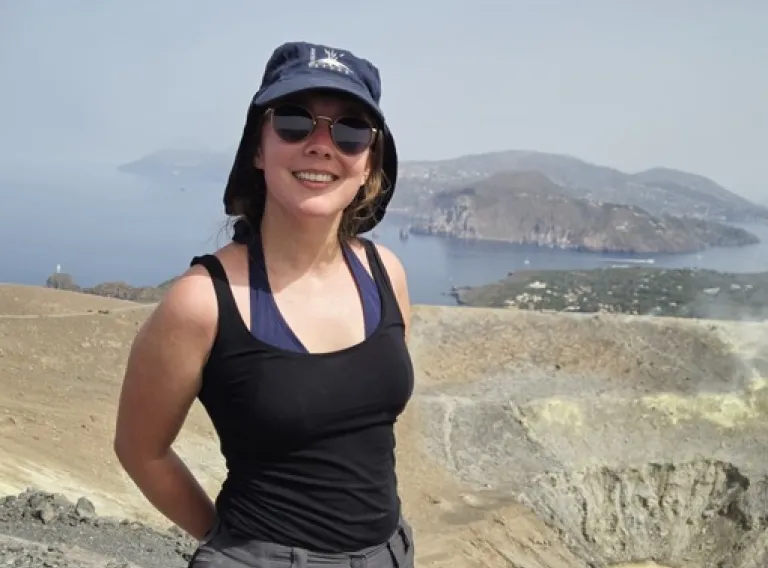
Méline was born on the volcanic island of Réunion in 1999. She had wanted to become a veterinarian from childhood, unfortunatly or maybe fortunatly her application to the study process was rejected. She then started a double bachelor degree in Biology and Geology at the University of Reunion in 2017. In her second year she decided to drop biology and pursue in only geology after a professor in geophysics put her up for the rainiest and foggiest field work on the Piton de la Fournaise. She did an Erasmus at the University of Iceland in the spring of 2020 when she met Ármann and Þorvaldur. The following fall she started a master degree in Geology at the Institut de Physique du Globe de Paris (IPGP) where she met with her supervisor Guillaume Carazzo. In April 2023 she started a PhD under the supervision of Guillaume, Ármann and Þorvaldur.
Share
Buses 14, 1, 6, 3 and 12 stop at the University of Iceland in Vatnsmýri. Buses 11 and 15 also stop nearby. Let's travel in an ecological way!