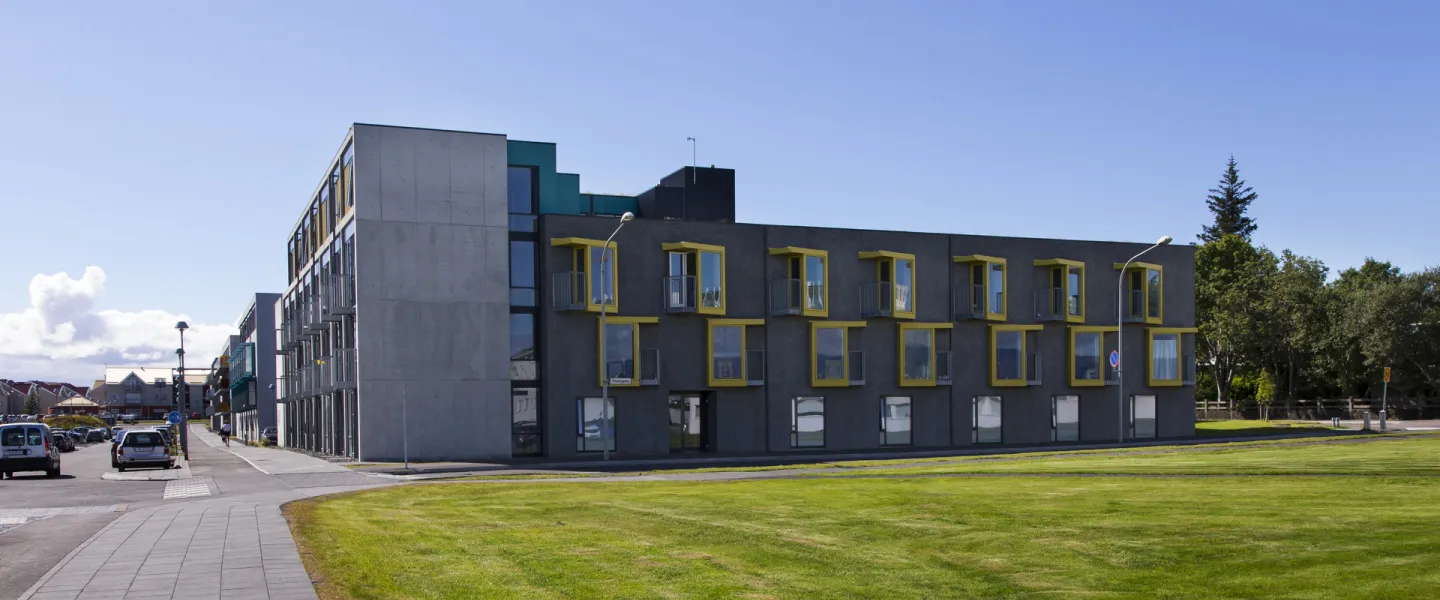
Askja
Room N-132
Event on Zoom:
https://eu01web.zoom.us/j/66565477802
Doctoral candidate: Matthias Baldursson Harksen
Title of thesis:
Quantum fluctuations of non-Lorentzian black holes
Opponents:
Dr. Thomas Mertens, Associate Professor at the Faculty of Sciences, Ghent University, Belgium
Dr. Jan Rosseel, Division of Theoretical Physics, Ruđer Bošković Institute, Zagreb, Croatia
Advisor:
Dr. Lárus Thorlacius, Professor at the Faculty of Physical Sciences
Other members of the doctoral committee:
Dr. Watse Sybesma, Nordita Assistant Professor, Sweden
Dr. Valentina G. M. Puletti, Professor at the Faculty of Physical Sciences, University of Iceland
Dr. Friðrik Freyr Gautason, Professor at the University of Southamption, United Kingdom
Dr. Niels A. J. Obers, Professor at Niels Bohr Institute, Copenhagen University, Denmark
Chair of Ceremony:
Dr. Benjamín Ragnar Sveinbjörnsson, Associate Professor and Vice Head of the Faculty of Physical Sciences, University of Iceland
Abstract:
This thesis explores quantum gravity through the lens of holography, with particular emphasis on non-Lorentzian gravity and black hole thermodynamics. Its central aim is to understand how ideas from relativistic holography and lower-dimensional gravity are modified when one considers non-Lorentzian symmetry structures such as Carrollian, Galilean, and Lifshitz symmetries. Rather than extending holographic models by adding new fields or extra dimensions, the thesis explores how far one can go by relaxing the underlying relativistic symmetry structure itself. The core of the thesis consists of three research papers, each addressing a different aspect of non-Lorentzian gravity. The first studies Carrollian string theory, examining how strings may be described in the ultra-relativistic limit in which the speed of light tends to zero, a regime naturally relevant near black hole horizons and at null infinity. The second investigates quantum corrections to the thermodynamics of a two-dimensional dilaton gravity model obtained by dimensional reduction of a Lifshitz black hole, with the aim of exploring how ideas familiar from JT gravity and Schwarzian boundary dynamics extend beyond the relativistic setting when one reduces, rather than enlarges, the symmetry algebra. The third studies non-relativistic de Sitter space, focusing on the formulation of an action principle for a non-relativistic analogue of Jackiw-Teitelboim gravity in terms of Newton-Cartan geometry and on the associated implications for lower-dimensional gravity and cosmology. In addition to the appended papers, the thesis contains an introductory chapter written for the general reader, including reflections on why fundamental research matters, what practical value it may have, and a short introduction to high energy physics as a subject. It also includes a pedagogical chapter based on lectures attended during my PhD, which develops the relativistic perspective on which the appended papers build.
About the doctoral candidate:
Matthias Baldursson Harksen is a doctoral student in theoretical physics at the University of Iceland. He has been appointed to a two year postdoctoral research position at the Technical University of Denmark, DTU. Matthias is the son of Baldur Arnviður Kristinsson, system administrator at Morgunblaðið, and Birte Harksen, preschool teacher, who has received the Icelandic Education Award as an outstanding teacher. His younger brother is Bjarki Baldursson Harksen, a programmer. Matthias’s partner is Álfheiður Edda Sigurðardóttir, a mathematician who works at Chalmers University of Technology in Gothenburg, Sweden. Matthias completed a master’s degree in mathematical physics at the University of Oxford in the United Kingdom. He has also completed teacher certification studies and taught at Reykjavík Junior College for three academic years before beginning his doctoral studies in theoretical physics at the University of Iceland. Alongside his studies and research, Matthias has placed emphasis on teaching and science communication. He has, among other things, contributed to the training of Icelandic students for international physics competitions and worked on projects aimed at making physics more accessible to students and the general public.

Share
Buses 14, 1, 6, 3 and 12 stop at the University of Iceland in Vatnsmýri. Buses 11 and 15 also stop nearby. Let's travel in an ecological way!